Politics & Government
Dixon Then and Now: Gravestones and Ghosts? All About Dixon's Ancient Cemetery
The Masons' and Odd Fellows' graveyards were combined early on


Here’s a historical column about Dixon’s old cemetery – a sort of gravestone talking about lots of other gravestones.
I find old gravestones fascinating. Looking at them, one learns about the old families – the first settlers. One learns where the early immigrants came from and how long people lived 100 or 150 years ago. The sentiments expressed on gravestones about the loss of spouses or children are poignant. Add to these the interesting and various designs of gravestones, from modest to heroic.
At any rate, Dixon’s graveyard along First Street dates back to the 1860s when the Odd Fellows organization (the I.O.O.F.) opened a small cemetery.
Find out what's happening in Dixonfor free with the latest updates from Patch.
Then, according to the in July 1877, “G. C. McKinley … sold a piece of land containing about four and five-eighths acres, adjoining the Odd Fellows Cemetery on the northern side, to the Dixon Lodge of Masons for cemetery purposes. The price paid was $2,000.”
At some point during these early years, the graves from the former village of Silveyville were gradually moved to this cemetery just as the homes there were moved to the new town of Dixon. In fact, Dixon’s cemetery is still known as the Silveyville cemetery, and the founder of Silveyville, Elijah Silvey, is buried there along with other family members. He died an accidental death at the age of 49.
Find out what's happening in Dixonfor free with the latest updates from Patch.
Things became more organized when the Silveyville Public Cemetery District was formed in 1927 by an act of the Solano County Board of Supervisors. This meant that a small portion of the property tax paid by residents of the district was provided to help with the operation of the cemetery. This funding continues and currently makes up approximately 60 percent of the district’s annual budget.
The district, under its first superintendent, Karl Muller, began a steady acquisition of existing and new cemetery land. In 1928, over three acres was purchased from the Kilkenny family. In 1929, the Odd Fellows and Masons side-by-side cemeteries (over nine acres) were bought for the princely sum of $10 each.
Expansion was then on hold until 1963 when three more acres was obtained from the estate of Annie Kilkenny for $11,000. In 1968 and 1979, a cumulative total of around five acres was purchased for $37,000 from the Dixon Game Conservation Club, which for many years had a pheasant-raising farm just south of the cemetery (the Dixon Tribune noted that quail was hunted in the cemetery in 1933). As a result, the cemetery has continued to have enough space to handle the burial needs of Dixon and the surrounding area.
In fact, the district’s boundaries cover 212 square miles, going as far north as Putah Creek, as far west as Leisure Town Road and Allendale, as far south as Hay Road and Liberty Island, and as far east as Mace Boulevard. Living in the district (or having a relative in the district) entitles one to a basic burial for approximately $1,760. Burial for someone with no connection to the district costs an extra $350.
Currently, the district estimates that its remaining 3.7 acres of open cemetery space should handle burial needs for 60 or 70 years more.
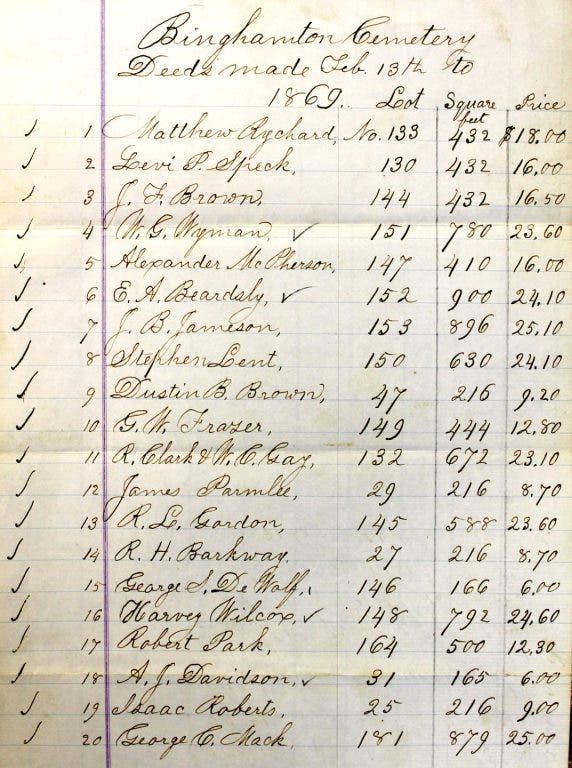
In addition to the Dixon cemetery, the district over time also assumed ownership and control of the Binghamton and Tremont cemeteries in 1964 and 1929 respectively, and the well-preserved Tremont country church (). The last burial in the Binghamton cemetery, just off Hwy. 113 south of Dixon, was in 1957.
Today, small portions of the Dixon cemetery are reserved for the burial of infants and children, even though such burials have taken place outside that area. Another area is reserved for those who may have died indigent or homeless (a so-called potters’ field), although I’m told that such burials haven’t taken place within recent memory.
In addition to the grave of Elijah Silvey, the grave of Thomas Dickson, Dixon’s founder, is easily found. In 1929, the body of the last Pony Express Rider, Thomas Reynolds, was buried here. He had ridden a route between Benicia and Knight’s Landing. The only Dixon police officer to die while on duty, Daniel McKinnon, is honored with a grave marker near First Street. Annual Memorial Day observances are held at the cemetery’s grave of the unknown soldier.
The in 1933 carried a story about four schoolchildren who fainted as they stood in the hot sun during Decoration Day (the precursor to Memorial Day) observances after they’d marched to the graveyard.
The Dixon cemetery has many cypress trees of a particular variety with somber and gothic-looking trunks. The graveyard also has two mausoleums – but no more above-ground burials are being allowed.
The new Valley Glen housing development was slated to occupy all the land behind the cemetery to the west but hasn't been completely built out yet.
Currently the Silveyville Cemetery District operates out of an office on the Dixon cemetery grounds and is run by a board of trustees appointed by the county supervisors. Today, the trustees are Chairman John Reeb, along with Marcy Savala, James Bounds, Margarite Kittyle and Scott De Bie. The district’s manager is Mike Obelleiro.
I haven’t heard any stories about the ghost of Elijah Silvey haunting the place, bemoaning the disappearance of his namesake town, but you never know.