Community Corner
Dixon Then and Now: Post Offices Were Here From the Very Beginning
An 1866 postmark raises questions


Back before Dixon was founded, and before the discovery of gold, about the only way Californians could communicate at a distance was by letter. Mail moved slowly by horse-drawn vehicle or ship.
Things improved when the population grew during the gold rush and mail transportation networks were cobbled together to move the mail faster and more frequently.
Serving travelers along the stagecoach road (or trail) between Sacramento and the Bay Area was the small town of Silveyville, situated several miles north of what was to become Dixon. As part of that bustling place’s development was this area’s first post office, said to be established in 1854. Maine Prairie, the grain-shipping port at the end of Cache Slough southeast of today’s Dixon, began to take shape around 1859, and had a small post office. Binghamton, about six miles south of present-day Dixon, had a post office beginning in 1864. Later, there were post offices in the Tremont area and in Batavia. All of these towns eventually disappeared (Tremont and Batavia were mostly agricultural shipping points along the railroad) and their mini post offices were wiped off the map.
Find out what's happening in Dixonfor free with the latest updates from Patch.
Having a post office and a post-office-approved town name was essential to settlements in those days.
Settlers had to be very patient in the years before the transcontinental railroad was completed – a letter from California to New York City could take from one to four months to be transported by ship. People took time to write their letters, too, as indicated by their ornate and careful handwriting. Letters were often kept and preserved, rather than the here-today, gone-tomorrow emails of today.
Find out what's happening in Dixonfor free with the latest updates from Patch.
The first across-the-United-States mail service on land was provided by the Butterfield Overland Mail, which used stagecoaches to carry mail and passengers along a southerly route into California between 1857 and 1861. A faster cross-country system began in a brief blaze of glory as the Pony Express carried letters between 1860 and 1861. Normally, the Express ended its journey at Sacramento, where mail was transferred to boats going to San Francisco, but on a number of occasions when boats weren’t available, young men on fast horses took Pony Express mail overland to Benicia on its way to Bay Area cities. One of their stops was at Silveyville, commemorated today by a brass plaque along Silveyville Road. Silveyville, of course, no longer exists.
To send a simple letter across the U.S. via Pony Express cost over $100 in today’s dollars, so it wasn’t much used by regular folks. Both the Butterfield Overland Mail and the Pony Express went out of business when the first transcontinental telegraph line was completed in 1861. Telegrams must have been much less expensive!
Now we come upon a conundrum. For my historical columns I’ve relied upon others’ writings to establish important dates. Everywhere you look, the date of the establishment of the town of Dixon has been set as the same year the California Pacific Railroad tracks were laid through this area – 1868. Dixon, it’s been said, never got going until the actual tracks were laid through the area.
Yet in the Dixon library archives I came across the photocopy of a postmarked envelope provided by Richard McLaughlin of Dixon in 1990. He’d bought it at philatelic show in Southern California (the image is attached to this column). Believe it or not, the postmark reads: “DIXON CAL – JUN 7 ’66.” The postmark is over a three-cent stamp (the amount charged for letter mail at the time) and the letter is addressed to a person in Washington County, Wisconsin. Either the postmark was set for the wrong date or a post office existed in a town of Dixon two years before the railroad tracks were laid. I did learn that grading for the railroad began in 1866, so maybe that explains the early date. It’s also interesting that the town is spelled “Dixon” rather than “Dickson,” which tends to disprove the legend that Dixon became the name of the town because of a misaddressed rail freight shipment or misspelled train stop sign after the railroad was completed. Let’s look for a new explanation for “Dixon”!
At any rate, the coming of transcontinental railroad service which carried mail (and had an associated telegraph line) in 1868 meant much faster communications for residents of the new town of Dixon.
And now to Dixon, or Dickson, or Dicksonville. Because of the 1866 postmark, there must’ve been a post office that year in what was to become the city of Dixon. Records, however, pinpoint the first officially appointed postmaster as William Ferguson in 1869. In those early days, the post offices were usually in downtown businesses, such as McBride’s and (later) Kirby’s drug stores, and also in the Knights of Pythias building. While Eli McBride was postmaster in 1908, Oscar Schulze (or his family after he died) built a substantial post office across the street from their large mercantile store, and I presume he or they leased the post office to the government. The first floor was devoted entirely to the post office and the upper level contained three offices for rent. A few years later, the Carnegie Library was built next door.
The old post office building still stands today at the northeast corner of First and ‘B’ streets, although it has been modified. The building was never an architectural gem, being a plain, stand-up, utilitarian building, but the expansion of the street-level floor to the sidewalks ruined the integrity of the building. Also, some embellishments on the outside of the building such as the date of construction and the words “post office” were obliterated. The current major tenant is a driving school.
For many years, postmaster jobs were plums awarded to the political party in power at the national level. At the local level, the branch of the Republican or Democratic party was given the power to select the postmaster, and those who wanted the job actively campaigned for support. (For example, after World War II, when a rural mail route became available in our Wisconsin town, my father appeared before our county’s Democratic committee – when the Democrats held power in D.C. – and asked for the job, and got it.) When we look at the years between 1869 and 1933 (64 years) there were no less than 13 postmasters in succession in Dixon. Postmaster James Kilkenny, who became Dixon’s postmaster in 1933 and served for 34 years, broke that short-stint mold (maybe he was politically neutral or so popular either party didn’t care to replace him). Later on, political appointments within the post office were finally eliminated.
A recent TIME magazine article waxed eloquent about the importance of post offices historically, and bemoaned the closure of many smaller offices because of declining Postal Service revenues. It is certainly true that Dixon’s post office at First and ‘B’ was an important community resource, where folks would daily hitch their carriages or park automobiles to fetch their daily mail from ornate post office boxes (rural delivery didn’t begin here until the 1930s and city residential delivery until the 1950s). There, people could gossip, discuss the news of the day and see and be seen.
Early on, post offices were seen as important enough to the nation to be supported by annual subsidies from Congress (in fact, in 1885, the cost of mailing a letter was reduced from three to two cents). Later on, though, when the Post Office Department became the Postal Service, it was directed to become financially self-sufficient.
A look at the historical “Brevities” columns of the Dixon Tribune (available online) revealed some tidbits of Dixon’s postal lore:
- During Dixon’s downtown firestorm in 1883 the post office burned down. Only some brick walls were left standing.
- In 1894, Dixon’s postmaster announced that locals could no longer toss letters into the mail car while the train briefly stopped in Dixon. All letters had to pass through the post office (where they would get a Dixon postmark).
- For quite a few years, G. W. Hulen and his high-wheeled, horse-drawn cart had the contract to take mail from Dixon to Maine Prairie. The high wheels were necessary to get through mud and pools of water during the rainy season. During floods, Hulen would have to transfer the mail to a boat headed to the isolated community. In 1908 the post office tried to reduce his pay, saying his route had been shortened, and he quit. He was rehired later after submitting the winning bid, and as an old man died when he was blown into a large puddle and couldn’t get out on his own.
- In 1911, someone broke into Dixon’s post office boxes, so the box section had to be closed after 8 p.m.
- Letters traveling across the U.S. were speeded up in 1911 when some of the first airplanes were pressed into service on regular mail runs, bad weather or not.
- In 1919, the editor of the Tribune suggested Postmaster McElroy might want to say to Dixonites: “Don’t ask us to lick your stamps. … Don’t look at us in a way to imply we’re liars when we say ‘no mail.’ … Why pound on the doors after hours when you can use a crowbar to break in? … Don’t come to mail a letter after the sack is made up – we’d like to accommodate you but would look funny running up the track trying to catch the train.”
- The Tribune noted in 1931 that Mrs. Thelma Thompson filled in as a rural carrier. Women as letter carriers were a rarity at that time. However, women served as postmasters in 1876, 1918, 1921, and 1933.
When the post office began to deliver parcel post in 1913, and mail order catalogues from companies such as Sears Roebuck and Montgomery Ward were freely available, local merchants didn’t like the competition (similar to today’s competition from Internet retailers).
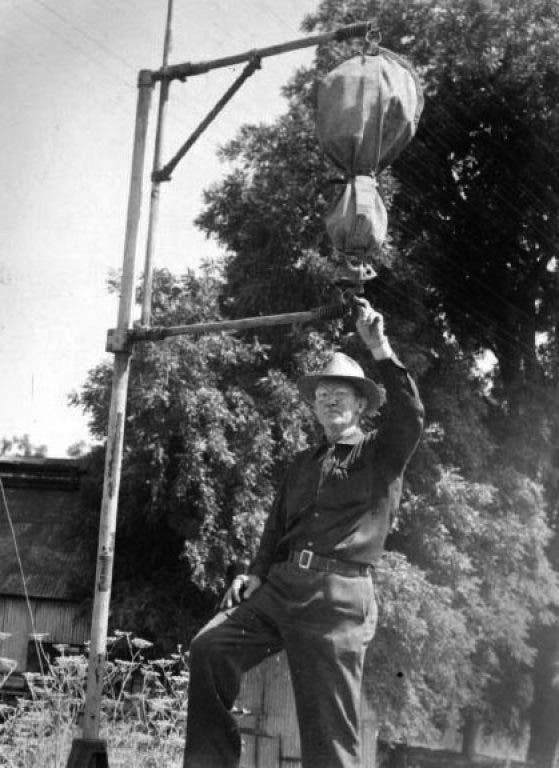
Probably when passenger trains no longer stopped here, a device was installed whereby a canvas sack with Dixon’s mail could be suspended from an arm alongside the tracks and mechanically grabbed by the mail car as it sped by. I assume there was also a provision to drop mail off at the same time. Postal employees in the mail cars sorted mail while the train was in motion. This arrangement ended in 1958. Nowadays, almost all local mail travels by truck.
While James Kilkenny was toward the end of his 34-year run as Dixon’s postmaster in 1965, the Post Office Department had a new post office built along ‘A’ Street near the train tracks, perhaps because more mail-sorting space was needed after the introduction of home delivery a few years earlier. Just as when the new fire station was built a block away in 1929, community pride was expressed in a dedication ceremony sponsored by the Chamber of Commerce and postal employees. Introductory remarks were given by Homer Siss and a dedication poem was read by A. D. Boone. The raising of the flag was by the U.S. Naval Radio Station Squad. At that time, the facility had nine regular employees.
The building’s design reflected the architecture of the 1960s, which was used in everything from schools to large business buildings – simple lines creating rectangles, some of which held large windows. The same type of design was used for the First Northern Bank building along First Street. Today, surrounded by trees and with vines growing along the front, the building still maintains an attractive appearance.
In more recent times Angelita Daniels assumed the Dixon postmaster position in 2006 from Jon C. Stalnaker, Sr. A 23-year postal veteran, Daniels began her career as a letter carrier in Richmond, Calif.
Nowadays, Dixon postal employees carry seven city delivery routes and five rural routes in addition to staffing the retail counter. The staff and letter carriers deliver to 1162 post office boxes, 4427 residences, 269 businesses, and to 2,183 rural stops.
As the Postal Service decides how to downsize and economize in light of declining revenues (due to completion from the Internet and private delivery services), it still has an important role to play. I wouldn’t be without my magazines, Netflix DVDs and seed catalogs, and the ability to send out real Christmas cards. Also, having been a stamp collector as a kid, I enjoy decorating mail with all the available varieties of commemorative stamps. They are often miniature works of art. And, we no longer have to lick them!