Schools
Vacaville Area May Be a Migration Corridor for Pacific Northwest Monarchs
One tagged monarch was sighted in Vacaville garden after traveling 285 miles in seven days from Oregon.


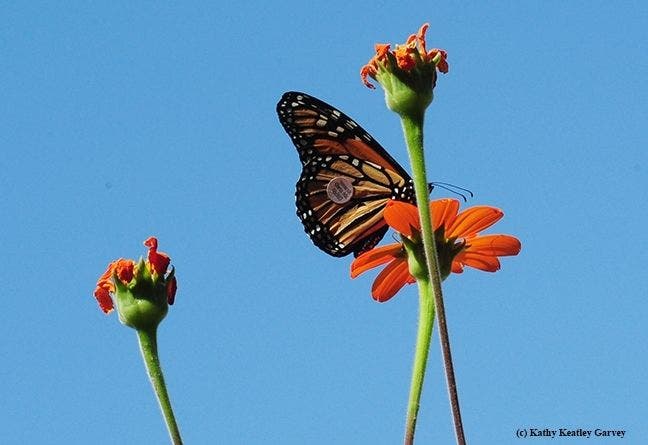

DAVIS, CA – PHOTOS: 1: That amazing migratory monarch project at WSU and serendipity in Vacaville; 2: WSU-tagged monarch on the seed pod of a Mexican sunflower, Tithonia, in Vacaville. (Photos by Kathy Keatley Garvey)
By Kathy Keatley Garvey
If you see a monarch tagged with monarch@wsu.edu migrating through Northern California, Washington State University entomologist David James wants to know.
Find out what's happening in Dixonfor free with the latest updates from Patch.
It’s part of his Pacific Northwest research project.
One WSU-tagged monarch, a male released by a citizen scientist in Ashland, Ore., recently stopped in Vacaville for some “flight fuel”—nectaring Mexican sunflower (Tithonia) and a butterfly bush.
Find out what's happening in Dixonfor free with the latest updates from Patch.
The monarch, serial number A6093, fluttered into the pollinator garden of Jim and Kathy Keatley Garvey on Labor Day. It hung around for five hours.
Citizen scientist Steve Johnson of Ashland, Ore., a member of the Southern Oregon Monarchs Advocates, tagged and released the monarch on Sunday, Aug. 28.
"So, assuming it didn't travel much on the day you saw it, it flew 285 miles in 7 days or about 40.7 miles per day," James told the Garveys on Sept. 6. "Pretty amazing. So, I doubt he broke his journey for much more than the five hours you watched him--he could be 100 miles further south by now. Clearly, this male is on his way to an overwintering colony and it's possible we may sight him again during the winter in Santa Cruz or Pacific Grove!”
The Garveys are continuing to see monarchs, as many as four or five at a time, in their pollinator garden. James said the Garvey yard—and perhaps the entire Vacaville area--may be a migration corridor.
Migration through Northern California will continue until the end of October, he said. Then around late February, the monarchs will leave their overwintering sites and head inland. A6093, he told the Garveys, “could well travel through your yard on his way back.”
“I’m still releasing tagged monarchs in Yakima and I know many are still being released in southern Oregon, so there’s plenty of time yet for another tag to come through,” James said.
James, an associate professor at WSU, said citizen scientists involved in his project tagged 2906 monarchs during the late summer and fall in the Pacific Northwest in 2015. In his progress report, written February 2016, he wrote that 16 tagged monarchs were recovered at distances greater than 50 miles from the release location, “mostly in overwintering colonies on the California coast. The longest distance traveled was 775 miles by two miles released at Walla Wall a and Pasco and found in the same overwintering colony at Morro Bay, Calif.”
James’ project goals and objectives are five-fold:
1. To determine the phenology and ecology of monarch butterfly breeding in eastern Washington.
2. To determine migration directions, routes and destinations used by summer and autumn monarch butterfly generations in the Pacific Northwest.
3. To determine the environmental cues responsible for inducing reproductive dormancy and migratory behavior in Pacific Northwest monarch butterflies.
4. To engage incarcerated citizens at the Washington State Penitentiary in scientific research with demonstrable social and educational benefits to themselves and the corrections community.
5. To provide scientific information needed for development of effective and targeted nectar and host plant conservation strategies along monarch butterfly migration corridors
(Note: Kathy Keatley Garvey, a WSU graduate who works for the UC Davis Department of Entomology and Nematology, also rears monarchs—41 to date. She wrote about the serendipity of finding a WSU-tagged monarch on her Bug Squad blog at http://ucanr.edu/blogs/blogcore/postdetail.cfm?postnum=22205)
Get more local news delivered straight to your inbox. Sign up for free Patch newsletters and alerts.