Politics & Government
Local Farming Faces Hidden Fuel Cost Crisis: How Geopolitics Ripple Through Food Economy
Fuel costs surge past $6–$7 a gallon, tightening margins for farmers, ranchers, and market vendors already hit by tariffs and input costs.


CALIFORNIA, CA — The average price of a gallon of gas in California has climbed above $6. In the Bay Area, that number is edging up to $7, and in some places, prices are even higher. Warnings of a potential crude crisis are looming amid soaring gas prices, threatening a gas shortage.
In Healdsburg, a gas station taped up "Out of Order" signs on pumps, limiting supplies to only premium gas. A similar scene played out nearby, in Santa Rosa, with signs taped on pumps. In this case, the station restricted sales to 87 octane gas.
Station owners said the shortage was due to a delivery problem rather than the aftermath of an 11-week geopolitical struggle that is playing out in gas prices.
Find out what's happening in Healdsburgfor free with the latest updates from Patch.
The prices are most visible at the pump. However, for farmers, the cost of gas is magnifying other burdens, including increased tariffs and the increased price of fertilizer because of the supply chain squeeze caused by the Iran War. Vendors say that they are feeling the impact.
Profit margins in agriculture, in general, are thin. Now, the instability of oil prices are exacerbating tariffs, especially for large-scale commercial farmers.
Find out what's happening in Healdsburgfor free with the latest updates from Patch.
But fuel is one of the hidden costs of farming, even in alternative, community-supported agriculture. This is also true at farmers' markets, where food moves through fewer steps than supermarket chains, fuel costs still land directly on growers.
The shorter supply chain reduces middle layers—but not the dependence on transportation.
Vendors driving between Sonoma County, Marin, and the East Bay still absorb every increase at the pump immediately. Duncan Soldner, of Duncan’s Gourmet Growers, which specializes in gourmet mushrooms, said the tariffs sent up prices, but it didn't stop there.
“Now it’s all gas,” he added.
Mushrooms may seem like an outlier. Instead, they exemplify the similarities between sustainable and large-scale commodity agriculture from coast to coast in the United States.
The idea that local or sustainable farming shields producers from global volatility is breaking down as fuel costs and input prices rise together.
Tariffs and trade policy add another layer of pressure, driving up the cost of both food products and essential inputs like cardboard packaging and machinery parts—goods embedded in global supply chains where price shifts ripple quickly, even for small producers.
These costs rarely appear as immediate retail price jumps. Instead, they are absorbed unevenly—first by farmers, then by processors and distributors, and only later passed on to consumers in gradual, delayed increases.
Soldner, for example, said Tuesday that he is being squeezed. His margins are small. His mushrooms have a short shelf life, so any increase is hard to absorb without eventually raising prices.
So far, he said he has managed to avoid passing on the pain to his customers. A good part of those customers are chefs at the Bay Area's most decorated Michelin restaurants. But some are smaller with their own razor-thin margins and also trying not to raise their prices.
When fuel costs and tariffs rise, they reinforce each other, squeezing margins across the entire system. In mass-market supply chains, that pressure is layered through transport, refrigeration, labor, and packaging — and cushioned, in part, by subsidies.
In farmers' market systems, the chain is shorter, but fuel exposure is direct: growers still drive long distances between weekly markets, so gas and diesel spikes hit immediately, landing directly on already thin margins.
The Greek Table, a family-owned Vacaville business, sells Mediterranean appetizers alongside community-based growers at Northern California farmers markets. One of the vendors, Sam, said his fuel costs have doubled from $35 to $70 per fill-up (he asked not to use his surname).
Whenever the price of gas goes up, everything goes up with it,” Sam said, adding that the company is trying to avoid raising prices but isn't sure how long that can last.
At Beffa Springs Ranch, operations show the same pattern: even when food is raised locally, it must still be hauled, processed, and distributed through fuel-dependent systems, making diesel one of the least visible but most persistent costs in agriculture.
"Everything uses gas, and everybody is affected," Beffa Springs cattle rancher Christine Shepherd said.
"We try to stay as local as we can," she said. To keep fuel costs manageable, she limits travel to nine farmers markets across Sonoma, Marin, and Napa counties.
However, fuel for equipment to move hay, to haul feed, and to check on herds also adds up. On some remote dairies, gas can cost workers $50 just to get to work, as in remote coastal areas of Marin.
Operators like Beffa Springs Ranch have access to a mobile butcher unit, which is a big help, but for ranchers or processors who don’t have one, getting their product to market is expensive.
Cattle must still be hauled, processed, and distributed.
Eric Ortiz from the Ortiz Family Farm said that, between all the markets he sells at, he travels about 150 miles a week. The markets are in Sebastopol, Santa Rosa, Marin County, Healdsburg, and Sonoma—some of them twice a week.
The farm also has equipment to fuel, so at $8 a gallon for diesel, a fifty-gallon tank every two weeks is extremely expensive. In the spring, they use even more fuel because the farming is most active.
Between travel to markets and fueling diesel equipment, which is even more expensive than regular gasoline, the cost is adding up. "It’s affecting everything,” he said.
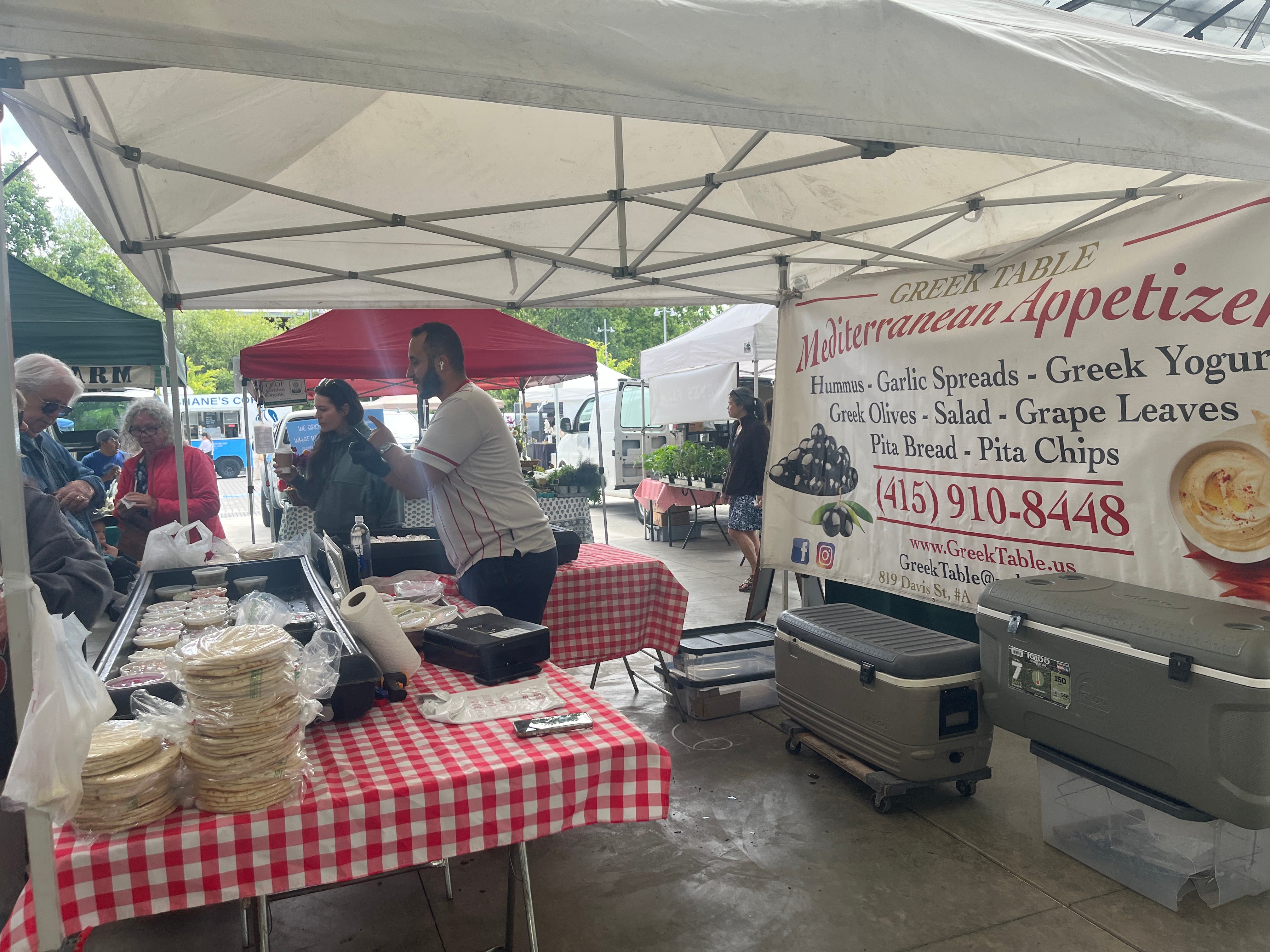
A vendor for The Greek Table, which sells Mediterranean appetizers at numerous Bay Area farmers markets, said his fuel costs have doubled from $35 to $70 per fill-up.
Get more local news delivered straight to your inbox. Sign up for free Patch newsletters and alerts.