Community Corner
Top Gate Company in Palo Alto Answers the Questions Homeowners Ask Before Installing a Driveway Gate
A practical guide to choosing, permitting, powering, and maintaining an automatic driveway gate in Palo Alto
This is a paid post contributed by a Patch Community Partner. The views expressed in this post are the author's own, and the information presented has not been verified by Patch
Driveway gates have quietly become standard equipment in parts of Palo Alto. Walk Crescent Park or Old Palo Alto and the sliding gates outnumber the open driveways. Barron Park and the streets climbing toward the foothills have gone the same direction over the past decade. The reasons vary. Some owners want the package problem solved. Some have a dog that treats an open driveway as an invitation. Plenty simply want the entry to match a house that cost more than most people's retirement.
What surprises almost everyone is how much of the project has nothing to do with the gate. Permits, tree roots, utility coordination, and fire access all shape the outcome before a single piece of steel gets cut. Bay Area Lions Gate works out of an office and fabrication shop in Palo Alto, which means most of these projects are a few minutes from the bench where the gate gets built, and the local details come up constantly.
Palo Alto Lots Create Different Problems Than San Francisco Lots
Palo Alto driveways are generally flat, wide, and set well back from the street, which removes most of the constraints that dominate gate design in denser cities. That freedom introduces its own complications.
Deep setbacks mean long low-voltage and power runs from the house to the operator, often forty or eighty feet, sometimes more. Those runs have to get across the yard somehow, and Palo Alto takes its trees seriously. Trenching inside the protected root zone of a mature oak or redwood is not something to improvise, and the city's urban forestry rules should be checked before anyone puts a shovel in the ground. Boring around a root system costs more than trenching straight through it, and costs far less than removing a protected tree that dies eighteen months later.
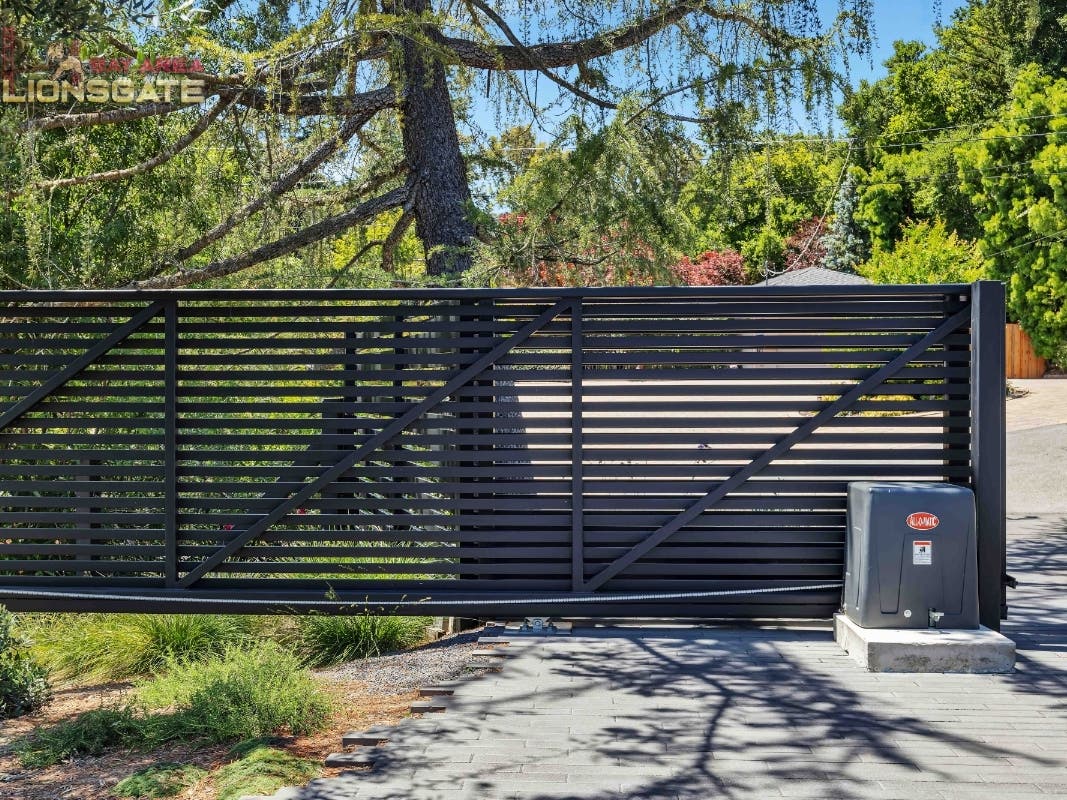
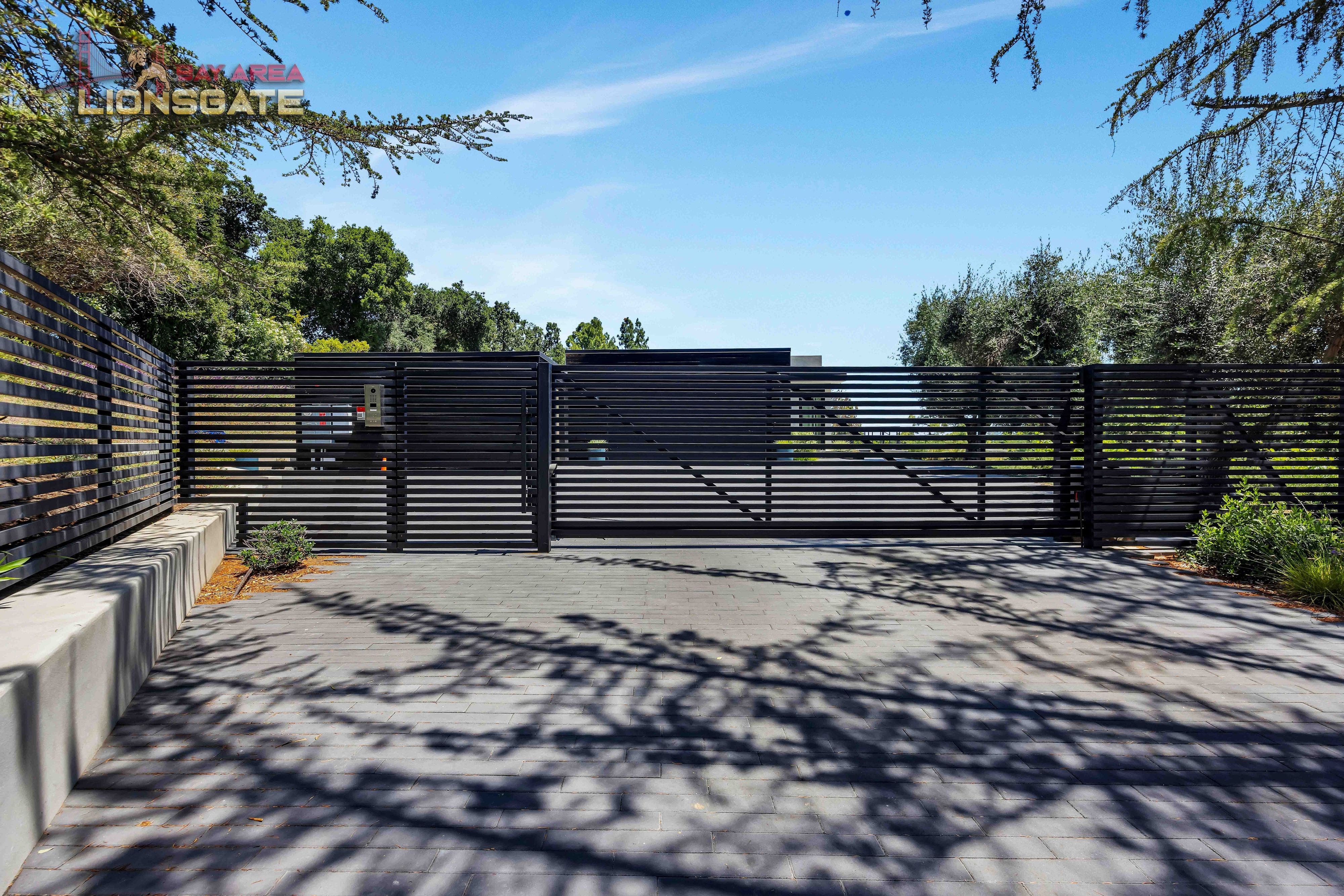
Eichler neighborhoods add a design question rather than a technical one. In Greenmeadow, Fairmeadow, Green Gables, and Royal Manor, a heavy ornamental iron gate fights the architecture. Horizontal slat gates in wood or powder-coated aluminum sit far better against those flat rooflines, and they weigh less, which lets a smaller operator do the work.
Wide frontages open up options that tight lots do not. A property with thirty feet of side yard can take a straightforward slide gate on track. A property without that room ends up looking at cantilever configurations, bi-folding leaves, or a swing pair, and the decision usually comes down to how much room exists inside the property line rather than what the owner originally pictured.
The Permit Situation Changed, and Not the Way Most People Assume
Palo Alto does not require a fence permit. The city says so in its own published fence handout, citing PAMC 16.48.050, and adds that no building permit is required either. Homeowners read that line and stop reading. That is where the money gets lost, because the exemption covers the fence and not the motor attached to it.
Two permits still apply to a typical automated driveway gate. An electrical permit covers the operator circuit. The FY2026 adopted fee schedule prices an electrical permit not otherwise listed at $580 for single family and duplex and $754 for multifamily and commercial, with a $305 base fee on standalone permits. Fire protection and fire access plan review for new development or additions bills at $455 per hour with a two hour minimum. A fence inside a public utility easement needs an encroachment permit from Public Works, priced at $2,198. Skipping a permit is the expensive path: the schedule sets work without one at twice the building permit fee and twice the plan review fee.
Height comes from PAMC Chapter 16.24, and it is set by where the structure sits relative to the street setback line rather than by material or by what you call the structure. Between the street setback line and the lot line the limit is four feet, which catches owners who assumed a driveway gate gets special treatment. It does not. Past the setback line, front and street side yards allow six feet and interior side and rear yards allow seven. The vision triangle rule under 16.24.040 catches more projects than people expect. It limits height to three feet within a triangle measured thirty five feet from the intersection of curb line projections, which becomes relevant on any corner lot. One more detail worth knowing: the fence handout PDF still circulating from the city's site dates to 2002 and no longer matches the current code text, so the code library is the reliable source rather than the handout.
The full breakdown, with the code sections and current fee figures, is laid out in Palo Alto Gate Rules in 2026 and the Two Permits You Still Need, which cites each code section and fee line so you can check the language yourself.
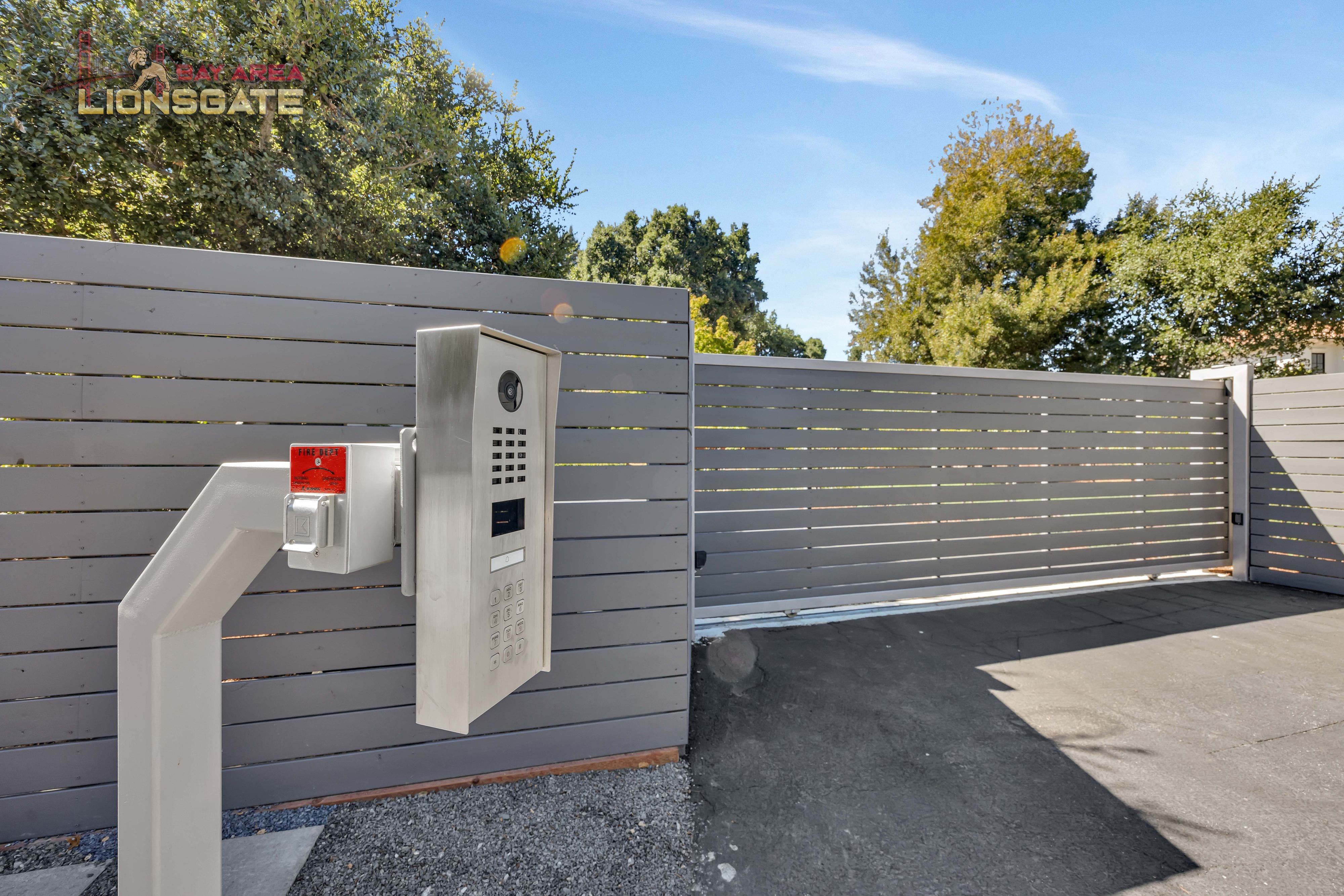
Fire access deserves its own note. PAMC 15.04.230 requires an approved means of deactivation or unlocking for security gates across fire apparatus access. It does not name a specific product. What satisfies the requirement is determined by the fire code official for the property, so that conversation belongs early in the design rather than after an inspection.
Design Choices That Determine the Next Fifteen Years
The gate that gets specified on day one dictates most of what happens later. Undersized operators are the single most common regret. A manufacturer's weight rating assumes a level installation with clean hardware and moderate cycle counts. A gate that sits at the top of its operator's rating will work fine for two years and then start showing up as intermittent faults, overheating, and premature gearbox wear.
Cycle count matters more than owners expect. A household with two commuters, a teenager, and steady deliveries can push a gate past thirty cycles a day. Equipment specified for light residential duty does not enjoy that.
Material selection is mostly about maintenance appetite. Wrought iron and steel take the most abuse and need periodic finish attention. Powder-coated aluminum handles weather with less upkeep and weighs considerably less. Wood-and-steel hybrids give the warmth many Palo Alto homes want, at the cost of refinishing on a schedule.
Access control should be decided during design, not bolted on afterward. Keypad, fob, cellular callbox, IP video intercom, and vehicle detection loops all have wiring implications that are cheap while the trench is open and expensive once the driveway is repaved. Owners planning a custom driveway gate installation in Palo Alto generally get better results by settling the full access plan before fabrication starts.
What Actually Breaks
Service calls concentrate around a handful of causes, and a surprising share of them are things a homeowner can check first.
Photo eyes top the list. A dirty lens, a spiderweb, or a beam nudged out of alignment by a landscaper stops the gate from closing. Cleaning the lens resolves the problem often enough to be worth trying before anyone calls.
Capacitors come next. A motor that hums without moving the gate usually points there, though a jammed track or seized gearbox produces the same sound.
Loop detectors generate the strangest complaints. A gate that opens on its own overnight is almost always a loop detector that has taken on water or a loop wire broken by pavement movement, not a person on the property.
Rollers and track failures dominate on slide gates, showing up as grinding, jerking, or a gate stopping partway. Control boards fail less often and cost the most, generally after a surge event or years of moisture intrusion. Boards for LiftMaster, DoorKing, FAAC, Nice and HySecurity, and All-O-Matic equipment are commonly stocked by established local shops, which is the difference between a same-visit fix and a week of waiting.
Force and limit settings are the one category to leave alone. Those adjustments are the entrapment protection on the gate. When symptoms point in that direction, expert automatic gate repair services in Palo Alto are worth the call rather than a trial-and-error session with a screwdriver.
Palo Alto Is Not on PG&E, and That Changes the Outage Conversation
Most gate advice written for the Bay Area assumes PG&E. Palo Alto is the exception. The city runs its own municipal electric utility through City of Palo Alto Utilities, which means CPAU holds the shutoff authority inside city limits, publishes its own outage map, and operates its own alert program.
CPAU's wildfire mitigation planning treats a Public Safety Power Shutoff as a last resort in extraordinary circumstances, with the lines most likely to be considered sitting west of Highway 280 in the Tier 2 elevated fire risk area on the state fire threat map. Properties in the foothills therefore carry a different exposure than properties on the flat. Palo Alto can also be affected by PG&E activity upstream, so the local utility boundary does not fully insulate the city.
For gate owners the practical point is the same regardless of which utility drops power. The failure is rarely limited to the motor. Battery backup on the operator does nothing for the intercom, the cellular controller, the router, the loop detector, the maglock, or the safety devices, each of which needs its own answer. That whole-system view is the subject of What Happens to Your Automatic Gate During a PG&E Power Outage, which covers what keeps working, what quietly does not, and how manual release is supposed to function when nobody has practiced it. Palo Alto readers should substitute CPAU for PG&E throughout, and sign up for the city's outage alerts rather than relying on PG&E notifications that will never arrive.
Twenty Minutes Twice a Year
The maintenance that prevents expensive failures is unremarkable. Clean the photo eye lenses. Clear the slide track. Verify surge protection exists at the operator and not only at the panel. Test the manual release and make sure whoever is actually home during an outage knows how to use it. Check battery backup by cutting power rather than trusting an indicator light. Look at hinges and rollers for early corrosion.
Households with a hillside address should do this before fire season rather than during it. Discovering that the manual release is stiff and unfamiliar is a different experience at eleven at night with an evacuation advisory running.
For homeowners weighing a new install against a repair, or trying to work out what the city will actually require, the Top Gate Company in Palo Alto is generally the one that can answer the permit question, the tree question, and the operator question in the same conversation. Bay Area Lions Gate handles design, fabrication, installation, and service from its Palo Alto shop under California contractor license CSLB #1055691.
This post is an advertorial piece contributed by a Patch Community Partner, a local brand partner. To learn more, click here.