Politics & Government
Coming Soon: 35th Annual Show of the El Cerrito Art Association
Saturday is the deadline for artist entries for the Art Association's big annual Art Show, Sept. 30-Oct. 2. Founder Barbara Brendlinger recalls its origin: "I wanted a place to hang (my art)."
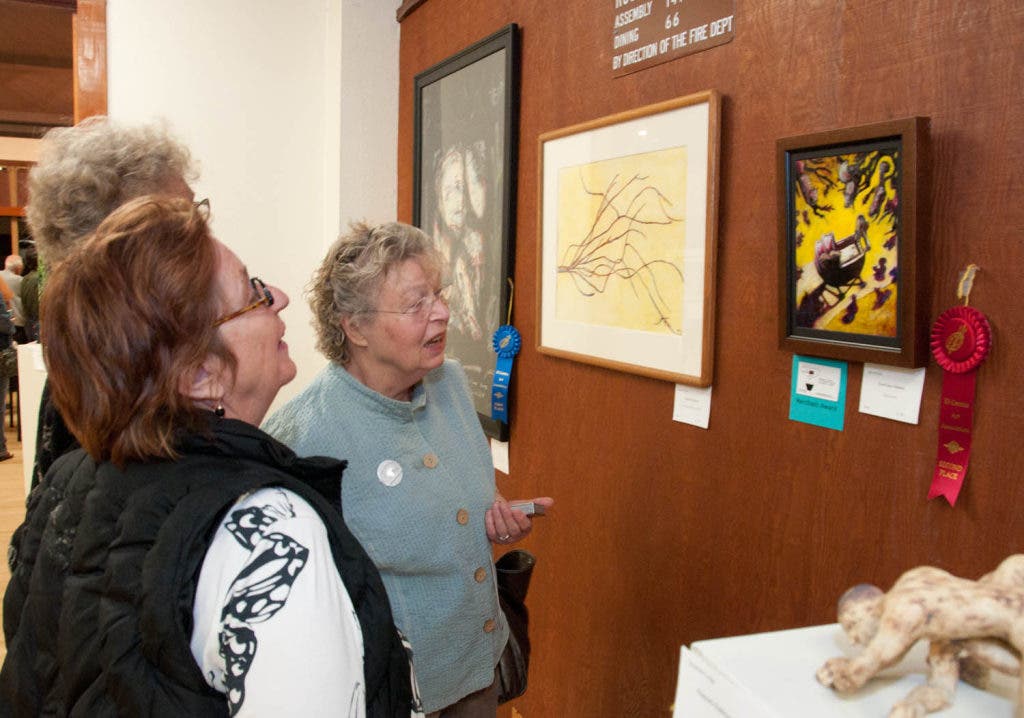


The ’s annual Art Show, scheduled Sept. 30-Oct. 2, also qualifies as the group’s 35th. Barbara Brendlinger can verify that; as its founder and still active member, she has collected a program for every year.
As usual, the event will be held in the , 7007 Moeser Lane, and will comprise a gala Friday night reception with wine and hors d'oeuvres where art fans get first shot at buying art they fall in love with, followed by daytime open houses Saturday and Sunday.
But things have changed. Within a few years after its launch, the event expanded into a new room added to the center. By the 1980s, it expanded to accept photography and a whole new dimension, 3D, with acceptance of sculpture. And this century, the association has been scrambling to keep up with global leaps in computer-aided visual arts.
Find out what's happening in El Cerritofor free with the latest updates from Patch.
The association must be doing something right. At the September meeting Monday, president Jean Witzke announced to members that “we now have 160 members; our membership has doubled in the past five years” after hovering at 70-90 for years.
The art shows preceded the association by decades, Brendlinger recalls. She was a member of the junior chapter of the General Federation of Women’s Clubs, a service club, as far back as 1956 when it already was running the annual event.
Find out what's happening in El Cerritofor free with the latest updates from Patch.
But by the 1970s, “they decided it was too much work and they weren’t going to do it anymore.”
At that point she was in her 50s, the children had grown and she had taken up painting. However, “I was a beginning painter, not good enough to get into juried shows,” she says—and all local shows were juried. “I wanted a place to hang. Beginning painters have to have a place to show.”
Her solution: Start her own art show. She queried Joel Witherell, head of the Parks & Recreation Department, about starting an association through the city to organize the event. “I had finished raising seven kids, and I had time to do it. He agreed.
“They were really good at helping us. They took care of all the publicity. The stands to show the art, Joe built in his back yard.”
She also credits the now-defunct Richmond Independent for helping: “We got magnificent publicity from them.”
The El Cerrito Art Association lost no time taking off. Thirteen people assembled for the inaugural meeting, 36 for the second, and it grew from there.
She served as the group’s first president for several years and wrote the bylaws, ensuring the exhibit would be non-juried. “For a time we were the only non-juried show in the East Bay,” she boasts, and the non-juried rule still holds today.
“The first show we put on as an association, we had over 200 paintings,” she says. “There was no place to put them; we didn't have the other room,” which was added later adjoining the main room. “We put them on the floor and stood them up against the wall.”
Part of the problem was that the new organizers had not yet learned to limit the size of entries. A Walnut Creek painter, for example, entered a five-foot painting of a tiger. The most memorable painting for Brendlinger was a portrait of a man that was flat except for his hooked nose, which stuck out from the canvas.
More support came from the , which “built the most gorgeous floral pieces just for the show” for several years.
Photography was accepted starting about 1983, according to old show programs; but it took some doing. First the membership had to accept the view that photography was art.
“First couple of times, we only got a few photographs, all black-and-white. Most of the time the category never got the 10-12 entries needed to give prizes,” Brendlinger explains. “So we worked with the Berkeley Camera Club; they did some presentations for us. Then people realized it was a valid art form.”
Still, it took even more time for color photography to gain equal stature and participation with arty monochromes.
“It's now an immense area,” Brendlinger observes. “It’s still not covered as much in the club, in (monthly meeting) presentations, but there are a lot of pictures in the show.”
Actually, there’s a lot of variety in the show; art categories include paintings, drawings, photography, sculpture, pastels, collage and prints. This year ECAA has a Special Theme category, “Let’s See What That Sounds Like,” to add challenge and kick-start creativity.
Like many art groups, the association is racing to keep up with the digital advancements that have transformed visual arts along with virtually every other part of modern society, Witzke says.
“Six or seven years ago we started getting (film) photographs, digital photographs and manipulated photographs; some had text on them,” she explains. “(Art organizations across) the U.S. decided to categorize them as computer-manipulated and film,” and ECAA followed suit.
By now the artistic distinction between straight film and digital images has disappeared; the show’s photo categories are Color and Black-and-White. Photographs significantly altered into works of art now go into a separate category, Digital Art.
Also by now, two-dimensional art can be a tossed salad of media—for example, a digitally distorted image printed on canvas, art paper or metal and then painted with water color or acrylic—not to mention collages of up to thousands of images, with or without graphics.
“My son does computer work with acrylic on top,” Witzke reveals.
For that, the competition offers Mixed Media/Collage, for art that “doesn’t fit anywhere else,” according to the art show rules.
Awards are granted in each category; in addition, there are a number of special awards including Merchant Awards donated by local businesses and several memorial awards, according to the association’s show announcement.
At 85, Brendlinger no longer can get to all the meetings and events, but she remains a vital leader. This year ECAA dropped from the bylaws long-standing rules restricting participation of professionals, and “we never would have done that without consulting with Barbara,” says. Brendlinger also teaches watercolor in her home.
Concerns about professional artists notwithstanding, the association creates several opportunities for members to sell displayed art. The art show is the main venue. Each item’s label includes a price and is marked when sold but kept on display.
Reception attendees get the first pass, but pieces remain available Saturday, 12-5 p.m. and Sunday 10 a.m.-4 p.m. In addition, on Saturday members can set up small booths inside the doors to sell items. And this year for the first time, members can submit matted, priced art to be offered in bins on Saturday and Sunday.
Another big opportunity happens at the annual July 4 celebration near Cerrito Vista Park, attended by thousands, where the city also supplies space for association members to set up booths at no cost except a modest share of sales revenues.
As if that weren’t enough, not long after the association started it arranged for members to hang art with price tags in rotating exhibits at three public facilities that attract crowds daily throughout the year: The on Stockton and Lexington Avenues, the Community Center and the Department of Motor Vehicles office at 6400 Manila Ave.
All that exposure comes on top of the monthly meetings at the Community Center, where guest experts present a range of topics from painting to printmaking to setting up a personal art marketing blog.
Even now the membership far transcends the city boundaries. About 50 percent are local, with a great number from Berkeley and Richmond, Witzke notes; but the roster also includes residents from Vallejo to Pinole to Oakland, and “we have had people from Hayward."
Although the show is not until Sept. 30-Oct. 2, members must register entries by 8 p.m. this Saturday, Sept. 17, by turning in paper registration forms, labels and payment to treasurer June Hunt. Entrants can download the form and find additional information at www.elcerritoart.org.
Because the show is non-juried, non-members can enter by becoming members at the same time that they register. Email ecartassociation@gmail.com for more information.
Dale Mead is an El Cerrito Art Association member and volunteer photographer.
* * *