Community Corner
Residents Appeal Contentious Senior Housing Approval In NorCal Town
Two neighbors argue the project's medical care and density bonus application violate Healdsburg zoning rules.


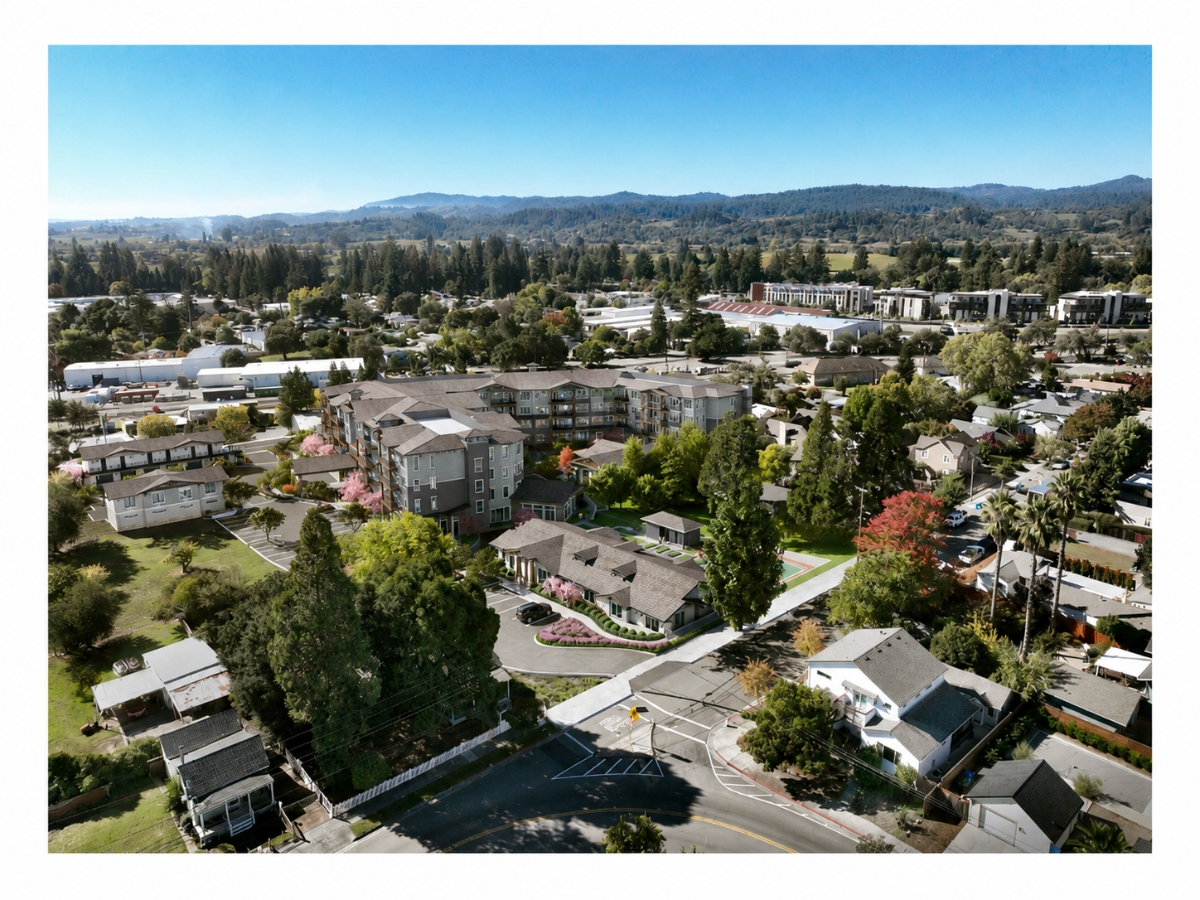
HEALDSBURG, CA — Two Healdsburg residents are asking the City Council to overturn approval of a sprawling housing development, The Hudson, arguing the proposed continuing care retirement community at 359 Hudson Street would provide medical care that the city’s zoning rules do not conditionally permit.
Lewis Bangham and Jon B. Eisenberg appealed the Planning Commission’s Aug. 11 decision granting Gallaher Signature Living a conditional use permit and density bonuses for the project.
Both men live near 359 Hudson Street, according to their Aug. 20 appeal. They want the City Council to reverse the permit approval or, alternatively, require Gallaher to submit a marketing plan and related information before receiving density bonuses.
Find out what's happening in Healdsburgfor free with the latest updates from Patch.
The appeal centers first on how Healdsburg’s zoning code treats residential care.
Bangham and Eisenberg argue the applicable zoning ordinances allow “residential care, general,” which the city defines as “nonmedical residential care” that can include limited medical assistance, such as dispensing prescribed medications. They contend a residential care facility for the elderly, or RCFE, goes further because state law allows licensed professionals to provide medical care.
Find out what's happening in Healdsburgfor free with the latest updates from Patch.
The appeal says RCFE residents can receive medical procedures, dementia care, and annual medical assessments from licensed professionals. It also points to The Hudson’s project narrative, which describes an onsite medical suite with visiting physicians, and a plan showing a separate medical room for those physicians.
The residents also dispute statements made during the Planning Commission hearing that an RCFE is a nonmedical residential setting and that the facility would have only nonmedical staff.
The appeal argues California law does not define an RCFE as nonmedical and requires such facilities to ensure residents receive prescribed medical care from appropriately skilled professionals.
Memory care presents another part of their challenge.
The appeal contends that dementia care constitutes medical care and would not necessarily remain confined to The Hudson’s separate six-unit memory care building. It says RCFE regulations also allow certain dementia care in a larger facility, meaning residents in the project’s 67-unit main building could receive forms of memory care that the appellants contend the zoning does not permit.
Bangham and Eisenberg also argue the project needs a zoning change similar to one Healdsburg adopted for Enso Village. Their appeal says the North Entry Area Plan overlay specifically treats assisted living and memory care as residential uses, while the Central Healdsburg Avenue Plan covering 359 Hudson Street lacks a comparable overlay.
They contend density bonus law cannot overcome that zoning issue because the law applies to development standards, such as height, setbacks, floor area, open space, lot area, and parking, rather than local rules governing whether a particular use is allowed.
The appeal separately challenges Gallaher’s density bonus application.
Bangham and Eisenberg say Healdsburg’s municipal code requires a marketing plan for affordable housing units, an explanation of how the applicant will verify income and maintain affordability, and, for projects with five or more units, a financing mechanism for ongoing administration and monitoring. They argue Gallaher’s application contains none of that information and therefore remains incomplete.
The appeal also points to The Hudson’s project narrative, which describes the affordable units as “workforce housing.” Bangham and Eisenberg argue Gallaher intends to target The Hudson’s employees, rather than members of the community at large, for those units.
The residents also ask the City Council to reverse the Planning Commission’s approval of the conditional use permit.
A point of contention is the development's site next to the future SMART station.
The 3.6-acre project would sit across from the planned SMART station, an area the city has identified for a planning process intended to address housing, infrastructure, multimodal transportation, and transit-oriented development.
Healdsburg resident Steve Villano said the city should have completed its planned Station Area Specific Plan process before approving The Hudson.
Villano said planning commissioners approved The Hudson without first holding a meeting on the Station Area Specific Plan. He contrasted that process with planning for the Mill District, Saggio Hills, and North Entry Area, where he said the city spent years working through housing and development issues with community input.
"All of that excitement, community involvement, and careful city planning was jettisoned on August 11, when the City’s Planning Commission unanimously decided to bull ahead with a 3.6 acre housing proposal in the shadow of the SMART Train Station," Villano said on his blog after the meeting.
The commission acted, he said, without convening a meeting on the Healdsburg station plan.
"The democratic process that makes small city life in Healdsburg special, and desirable, had been shattered," Villano said. The Hudson, he added, "was being shoved down our throats, whether we liked it or not."
Get more local news delivered straight to your inbox. Sign up for free Patch newsletters and alerts.