Community Corner
A Northern California Town Readies For Next Stage In Development Battle
Opponents seek 600 signatures while pressing Cloverdale officials for a new environmental review before vote on Esmeralda development.


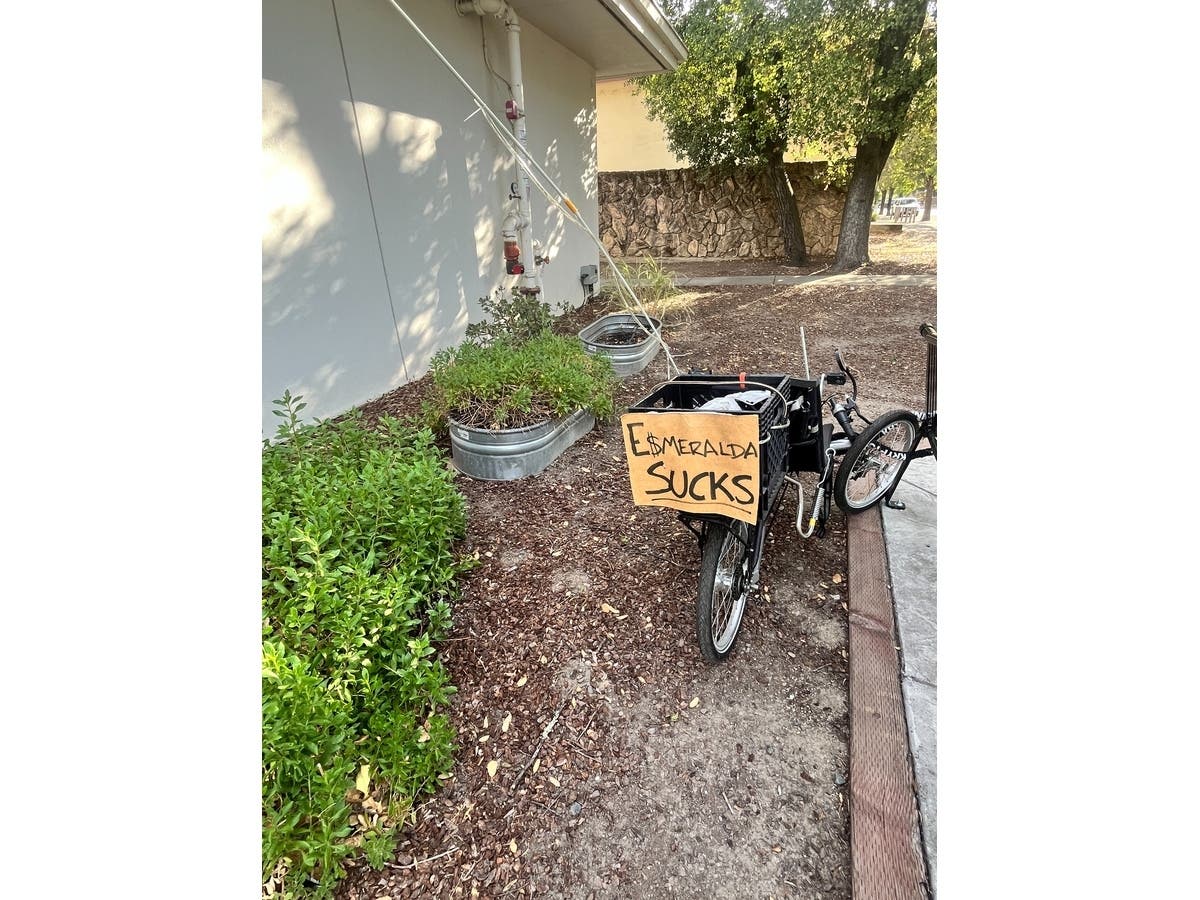
NORTHERN CALIFORNIA —Residents in a small Sonoma County town are organizing for a possible ballot fight over Esmeralda, a planned housing and resort development they say is too large, raises unanswered questions about water and contamination, and should not move forward without a new environmental impact report.
Organizer Nancy Brown said before an Aug. 20 community meeting that its goal was to explain why Esmeralda “doesn’t make sense on multiple levels.”
The proposal, brought forward by the Esmeralda company, envisions development of 266 acres at the southeast edge of the city, directly beneath the Cloverdale Municipal Airport runway approach.
Find out what's happening in Healdsburgfor free with the latest updates from Patch.
The project is too dense and would bring too many people, Brown said.
Reducing its scope could bring it closer to what residents want, she said. Esmeralda with a smaller footprint would not necessarily be a bad thing, she added. But residents need a greater voice in shaping what gets built and how in the town of about 8,700 people.
Find out what's happening in Healdsburgfor free with the latest updates from Patch.
Toxic
The property occupies the former location of a lumber mill. Past proposals have included a hotel, a spa, a golf course, an equestrian center, and residential units. Any development requires remediation of the former industrial site before construction can proceed. The question is how much is enough.
Brown lives across the Russian River from the development site and worries about toxic residues left by the property’s industrial past being exposed by the development.
“Nothing should happen without a new EIR,” Brown said. The last environmental impact report for the site was completed in 2009 for a different proposal that included about 170 residential units. Esmeralda proposes 605.
Jennifer Sullivan, who organized Thursday’s meeting, said she began examining the property’s toxic legacy and concluded that contamination, water, and the differences between the two projects warrant a new environmental review.
“There are different contaminants in different locations,” Sullivan said of the former industrial property. “This is about trust, and we need to trust this developer.”
Sullivan said the city is allowing Esmeralda to pursue an addendum to the 2009 EIR rather than requiring a subsequent EIR.
Too much has changed in 17 years for the earlier review to adequately address the current proposal, she argued, citing the project’s size, water conditions, the planned end of Potter Valley Project diversions, traffic, wildfire risks, wildlife, surrounding development, and conditions at the site.
Sullivan also questioned plans to conduct a human health risk assessment after project approval. She said the city should determine whether the former industrial site is safe for residential development before approving it.
“If the results could change the environmental finding, the mitigation, the development layout, or whether an addendum is legally sufficient, the city should know the results before it approves the project,” Sullivan said.
Water
Water also dominated Thursday’s discussion. Sullivan said Esmeralda would require about 76 million gallons annually at full buildout, compared with Cloverdale’s average annual use of about 353 million gallons from 2014 through 2025.
She questioned what data Esmeralda and the city used to define a worst-case drought and whether their projections adequately account for a future without planned Potter Valley Project diversions.
During a Dec. 10, 2025, City Council meeting, an Esmeralda representative said the analysis had “assumed the worst” regarding Potter Valley and expressed confidence that precipitation would largely buffer Cloverdale’s water resources.
Sullivan disputed that characterization, saying the analysis did not model Potter Valley diversions ending alongside drought conditions like those experienced in 2021 and 2022.
She also pointed to a Nov. 3, 2025, letter from Cloverdale City Manager Kevin Thompson to the State Water Resources Control Board that described the loss of Potter Valley Project diversions as posing a significant risk to the city’s water supply, particularly during summer and drought conditions.
Cloverdale is particularly vulnerable because the Russian River is its primary water source, Sullivan said. “We are solely dependent on this one source.”
Land
She also raised concerns about an area of the property known as the “Twinkie,” which she described as approximately 1.3 million cubic yards of wood waste and dirt near the Russian River. Sullivan said contaminated soil had been removed from parts of the property while other material remained beneath layers of clean fill.
She described it as “a layered cake” next to the river.
Sullivan also pointed to the proposed 500-seat amphitheater and questioned the additional traffic it could generate.
Residents who spoke at and after the meeting repeatedly said they were not opposed to housing itself.
“I’m not against residential at all,” one resident said, identifying water and environmental review as his primary concerns.
Trust
Trust emerged repeatedly during Thursday’s meeting.
Sullivan said Esmeralda and the city contend that technical studies have found no new significant effects or substantially more severe environmental effects. She called that conclusion “mind-boggling” given the Russian River, Potter Valley, contamination concerns, and the scale of the proposal.
During a question-and-answer session, residents asked how they could force the city to require a new EIR.
Sullivan considered the chances of the city voluntarily requiring a new environmental review low. That raised another possibility: a lawsuit.
Asked whether opponents were prepared to sue, Sullivan said, “That is the plan.”
She called litigation the most effective option but acknowledged its cost.
Opponents are simultaneously pursuing a political route including putting the issue to a public vote. A day after the meeting, Sullivan called for 20 “Cloverdale Captains” to collect 30 signatures each, for a goal of 600.
“Let the people vote on Esmeralda,” Sullivan said. “Require a Subsequent EIR.”
She said Esmeralda documents are expected to be released the week of Aug. 24, with Cloverdale Planning Commission hearing tentatively planned for the week of Sept. 16. That date has not yet been confirmed by Patch.
Sullivan also urged residents to attend the Wednesday Cloverdale City Council meeting and support putting Esmeralda before voters.
Sullivan, who lives in unincorporated Cloverdale and therefore said she would not get to vote on the project herself. But, she said,“I trust that the people of Cloverdale can make the right decision themselves."
Community
Devon Zuegel, associated with Esmeralda Land Company, has been pursuing the Cloverdale property since 2024. The community is modeled on Chautauqua, a settlement in western New York founded in 1874 whose name came from the original indigenous communities.
Zuegel describes the concept as a “cross between a college campus and a family summer camp" that would include a resort hotel, an amphitheater, bike and walking paths, office and co-working spaces, and school facilities.
Attendees at the Thursday meeting repeatedly said the EIR, water, and traffic were not excuses to stall Esmeralda and push an anti-development agenda.
Underlying the environmental, financial, and ballot questions was a broader debate over what Cloverdale wants to become.
For some residents, that question matters as much as Esmeralda itself. They said they do not oppose housing or development but object to having a new community imposed on the one they already have.
“What kind of place do we want to be?” Sullivan asked. “Do we have any vision for the future of this town?”
A man who said he has lived in Cloverdale for nearly 70 years said residents want a role in guiding development rather than stopping it. He was at Papa's Pizza Café, a restaurant on the Cloverdale Boulevard, the town's main artery, and one of the few businesses to stay open until 9 p.m.
A couple sitting at the bar called Cloverdale the “last of the small towns” in northern Sonoma County and said they have watched communities such as Healdsburg change. They asked not to be named.
Esmeralda talks about creating a community in Cloverdale, the husband said. “We have a community.”
His wife recalled Zeugal asking attendees at a late-2025 town hall to imagine their children riding bicycles to friends’ homes. Their children already do that every day, she said.
The small downtown is dotted with vacant storefronts, making the Esmeralda development appealing to city council members looking for more tax revenue coming to nearby towns like Geyserville and Healdsburg — both from property and sales taxes.
But the couple also rejected the argument that Esmeralda would necessarily benefit them or that Esmeralda residents would revive downtown businesses. Instead, they worried about being priced out and losing the small-town community they value.
“I care more about my community than property values,” the husband said.
Get more local news delivered straight to your inbox. Sign up for free Patch newsletters and alerts.