Neighbor News
Cordemans, Samaha and Warner Discussion of Collage at The CAP Gallery
Isabelle Cordemans and Sandra Samaha discuss collage and what it is to be a female artist in today's art scene.
By M. “Charlie” Ferrazzi
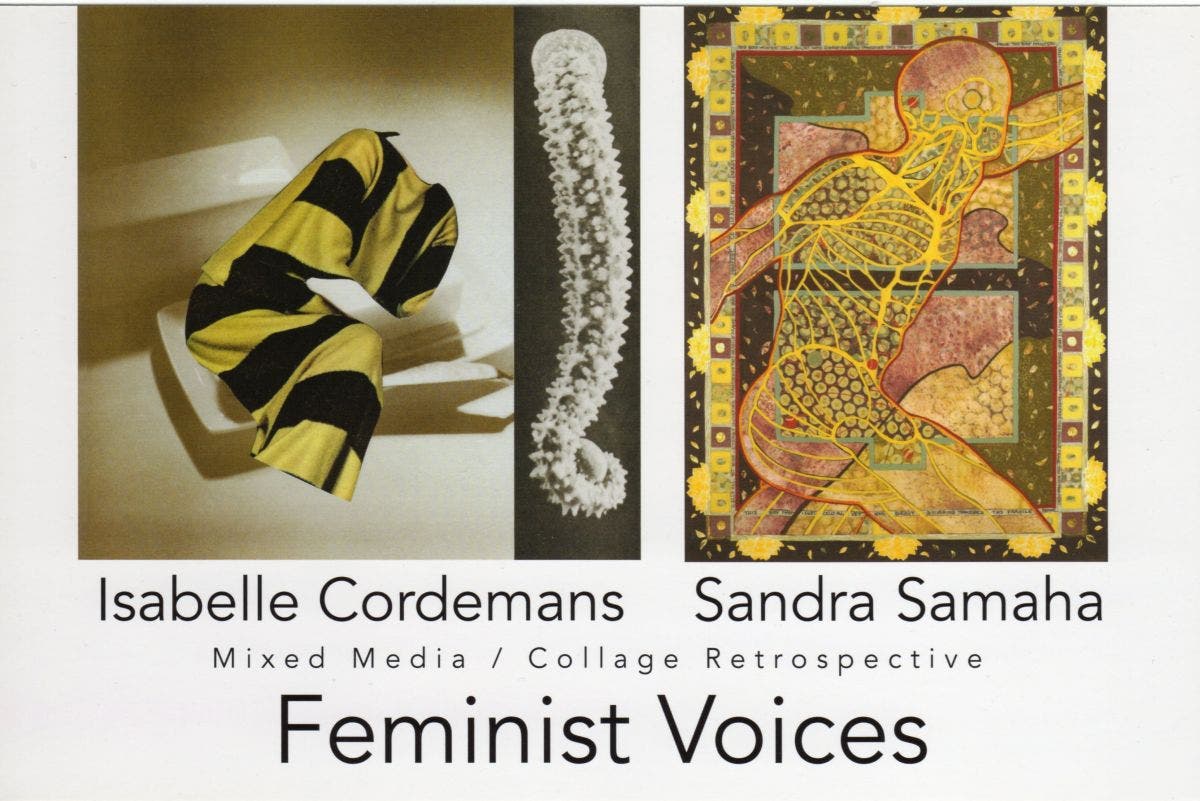
“Feminist Voices” is a two-person retrospective of mixed media / collage artists Isabelle Cordemans and Sandra Samaha, juried by Malcolm Warner, Executive Director of Laguna Art Museum.
An Artists Talk was recently held at The CAP Gallery. Moderated by Malcolm Warner, both artists answered questions about their background, inspiration and methods of creating.
Find out what's happening in Laguna Beachfor free with the latest updates from Patch.
How did you start your Art career?
Growing up in Belgium, Isabelle Cordemans was surrounded in artists, as not only was her family artists but also her neighbours. Painters, sculptors, concert musicians; Art was a strong thread in her environment. Nature was also prominent due to the many botanical and castle gardens around her neighbourhood. This art-saturated world allowed her to show her early aptitude for art and stimulated an early beginning to her studies. Collage was one of her earliest forms of creating art, but she went on to study photography in Belgium and painting in Italy.Cordemans uses photographic images as elements in her collage works. She may see scrap pieces from previous works, or something in a magazine will catch her interest. She then starts cutting, arranging, side-by-side, overlapping, cutting more, re-arranging, edit, edit, edit until she feels the work is done. Cordemans’ interest is in shapes and the way they are arranged in space and their effect on a person. Sometimes it is the absence of an image and that empty space that makes an impact or statement. There is a sort of surreal feel to her work.
Find out what's happening in Laguna Beachfor free with the latest updates from Patch.
Sandra Samaha, a recent transplant from New England, developed a love of Art at an early age, but her family felt that she should be more practical in her career choices. That did not dampen her desire to create. While in college she started doing mono-print work. She continued doing her art even after she went into teaching and raised a family.
While at a quilt exhibit she realized that she could make bigger works by working in collage. Small pieces come together to make bigger pieces. She also found the idea of using disparate items to create a complete work intriguing and incorporates it into her work. Her work has evolved over time due to her life style and the changes it has gone through.When working on a collage, Samaha paints sheets of paper to get the ideal colour or pattern she needs; these sheets would then be cut into the size and shapes as needed. She also incorporates words within the work to help tell the story of the piece.
Collage is the unifying theme of this exhibit. In the past it was not considered Fine Art until the likes of Picasso and Braque started doing it. What place does this have in the current Art Scene?
Both Cordemans and Samaha feel that it a serious form of art and is being done by a great number of artists in a wide variety of genres, styles and methods.
Cordemans has been exploring the question of “where does collage begin and end” for a number of years. She notes graphic designers have used a form of it for many years in the creation of their designs; photographers use it in composing their photographs. Currently it is going through more changes and mutations as artists experiment.
Samaha pointed out the Matisse used pattern, design and colour in his works. Picasso’s use of multiple perspectives in his figurative works could be considered a form of collage. Samaha feels that her work has elements of religion and spirituality that have developed unconsciously, adding another layer to her collages. This was something she noticed during an exhibition she had in Japan.
What are you hoping to communicate to the viewers of your work?
Cordemans’ focus is to let the viewer develop their own ideas of what the art piece means to them based on what they are looking at and experiencing, not just on what pictorial images are or are not in the work.
Samaha tells a story with each piece she creates. Her use of colour, pattern, shapes, and words are to direct the viewers’ eyes to close examination of the piece and draw them in to the place and time making them feel a part of the story.
What is the best thing about being an artist?
For Cordemans it is to be able to communicate on various levels. To spend time in the studio in a constant state of creating. To be with creative people exchanging ideas. “If I’m not doing Art I feel lost.”
To Samaha Art is an addiction. If she isn’t in the studio then she is working in the sketchbook that she carries with her. “It is a reflection of who you are and where you’re at.”
What are your thoughts on the title of this exhibit, “Feminine Voices”?
Cordemans doesn’t think of herself as a feminist but does feel the topic needs to be recognized. “It’s all about the people being seen, not just women.”
Samaha feels she is definitely one. Having a brother who seemed to have it all and get to do it all, she felt she has had it all through hard work, family and Art. It can be found in her work, having been inspired by motherhood.
What is your take on the Art Scene in Orange County?
Cordemans finds it is hard to get a dialogue going about Art in Orange County. People are too busy and don’t take time to make connections with Art or seem to have great a interest in it.
Samaha was “horrified to see the lack of it in Orange County schools.” Through her teaching experience she has found that people benefit from childhood on in having Art be in their lives. It contributes to problem solving in giving each person the tools to finding solutions to problems or situations.
Warner’s closing comments were that the two artists’ works “were a great combination and had so much in common. There is a lot of freedom and imagination in their work.”
Don’t miss this evocative exhibit.
Where: The CAP Gallery
260 Ocean Ave.
2nd Floor of Wells Fargo Bldg.
Laguna Beach, CA 92651
The exhibit runs through February 17, 2017. Gallery hours are 9-6 Monday through Friday, and Saturday 9-4. It is free to the public.
CAP's mission is to increase the visibility and appreciation of Art and serve as a catalyst for Art Education. CAP provides ongoing exhibitions in The CAP Gallery in the Rotunda Gallery space located on the second floor of the Wells Fargo Building, 260 Ocean Avenue. The CAP Gallery is a unique space for juried, solo and retrospective exhibitions. Visit www.caplaguna.org now for information about ongoing or upcoming exhibits, submission guidelines for juried shows, to join the e-mail list or become a member and supporter of CAP. CAP is a 501(3) C non-profit funded by member supporters, the lodging establishments and the City of Laguna Beach.