Community Corner
Review: Laguna Playhouse's "Lonesome Traveler" a Long But Worthy Trip
The production shines a light on the history of American folk music.


Over the last three years, the has mounted as many shows that lean toward musical concerts than it has straight plays. From Tony Bennett to Leonard Bernstein, the folks who run Orange County’s most venerable producing entity are gambling that, in a bruised and bleeding economy, offering audience-friendly music vehicles is a safe way to keep money pumping into its cash registers.
This time around, it’s American folk music that gets the spotlight, with the Rubicon Theatre’s production of Lonesome Traveler, originally staged by that Ventura-based company last spring.
Conceived by Rubicon artistic director James O’Neil (who also directs the Laguna show) the show is educational, historical and sounds really pretty. It’s also too long, too shapeless and sounds really pretty (more on that later).
Find out what's happening in Laguna Beachfor free with the latest updates from Patch.
First, the educational and historical part: O’Neil’s objective is to guide viewers through a 40-year period of American folk music. It begins when savvy impresarios started taping musicians in the Appalachian region in the early 1920s with newfangled recording machines, and ends in 1965 when Bob Dylan turned on and folk music was basically turned out by pop culture.
Early on, O’Neil makes sure that folk music purists won’t have much to complain about: characters talk about how the very definition of folk music is subjective (why is Woody Guthrie considered folk, but not Hank Williams? Leadbelly, but not Robert Johnson? Pre-electric Dylan and not John Prine?). This allows him to pick from a vast range of folk music without having to worry about covering every base.
Find out what's happening in Laguna Beachfor free with the latest updates from Patch.
And he also makes sure to remind viewers that folk musicians were gleeful alchemists, begging, borrowing and outright stealing songs from contemporaries and past artists. So the issue of ownership is less important to the proceedings than, as one character explains, the fact that the only constant in folk music is how it changes.
The narrative aspect of O’Neil’s play takes a back seat to the actual performing of the approximately 40 songs and medleys. But he peppers the show with juicy reminders that 20th Century folk music wasn’t all about pickin’ and grinnin'. The fact that folk music was predominantly a working class genre and was largely fueled by social concerns is never too far from the surface. Examples include Guthrie telling us that “This Land is Your Land” was a response to Irving Berlin’s flag-waving “God Bless America,” the role folk music played in unionizing, and the constant desire among many artists to raise awareness via the music about issues ranging from poverty and racism.
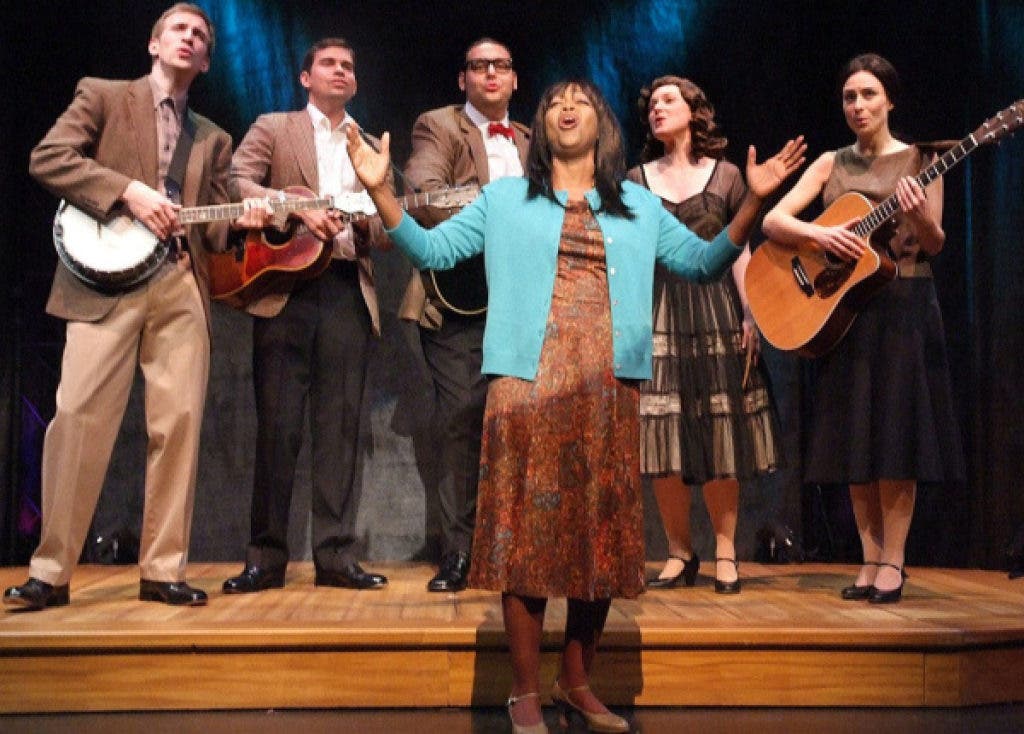
But, again, it’s the actual songs that count most in Lonesome Traveler. And the nine musicians (seven of whom sing) all sound great. Their strumming is flawless, they hit every note and sing with elegance and enthusiasm.
But it’s almost too perfect. With the exception of two, the singers hail from musical theater backgrounds. They’re trained and polished and sound really pretty. But while five-part harmonies are exceedingly pleasing to the ear, it’s the roughness and authenticity to folk music that gives it soul. And while all the music on-stage does come from wooden boxes, be they guitars, mandolins, banjos or upright basses, the voices are amplified and the echo and reverb in those voices actually works against the authenticity of the material in many cases.
The show also could use some tightening up. Its central conceit, a folk singer named Lonesome (played by the highly talented Justin Flagg) goes nowhere, and, at nearly 2:45, it’s about 30 minutes to long. O’Neil could easily cut some of the more superfluous tunes, including a two-song divergence into calypso music, without losing any of the show’s meat.
And that meat, of course, lines the bones of the material O’Neil chooses to include. Baby Boomers will love the inclusion of '60s standards like “Tom Dooley,” “Where Have all the Flowers Gone” and “Puff the Magic Dragon.” Guthrie and Leadbelly devotees will appreciate fare like “Do Re Mi” and “Goodnight Irene.” And it’s a nice touch to include three songs from the guy who broke folk music’s heart, Dylan’s “Mr. Tamborine Man,” “It’s All Over Now, Baby Blue,” and an electrified “Maggie’s Farm.”
The performers are all fine singers and players, with special mention going to Brendan Willing James, who may not look or sound like Dylan, but absolutely slays the material, and Jennifer Leigh Warren, the lone African-American in the cast, who proves that if there is something called Intelligent Design, it reached its zenith in the voice of black women.
While it’s long and sounds a bit too polished, there is such a wide range of material in the show that just about anyone with the slightest interest in 20th Century American music century will find something to feverishly applaud. Oddly, one of the most affecting songs is one of its most apparently trite: a gospel-infused performance of “Michael, Row Your Boat Ashore.” Ditto the fine version of Guthrie’s “Deportee,” as well as the medley of “Barbara Allen,” and “Kisses Sweeter than Wine,” which bounces between three male singers and two female singers.
The moments of poignancy and good-natured humor elevate Lonesome Traveler from just another musical tribute. O’Neil and cohorts cover a lot of ground—perhaps too much—but the journey has enough scenic viewpoints to be well worth the trip.
Lonesome Traveler at the Laguna Playhouse, 606 Laguna Canyon Rd., Laguna Beach 949-497-ARTS. Tues.-Fri., 8 p.m.; Sat., 2 & 8 p.m.; Sun., 2 & 7 p.m. Thru Feb. 5. $30-$65. www.lagunaplayhouse.com.