Community Corner
A Time of Grace and Favor: Revisiting Don Serrano's Rancho Cañada de Los Alisos
Return with us now—and at a fiesta on May 1—to relive the romance of California's rancheros!
So far, we’ve learned that developer Dwight Whiting and a number of pioneer families helped make the whistle-stop of El Toro a reality. But before the railroad—and before the church, schoolhouse and Victorian cottages on the knolls—the area we now call Lake Forest was part of a huge land grant belonging to Don José Serrano.
Don José was the son of Don Francisco Serrano, the great alcade (or mayor) of El Pueblo Nuestra Señora la Reina de los Ángeles del Rio de Porciúncula —a.k.a. today’s Los Angeles—during the late 1700s and early 1800s. Because Don Francisco had been well-regarded, Gov. Pio Pico awarded a large land grant to son Don José in 1842. Four years later, Don José added more land to his holdings, bringing his Rancho Cañada de Los Alisos (the Valley of the Sycamores) to 11,000 acres. On this land, he established great herds of cattle as well as orchards, vineyards and vegetable gardens.
The era of 'Mi casa es su casa'
Find out what's happening in Lake Forestfor free with the latest updates from Patch.
Who were Don José’s nearest neighbors?
Well, just across El Camino Real, or the King’s Highway—now the site of our Santa Ana Freeway—was Rancho Niguel, owned by his wife’s brother Don Juan Ávila. Don Juan’s holdings, also received from Gov. Pico, included what is now Laguna Woods, Laguna Hills and Laguna Niguel. As a demonstration of their familial bond, Don José and Don Juan established primary homes not far from each other, along Aliso Creek on opposite sides of the highway. Farther south was Rancho Trabuco, awarded by Gov. Pico to his brother-in-law, former British sea captain John Forster, as well as the small town that had grown up around Mission San Juan Capistrano.
Find out what's happening in Lake Forestfor free with the latest updates from Patch.
So it’s safe to say that by the mid-1850s a strong sense of community already had developed in the area now known as Saddleback Valley. The rancheros were well-known for their grace and hospitality, as Joe Osterman states in his wonderful An Old El Toro Reader:
“A horseman could go from Los Angeles to San Diego without spending a cent. He could trade his tired horse for a fresh one. Food was available. A place to sleep was always provided, as was money . . . If the traveler needed meat, he was even welcome to kill a cow.”
Still, Osterman adds, the rancheros were hard-working operations. Raising and maintaining livestock, especially during times of drought, was a challenging enterprise. But the people of the rancheros also took time to enjoy life. Don José, for example, built his own racetrack and rodeo grounds at what is now El Toro Road and Muirlands Avenue. Rodeos involved the roundup of the cattle that roamed free most of the year. Another event was the annual recogido, a roundup of horse herds that, like the cattle, were allowed to roam free. Although these activities involved an obvious practical element, fiestas were held in conjuction with them and could go on for several days.
Speaking of Fiestas...
On May 1 from 11 a.m. to 3 p.m., Heritage Hill hosts its own annual party, Rancho Days Fiesta. Activities include Ballet Folklorico and rancho-era dance demonstrations, hands-on crafts, mid-19th-century music, tours of all four historic Heritage Hill buildings and, for a nominal cost, refreshments. Admission is $4 for adults and $3 for children (free for ages 2 years and younger). Call 949-923-2230 for more information, or go online at www.ocparks.com/heritagehill.
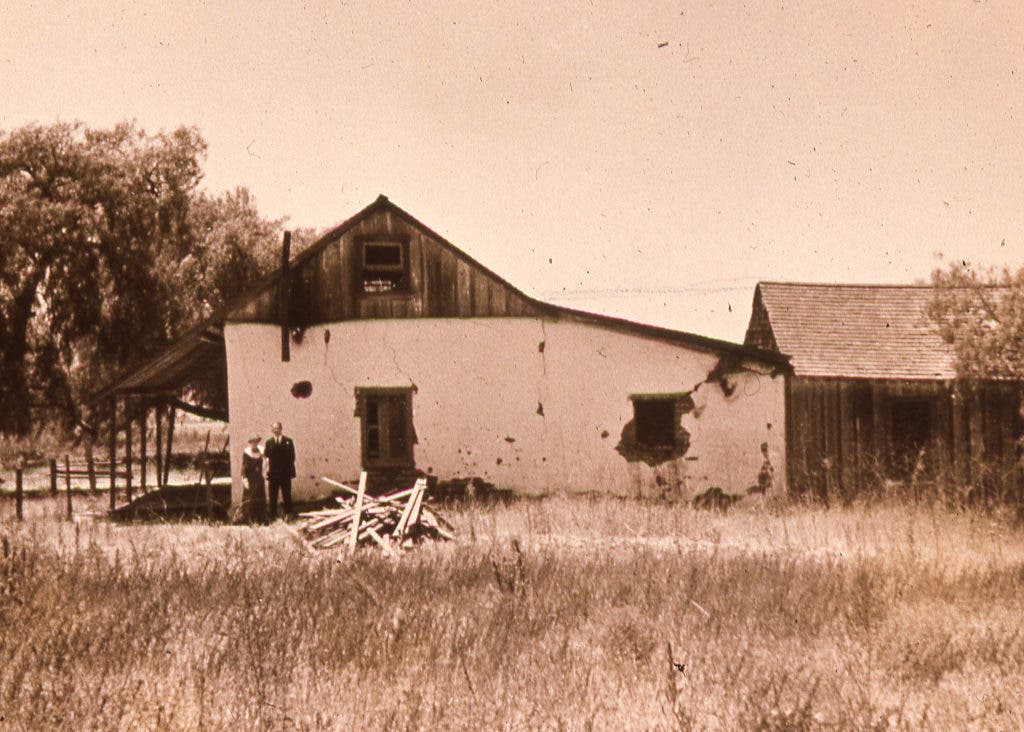
Another head’s up: When you walk through the gates, the first building you'll see is the Serrano Adobe, one of five homes Don Jose built for his children, and the only surviving adobe from Saddleback Valley’s rancho era.
After the Serranos lost their property holdings—which El Toro & More will cover in a future installment—the adobe passed through a variety of owners, including Dwight Whiting’s sons, George and Dwight Jr.
Later, Mr. and Mrs. V. P. Baker took over, from 1958 to 1969, and spent considerable time, money and energy restoring and refurnishing the house; they are the couple standing by the still-in-process adobe in the photo accompanying this story.
When the Bakers in 1969, part of the agreement required preservation of the Serrano Adobe. Occidental donated 55.9 acres around the adobe to the County of Orange, and that acreage subsequently evolved into the historic park you can now visit.