Community Corner
Celebrating A 120-Year-Old South County Tradition
St. George's continues to be a local presence, both as an Episcopal church in Laguna Hills and as a historic building and wedding site at Lake Forest's Heritage Hill.

Just about the time I turned 5, my maternal grandmother began making the request of my parents that I be dedicated at her church.
A former Baptist from Missouri, Grandmother Dollard had for many years been a member of the El Modena Friends Church. The church, located on Chapman Avenue between Orange and the County Park, had been the chosen place of worship for her and my late Grandfather Dollard, a former Catholic from upstate New York, since shortly after their 1911 marriage.
Now, almost 50 years later, Grandmother felt strongly that since neither her daughter nor son-in-law were current churchgoers, something should at least be done about her first grandchild. And while the Society of Friends—often known as Quakers—didn’t believe in baptism, Grandmother knew that once a child became old enough to attend school, a dedication ceremony was available.
Find out what's happening in Lake Forestfor free with the latest updates from Patch.
So that’s how one warm Sunday morning, 5-year-old yours truly walked hand-in-hand with my grandmother into a big white building, all the way to the front of the cool, cavernous interior, where we sat next to each other a pew. Next, I listened carefully, following the cues Grandmother and a man wearing long dark robes gave me. Then, after what seemed an eternity, we were once again outside and I was being clucked over by a gaggle of my grandmother's friends, all dressed in black and wearing the strange style of shoes I’d later see in photos of Eleanor Roosevelt.
Many years later—25, to be exact—a group of co-workers decided to hold a birthday celebration for me at that very same location. For by that time it had morphed into Moreno’s, a popular Mexican food restaurant that continues to this day.
Find out what's happening in Lake Forestfor free with the latest updates from Patch.
How did I feel about having lunch amidst strolling mariachis in the very same place—once a solemn meeting hall, now a dining area filled with tables, chairs and colorful décor—where my life had been dedicated to God?
Well, to be honest ... like I’d landed in a Fellini movie!
Don't get me wrong: I’m glad the Quaker meeting house once attended by my grandparents and so many others has been preserved.
All the same, I admit a partiality to how El Toro’s first place of worship transitioned—and continues to transition—from the 19th to the 21st century.
An Early Call to the Faithful
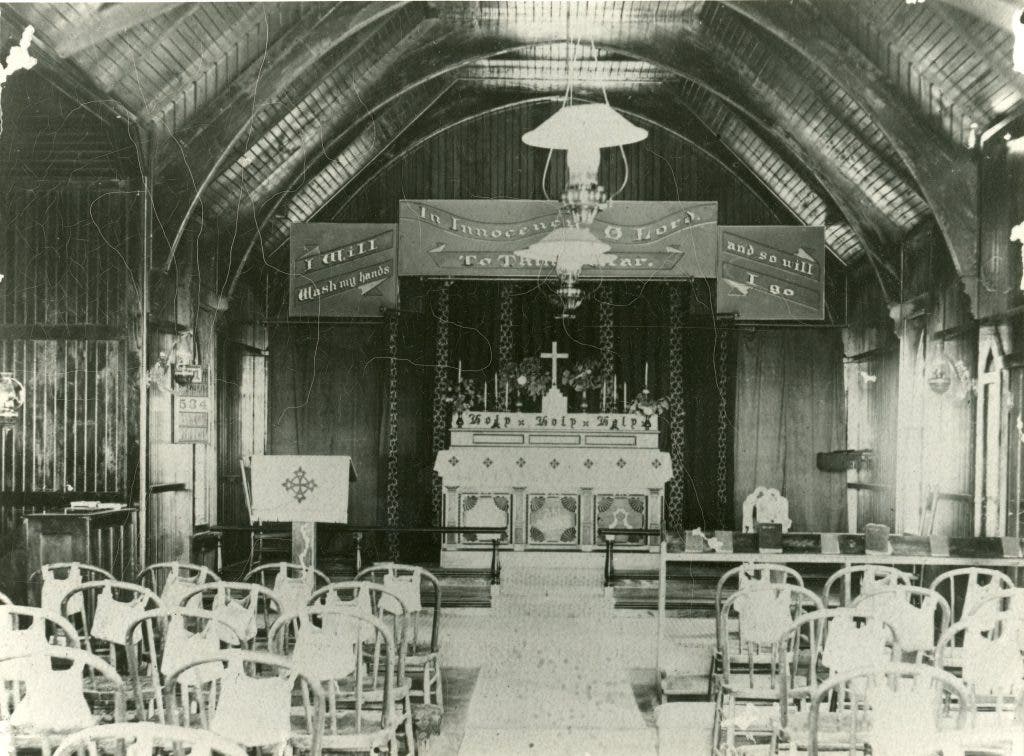
A few years after the El Modena Quaker meeting house was established in what is now the city of Orange, Dwight Whiting—intent on and a place of worship—set about planning for both. In this endeavor he also received support , who were eager to establish a memorial for their recently deceased son George. Since the establishment of the community was still in process, the structure would be classified as a mission rather than a church, with services led by visiting Episcopal clergy and various qualified members instead of a full-time clergyman.
Here's what Clara Mason Fox says in her 1939 publication, A History of El Toro, about the mission and the British folks who eventually did settle in our once-rural community:
“St. George’s Episcopal Church was dear to the heart of these people, so far from the home of their youth. It was organized in 1891, and a building erected on land given by the El Toro Land & Water Company. Later, Judge and Mrs. Keating gave the glebe and three acres adjoining, and also lots A and E, together 36 acres, which were planted to olives to provide a church income.
“The first service was held June 7, 1891, by the Reverend George Robinson, fifty persons attending ... A son of the Keatings, Rev. Lloyd K. Keating, officiated whenever he visited his parents. The pastor of the Orange church holds services here on certain Sunday afternoons. as long as he lived in El Toro, and also as lay reader.”
Two Changes of Venue
Fast forward now to the early 1960s. Sleepy El Toro—still a rural community of not much more than 400 residents—is about to undergo a transformation that would have boggled even the enterprising Dwight Whiting. For as suburbia begins to sprawl southward from Anaheim, Orange, Santa Ana, and Tustin, the gently rolling land—for many decades dedicated to orange groves—soon will be “growing” houses.
As for St. George’s, change is also afoot. Here's what St. George's current website says:
“In 1964, with the opening of Leisure World and the development of Mission Viejo, the mission church of St. George’s began to experience a new influx of families. In 1966 the Rev. Frederick C. Hammond became vicar-in-charge and was later called as the church’s first rector. Under Fr. Hammond’s energetic leadership, a new church building was erected at the present location [23802 Avenida de la Carlota, Laguna Hills] and dedicated in 1969."
But what about the the original structure? Not to worry, for seven years later, in 1976, it was moved to its present location at Heritage Hill Historical Park at Lake Forest Drive and Serrano Road, where it continues to serve the community, both as a place to relive El Toro history, and also—on occasion—as a wedding site.
(Currently the mission, along with the schoolhouse, are undergoing several refurbishing projects and are therefore closed, but will be ready to welcome docent-led tours once again by the end of September.)
What's In a Name ... or a Place?
In addition to the actual name, St. George's, you may have noticed several Georges connected to the mission's history: the Keating’s late son, commemorated with a plaque located inside the church, and the Rev. George Robinson, who led the first service. But as noted on the website of today's Laguna Hills church, the sanctified George, “also known as the dragon-slayer, is known for bravery in adversity; one legend has it that he slew the dragon to save a princess, and inspired an entire town to become Christians.”
Finally, just in case you're wondering what occupies the original site of our community's first church ... well, not too far from the El Toro Road and Whisler Drive site, where St. George’s once welcomed worshipers for approximately eight decades, is the intersection of Whisler Drive and Orange Avenue where the Abiding Savior Lutheran Church and School now resides.