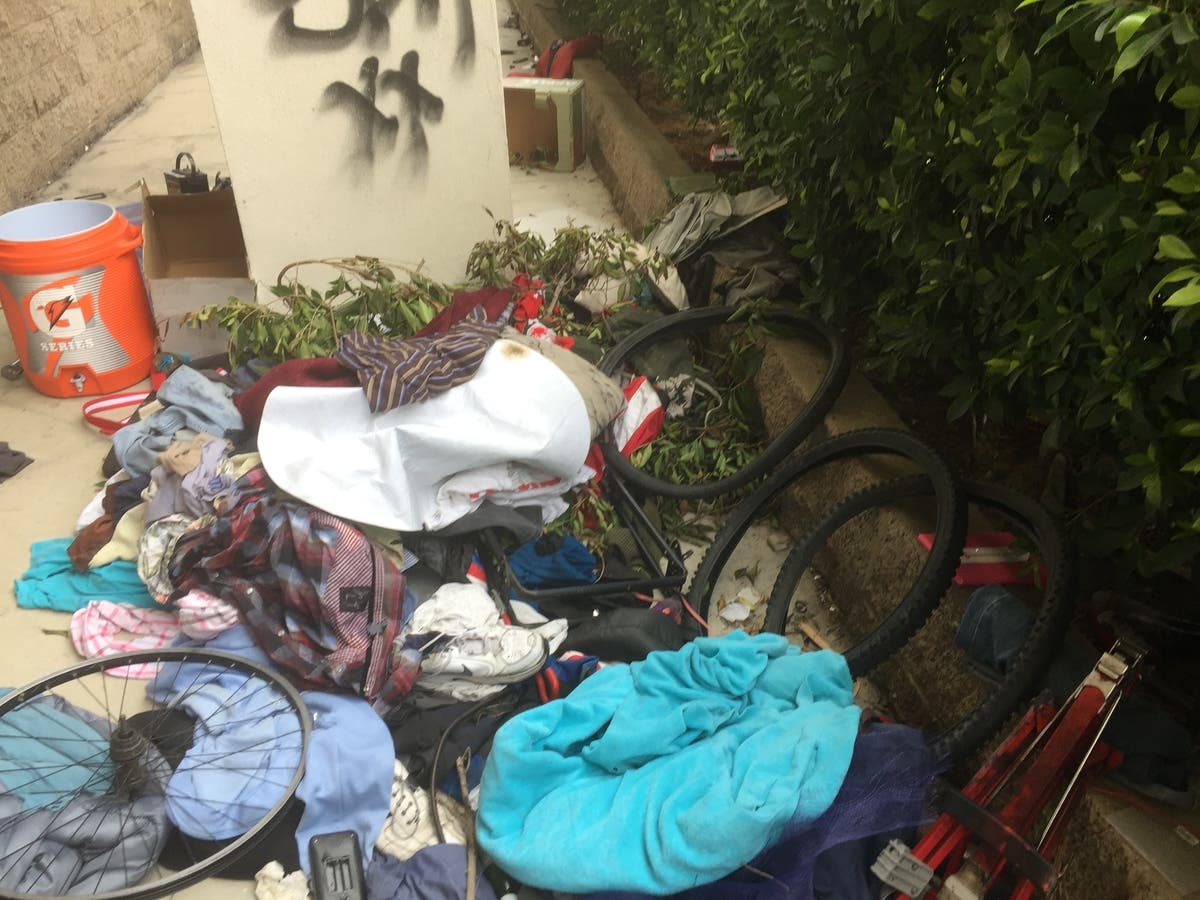


As everyone knows, the number of homeless people in Lake Forest grew in 2018 as a result of the poor job done by the Board of Supervisors who, first, ignored the problem, and then, under political pressure with an election coming up, rounded up the homeless and then disbursed them, causing 1,000 or more to find new places to stay (Click here). Just like every other City in Orange County, we got our share of the overflow. See the pictures that documented various places where the homeless were living last year.
My estimate was that the number increased by about 30%, but it was only an estimate. Yet it was clear that homeless people were more visible in the City. As Mayor I organized a committee, put staff on notice, and we slowly began a process of dealing with the problem at all the levels, concentrating on prevention but also dealing with the problem at hand – homeless people roaming around the City.
A few months into the program I asked the City Manager to go beyond the existing Homeless Liaison Officer (HLO) program in which our point-of-contact with homeless people was a Deputy Sheriff, and extend our outreach into the community to deal with the new challenges. Our HLO program has been a success since it was started a few years ago. We were the first City in OC to establish this service and many other cities followed our lead. Our HLO officers got a dozen or more homeless people off the streets every year, and compared to most other cities in OC we had fewer homeless on a per capita basis.
Find out what's happening in Lake Forestfor free with the latest updates from Patch.
While I was satisfied with the HLO program, a nagging thought bothered me – did we need to use a well-trained and experienced Police officer to deal with the average set of needs of a homeless person? There are times when a homeless person requires attention from a Police officer, but most of the time their needs are better met by a Social Worker. One of our HLOs, upon retiring, made exactly this point.
Therefore, while it’s necessary for every member of our Police force to understand how to deal with homeless people when they break the law (e.g., steal a bike, drunk in public), most of the contacts between the homeless and the HLO are not in the realm of public safety. Their needs are to find a place to stay, get something to eat, get medical assistance, re-connect with their family or friends, etc. – hardly the province of the badge and gun.
Find out what's happening in Lake Forestfor free with the latest updates from Patch.
Not only is a Police officer not particularly well-trained to deal with the plethora of needs of a homeless person (much less a homeless family), the badge and the gun are often threatening to homeless people, many of whom have not had good prior interactions with the Police.
By mid-2018 several agencies came to our attention that dealt with the homeless on the street. They reported good results. The City Manager and our staff interviewed several of them and chose Mercy House (Click Here). Mercy House came on board in September. Using a Public Records Request I obtained information about how they’re doing.
BETTER RESULTS
In October and November the Mercy House professionals placed 4 homeless people each month – 8 people off the streets. By comparison, our HLO helped transition half as many – 3 in October and 1 in November. Neither group placed anyone in December.
FWIW – in October and November of 2017 the HLO helped place 3 people so the 2018 data are consistent – an average of 2 per month and about 20 to 24 per year.
Result - Mercy House got twice as many people off the streets in the same time period.
LESS EXPENSIVE
The Mercy House program costs $7,000 per month and provides services 40 hours a week. The HLO program costs over $20,000 per month and provides service about 30 hours per week.
On an hourly basis, assuming 4 weeks per month, that’s $44 per hour for Mercy House coverage and $167 for the HLO program.
Result - the HLO program is nearly 4 times as expensive on an hourly basis to provide coverage. In addition, though it hasn’t yet been implemented, the Mercy House coverage will provide 2 to 3 professionals while the HLO provides 1.
In terms of cost-effectiveness, using the three months we have available, it cost $2,625 to place each homeless person using the Mercy House program ($21,000 for 8 people) and $15,000 to place them using the HLO program ($60,000 for 4 people).
Result – the HLO program is more than 5 times as expensive in terms of placing people.
SUMMARY
Three months of data is suggestive, though hardly conclusive. During this time Mercy House has been learning about the City and the homeless people who live here, so we can expect their performance to improve. Our HLO has generously shared his time and energy with the Mercy House professionals so he has been slightly distracted. But based on that data it appears that Mercy House provides more coverage for less money and achieves better results. More specifically –
- Mercy House transitioned twice as many people.
- The hourly cost for coverage by the HLO program was nearly 4 times the cost of the Mercy House program.
- On a per capita placement basis, the HLO program cost more than five times as much as the Mercy House program.
The three months of data supports my initial thought that the challenges of the homeless can be better met with professional social service agency management rather than through the Police. Needless to say we need to look at the long term results rather than the immediate placement data and we need to have data over a longer period of time.
The Police are a vital agency, but the costs of our Police contracts keep rising and the percent of our budget spent on the Police keeps rising every year. In Lake Forest we are close to 40%. In some OC cities they are more than 50%. We need to be sure to use our Police staff in the most responsible way possible. In this case, it looks like fading out the Police-based HLO program and replacing it with a social service agency (like Mercy House) is the best move for cities.
ABOUT THE AUTHOR
Dr. Jim Gardner was on the Lake Forest City Council from 2014 to 2018 and Mayor in 2018. Under his leadership the City became the first debt free city in the U.S. with a population over 25,000 people and the first city to live broadcast City Council meetings that allowed residents to participate online. In his former professional life, Dr. Gardner was a consultant to the Police and authored several research articles in this area.