Politics & Government
A History of Voting: Registrar of Voters Explains How Ballot Counting Works [WATCH]
The Orange County Registrar of Voters has given all a lesson in the history of voting in the United States.


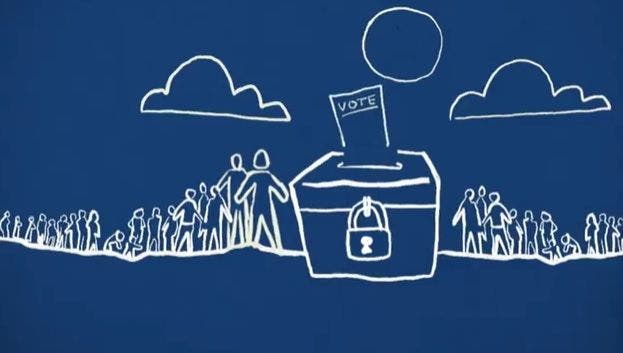
LAKE FOREST, CA —The Orange County Registrar of Voters invites all to view a history lesson on the origin of voting and how it has changed since the early 1800s.
“In the beginning of the United States democracy, parties would host voting, instead of the government,” Orange County Registrar of Voters Neal Kelley said in his video, “Blueprint for Democracy.”
When the Australian ballot was put into play in the early 1800s, the government took over, allowing locals to man their own polling places, according to Kelley’s history lesson.
Find out what's happening in Lake Forestfor free with the latest updates from Patch.
"We'll vote on paper, but have the government control that process," he said. "We adopted that here in this country and went to a paper ballot and a community- based election."
In the early days, we were an agricultural society, and polling places were set up around population centers.
Find out what's happening in Lake Forestfor free with the latest updates from Patch.
“Local community members would show up to support the election, and you would see your neighbors,” he said. “They would vote on Tuesdays because that was the day when everyone went to market. Here we are, it’s the 21st century, and we are essentially voting the same way.”
In Orange County, there are 3.2 million residents and 1.5 million voters.
“It’s the largest population of voters in the smallest geographic area,” Kelley said. "Orange County is surely on a national stage."
As the chief elections official for the county, Kelley’s office has created a video showcasing what it is like at the registrar’s office, from candidates being approved to run for office and the creation of sample ballots to voting day and the counting of those ballots.
“I remember when I ran for mayor, and it came to a recount,” one candidate said. It was just 15 votes that called that election, all hand counted at the registrar’s office, proving the theory and the often-lauded mantra that very vote counts.
“It’s a large complex operation,” Kelley said. “When we are at full speed, we have 242 people on site, and five to 10,000 volunteer poll workers, and 300 field personnel.”
According to Kelley, it all starts with a candidate deciding to run for office about 120 days prior to the election.
“There are signatures to collect, and fees to pay,” Kelley said.
“Most candidates need 20 signatures from registered voters,” Todd Spitzer said. “Getting the right signatures by the right people is what’s really important.”
Sometimes, candidates wait until the last minute and don’t have enough qualified signatures, according to the registrar’s office.
Something as a wrong date or an unregistered voter will knock a potential candidate from the ballot, but systems in place are there for a reason.
“The ballot creation is complex because you have thousands of voting precincts across the country,” Kelley said. “On top of that, you have language differences.”
If you go back 10 years, 300,000 people voted through the mail. In 2016, almost 900,000 people are voting through the mail, according to Kelley.
“More people vote from the ballots they receive in the mail, but turn in their ballots at the polling places,” he said. “That’s record-setting, as well.”
The video shows the large operation of writing and physically putting together ballots, to getting them into the mail. There are systems that are in place for getting the ballots mailed to the proper precincts and addresses, as each precinct has different measures on their ballots.
“What you and your neighbor are voting on could be two totally different things, and each ballot needs to be perfect and translated into eight languages,” Kelley said. “It’s like creating a 500-page novel in 120 days, and getting it onto the bookshelves in multiple languages. If one sentence is left out of part of a measure, we have to correct that.”
By mid-October, one and a half million Orange County voters have received their paper ballots for voting.
“If you lined up all of our ballots on the pavement, it would go from here to St. George, Utah,” he said. “That’s what keeps democracy humming.”
Scenarios and samples, measure files and documents, each have to be designed and agreed upon by the registrar’s office.
“As soon as they hit their door, the people can vote on it and mail them back,” Kelley said. “This is a year’s worth of planning coming together in one single day.”
He compares the event to Super Bowl or the World Series or any other major sporting event that takes such in-depth preparation and commitment. Still, it is a workday, and life can get in the way for those set-pieces Kelley’s office is depending on to do their job and do it well.
In the past, even power outages have stalled the reporting of election results in a timely manner. For those anxiously awaiting the results, that was agony, as is shown in the video.
“It’s like any other workday,” he said. “Our volunteers may call in sick or not show up to unlock the door. That’s something we need to think about. And the equipment, it might have a bug or two. Those are the things that keep me up at night.”
Photo from Screenshot of Youtube Video
Get more local news delivered straight to your inbox. Sign up for free Patch newsletters and alerts.