Neighbor News
The Homeless Chronicles. Part 7
What Percent of the Homeless in California are Mentally Ill?

This is the seventh in a multi-part series about homelessness. Previously we noted that
- Homelessness changes depending on your definition, from very narrow to very broad.
- There are three main groups of homeless people – (1) people who chose to be homeless, (2) people whose disabilities create/contribute to homelessness, and (3) people who experience a major negative event which propels them into homelessness.
- The life style homeless basically want to be left alone. The temporary homeless are looking for help to return them to their normal life. The chronic homeless have such disabling conditions they are the most difficult to reach and to help.
- In recent years, a greater percent of the homeless are coming from the temporary group, fueled largely by the high cost of housing in relationship to their income.
- The commonly used federal survey under –estimates the number of homeless. In reality, there are over a million homeless people nationwide, 250,000 in California and between 10,000 and 15,000 in Orange County.
- There is wide diversity among California counties in the percent of the population who are homeless. Orange County at 0.22% (22 homeless people for every 10,000 residents) is mid low range with an average of 0.39% for the State.
- There is wide diversity among California counties in the percent of the homeless population who are unsheltered. Orange County at 58% is mid low range with an average of 65.3% for the State.
Today we’ll get some perspective, looking at the homeless who are mentally ill. Generally speaking it is the unsheltered homeless mentally ill who come to the public’s attention more than the other groups of homeless.
What Percent of the Homeless Are Mentally Ill?
Bear in mind, despite conforming to the HUD guidelines, each county has its own definition of “mental illness” and its own way of assessing the condition. The most common labels are “psychiatric or emotional conditions” (Orange 2017, Santa Clara, Sacramento 2017, San Mateo, Tulare/King), “serious mental illness” (Orange 2019, Contra Costa 2017, Yolo), “mental illness” (Imperial, Sacramento 2013), “mental health problem” (Contra Costa 2015, Riverside, San Diego, San Joaquin) and “serious mental health problem” (Merced, San Bernardino).
Find out what's happening in Lake Forestfor free with the latest updates from Patch.
To compound the difficulty, the qualifying statement differs from whether or not the condition “limits the ability to live independently” (Orange 2019, Merced, San Bernardino), “interferes with your life” (Yolo), prevents you “from working or maintaining stable housing” (Orange 2017, San Diego, Riverside, Tulare/King, San Mateo, Sacramento) or merely “housing” (Butte, Imperial). Some counties don’t use any qualifier (Contra Costa 2015, San Joaquin, Sacramento 2013).
In most counties they record the prevalence of the condition for all homeless people but in a few counties they only look at the rate of serious mental illness (SMI) among unsheltered homeless adults (e.g., San Joaquin, Merced, Butte, Sacramento). Thus, comparisons are not “apples-to-apples” in every case.
Find out what's happening in Lake Forestfor free with the latest updates from Patch.
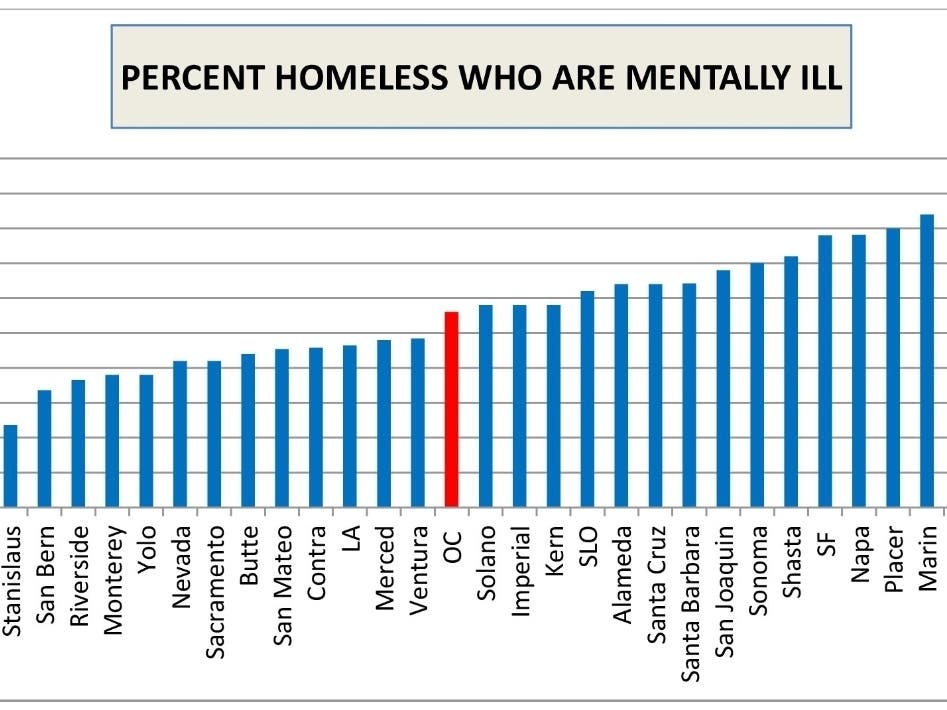
With 28% of the homeless OC adult population self-reporting SMI, OC’s proportions are mid-range. The average for 31 California counties is 29.5%.
Is Population a Factor?
There are no common factors identifying why one county vs. another has a higher percent of mentally ill homeless people. Here is a rank order of the top 10 most populous counties and their percent of self-reporting mentally ill homeless people –
- Los Angeles – 23%
- San Diego – 43%
- Orange – 28%
- Riverside – 18%
- San Bernardino – 17%
- Santa Clara – 42%
- Alameda – 32%
- Sacramento – 21%
- Contra Costa – 23%
- Kern – 29%
Is Density a Factor?
There is no pattern. Nor is density a factor. Here are the top 10 most dense counties along with the percent of homeless –
- Orange – 28%
- Los Angeles – 23%
- Alameda – 32%
- Contra Costa – 23%
- Sacramento – 21%
- Santa Clara – 42%
- San Diego – 43%
- Marin – 42%
- Ventura – 24%
- Stanislaus – 12%
There is no pattern.
Is Cost of Housing a Factor?
Here is the list of the top 10 counties with the highest percent of the homeless who self-report being mentally ill, along with the cost of housing as a percent of income.
- San Diego (43%) – 25.16%
- Santa Clara (42%) – 22.47%
- Marin (42%) – 22.06%
- Placer (40%) – 22.52%
- Napa (39%) – 24.63%
- San Francisco (39%) – 19.88%
- Shasta (36%) – 22.52%
- Sonoma (35%) – 23.98%
- San Joaquin (34%) – 22.52%
- Santa Barbara (32%) – 26.78
Once again, no pattern.
Summary
There is wide diversity across California in the percent of homeless who self-report being mentally ill, ranging from 12% (Stanislaus) to 57% (Tulare/King). There doesn’t appear to be any relationship between self-reported mental illness and population size, density, nor cost of housing.
Next time we’ll dig a little deeper into homeless people who are mentally ill.
About the Author
Dr. Jim Gardner is the former Mayor of Lake Forest. A Clinical Psychologist, he is a former University Professor and Department Head. He authored several reports about homelessness.