Arts & Entertainment
Peter Pan Junior Theater Soars Despite Economy
Local institution will never grow up but matures as a role model for kids and fundraising.
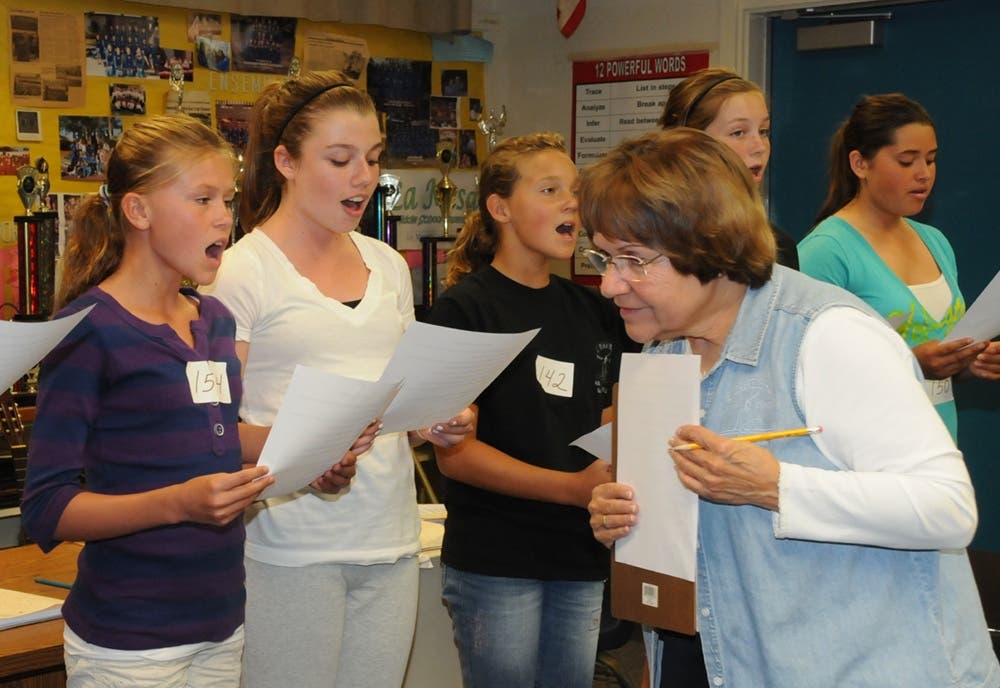


Some 250 fourth- through eighth-graders convened outside La Mesa Middle School's auditorium this month for a chance to appear in a spring production of "The Music Man." Professor Harold Hill, the con man in the play's mythical River City, would have been proud.
Director Mark Arapostathis certainly was. He says the number of auditioners for his Peter Pan Junior Theater rises each year. And that flies in the face of economic conditions.
California's financial woes have caused legislators to slash around $17 billion from educational spending the past two years. Art, music and drama programs are favorites for the chopping block, leaving millions of students without a productive outlet for their creativity. In one extreme case, a Sacramento middle school ran out of instruments for its band class, forcing about 15 students to practice with shabby stand-ins—their pencils.
Find out what's happening in La Mesa-Mount Helixfor free with the latest updates from Patch.
Thankfully, students in the La Mesa-Spring Valley School District still have extracurricular options, such as Peter Pan Junior Theater, a 41-year-old independent, volunteer-run institution that relies on participants for its fundraising.
Each production runs upward of $50,000, which includes a professional orchestra, theater space, rights to the show, sets and costumes. Parents are required to take part in planning committees, and each child chosen for the production—with his or her parents' help—is required to raise $250 in sponsorships from family, friends and local businesses.
Find out what's happening in La Mesa-Mount Helixfor free with the latest updates from Patch.
Some families are able to fund their children, but many take advantage of the sample solicitation letter provided by PPJT, which they can personalize before sending out.
Taking on this responsibility is almost as valuable to the production as the funds themselves.
"If the program was free, people would flake," said Joanne Cohen, mother of PPJT actress Eliana. "This way, the child and parents are invested, which makes the whole production stronger."
In this economy, family fundraising might seem a deterrent, but it hasn't made an dent in the number of children auditioning. Witness the 250 children at the first auditions Sept. 7-8.
The appeal of PPJT, which regularly draws former participants, is more than just the opportunity to perform.
Arapostathis, a City Council member and Rolando Elementary School teacher commonly known as Dr. A, infuses character-building into the curriculum—to the admiration of many parents.
"It's not just acting," said Stacy McKay, whose daughter Madeline has been a cast member for three years. "He teaches life skills: teamwork, confidence, helping others, standing tall"—skills that benefit students well into adulthood.
In fact, some take part beyond their acting years. Laura Erath and Zack Alper, PPJT's assistant directors, are both former cast members who want to give back to the institution that gave them so much.
Erath, a junior at Grossmont High School, considers Dr. A "the biggest role model in her life" while Alper, a senior at Steele Canyon High School, said making lifelong friends and being part of a "family" has inspired him to stay active in the theater.
That sense of family is what draws many returning cast members back to the stage, and also what sustains them through long months of practice. Between October and March, rehearsals run five days a week after school, plus some Saturdays (although not every child is required for every rehearsal). The rigorous routine gives cast members an appreciation for hard work, a trait that many believe is lost on the current generation of tweens and teens.
Such was apparent during the call-back process Sept. 10-11, when children were split into three groups—dancing, singing and line reading.
For the dance portion, potential cast members learned a quick routine from assistant directors Erath and Alper. Some children picked it up effortlessly, while others showed fierce determination to master it. A missed step or wrong turn did not result in frustration or resignation—it only inspired the dancer to work that much harder the next time.
Another positive character trait, collaboration, was on display in the singing module. Kids crooning the production number "Wells Fargo Wagon" were challenged to step outside their own "personal bubble" and listen to the other voices. Vocal director Elaine Arapostathis (Dr. A's mother) encouraged the children to ask themselves: "Am I too loud? Too soft? Too off?" and blend their voices accordingly.
Although the final cast selection included 90 children—less than half of those who originally auditioned—the process was not a total loss, even for those not chosen. The competitive nature of auditions, for both inclusion in the cast and specific roles, eschews the "everyone's a winner" attitude that many parents believe is prevalent these days.
"Even being picked for the chorus is an accomplishment," said Tonya Lehman, whose daughter Grace was part of the chorus last year and has been cast as a Pick-A-Little Lady this year.
In the end, regardless of the role assigned, the character- and leadership-building aspects of PPJT will be on full display March 16-19, when "The Music Man" takes the stage at the Salvation Army's Ray and Joan Kroc Community Theater just west of La Mesa.
"Many people assume drama kids are undisciplined," Arapostathis said, "and audience members are shocked to see how well-behaved and gracious our kids are."
So at the end of the show, when cast members thank you for coming, they are not just being polite—they are truly proud of their accomplishments, and genuinely grateful for the community's support.
Have you seen a Peter Pan Junior Theater Production? How did the youngsters compare to more senior performers? If you're a PPJT alumnus, what was your fondest memory? Tell us in the comments.