Schools
SDSU Astronomers Make Planet Discovery
Science advances due to San Diego State University's finding of third Kepler-47 planet: "the most interesting of the binary-star worlds."


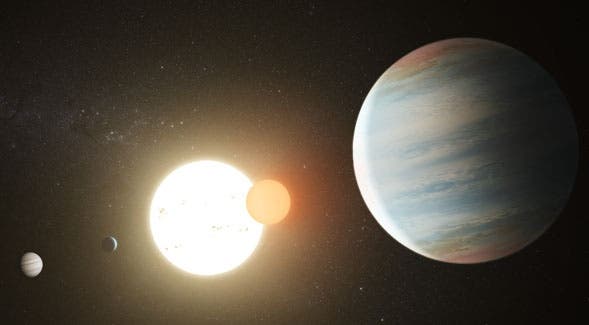
SAN DIEGO, CA – A team of researchers, led by astronomers at San Diego State University, detected a third planet in the Kepler-47 system -- the new Neptune-to-Saturn-size planet orbiting between two previously known planets, authorities announced today.
The planet, found using data from NASA’s Kepler space telescope and dubbed "Kepler-47d," secures "the system’s title as the most interesting of the binary-star worlds," SDSU officials said.
"We saw a hint of a third planet back in 2012, but with only one transit we needed more data to be sure," said SDSU astronomer Jerome Orosz,the lead author of the study published in the Astronomical Journal.
Find out what's happening in La Mesa-Mount Helixfor free with the latest updates from Patch.
"With an additional transit, the planet's orbital period could be determined, and we were then able to uncover more transits that were hidden in the noise in the earlier data."
In addition to confirming the planet's existence, the research team discovered that it is the largest body on record in the Kepler-47 system. All three planets also have a lower density than Saturn, our solar system's least dense planet. Kepler 47 is roughly 3,340 light-years from Earth toward the northern constellation Cygnus, experts said.
Find out what's happening in La Mesa-Mount Helixfor free with the latest updates from Patch.
The system itself is fairly compact and could fit within Earth's orbit around our sun. One of the system's stars is roughly similar in size to the one in our solar system while the other is roughly one-third that size. All three planets are at least three times larger than Earth, with Kepler-47d registering at seven times larger, according to SDSU scientists.
"This work builds on one of the Kepler's most interesting discoveries: that systems of closely-packed, low-density planets are extremely common in our galaxy," said Jonathan Fortney, a UC Santa Cruz astronomer who was not involved in the study. "Kepler-47 shows that whatever process forms these planets -- an outcome that did not happen in our solar system -- is common to single-star and circumbinary planetary systems.''
The research can be found here in the Astronomical Journal.
This work was funded in part by grants from NASA and the National Science Foundation.
--Bay City News contributed to this post
Get more local news delivered straight to your inbox. Sign up for free Patch newsletters and alerts.