Schools
Tricks of the Trade: Teachers Tell How to Lift La Mesa-Spring Valley Scores
School board told: "If you raise the bar, they will always meet or exceed your expectations."


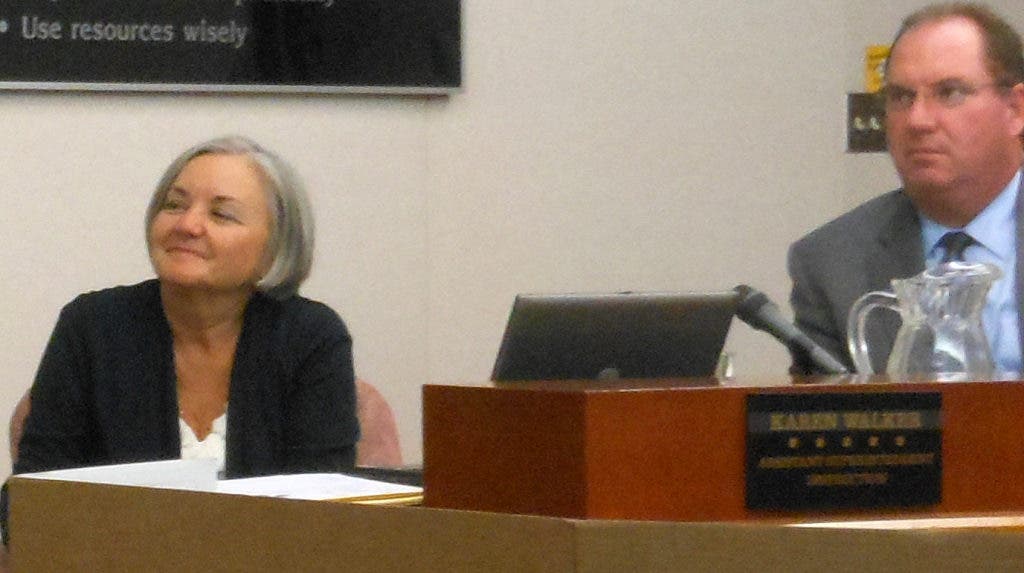

How can La Mesa-Spring Valley schools improve test scores—and achieve adequate yearly progress? One way, teachers said Tuesday night, is through intervention groups.
Kelli Triplett, a kindergarten teacher at Lemon Avenue Elementary in La Mesa, said teachers are analyzing data from pretests and post-tests to create intervention groups and additional learning opportunities for students not proficient in math and reading.
Jennifer Bonacorsi, who teaches a fifth- and sixth-grade combination class at Lemon Avenue, said learning targets are posted on the walls of her classroom and individual goals are posted on her students’ desks.
Find out what's happening in La Mesa-Mount Helixfor free with the latest updates from Patch.
“No more secrets, no more surprises,” Bonacorsi said. “They want to know their levels, and they want to know how to get there. If you raise the bar, they will always meet or exceed your expectations.”
Triplett said the same test data also help teachers identify advanced students who need more challenging work.
Find out what's happening in La Mesa-Mount Helixfor free with the latest updates from Patch.
She and others, including principals and students, appeared at a follow-up school board meeting in the wake of a Sept. 20 when officials discussed the K-8 district’s state Adequate Yearly Progress reports on standardized tests.
During that meeting, officials agreed the district needs to perform better because only five of the 21 schools met AYP criteria.
First-grade teachers noted how well prepared their students were at the start of the year, Triplett said.
“We love this time of day because we know that our students are getting their academic needs met at their learning level,” she said.
Tuesday night, Lemon Avenue staff told how the school’s three kindergarten teachers grouped their 100 students into proficient, below proficient and challenge reading groups, for example.
Teachers meet with their assigned group for 40 minutes each day.
Triplett said this is the third year that kindergarten teachers have grouped their students, who are reassessed and regrouped multiple times during the school year.
Principals, teachers and students also went before the La Mesa-Spring Valley school board to explain how their sites are adhering to the district’s five focus areas.
Schools Superintendent Brian Marshall said execution of the district’s five focus areas—professional learning communities and data analysis, student engagement, nonfiction writing, English language learners and special education—are key to achieving better AYP reports.
Representatives from and said they are working on each of the focus areas during the meeting at the district’s Date Avenue headquarters.
Teachers explained that they are building professional learning communities to collaborate with one another and analyze data from assessments.
Teachers are using similar methods at the district’s middle schools.
Dave Thompson, an eighth-grade science teacher at La Mesa Middle School, said the four teachers in the science department share the same preparatory period so they can communicate with one another.
They also teach the same concepts at the same time and give their students the same quizzes every Friday.
Their goal for students is a score of 75 percent or better on each assessment, he said.
After an assessment, teachers “redeploy” students so that those who passed work on more advanced assignments and others review the material.
About 75 percent of the students passed the most recent assessment about the phases of matter, which was roughly 50 questions, Thompson said.
After students redeployed, 95 percent of the students earned a 75 percent or higher.
“The key that we have is really our redeployment strategies, and the students’ desire to come in and learn the material,” Thompson said.
“We’ve tried to create a culture in the science department where the kids look forward to coming into class and taking those assessments so they can prove ‘I’m here,’” Thompson said as he raised his hand above his head.
In addition to creating professional learning communities and analyzing data, district teachers are engaging with their students so they know where they are academically and where they need to be.
Teachers also are incorporating nonfiction writing into subject areas to improve comprehension and writing skills.
After a math lesson, for example, Bonacorsi said she has her students write a paragraph about what they learned.
Finally, all teachers are collaborating to improve instruction for English language learners and special education students.
Ticia Bracher, a resource specialist program teacher and Teacher of the Year at La Mesa Middle School, said the school adopted a “learning center model” so that general education and special education teachers plan and work together.
Now students with disabilities are no longer viewed as “separate,” she added.
Thompson said instructors work together to create redeployment guidelines for English learners and special education students, too.
In fact, English learners and special education students increased their scores from 50 percent to 80 percent on the same quiz about the phases of matter.
Like the district’s principals and teachers, students agreed the focus areas are helping them learn.
“At La Mesa Middle School, we’re learning to be more independent and responsible for our learning and ourselves,” said Grace, a seventh-grader. “We’re more informed, involved and aware of how we are doing, which helps us to be the best we can be.”
Said Hunter, another seventh-grader: “We have learned that we are the most important part of our learning. We can be surrounded and supported by all the adults in the world trying to help us, but it all comes down to us, the students, doing our part.”
Following the presentation, board member Bill Baber, who has children in the schools, said he is pleased with the changes at both sites.
“Both of my kids seem to be making progress, so I’m very happy as a parent,” he said.
Karen Walker, the district's assistant superintendent for learning support, noted that representatives from other district schools will visit the school board throughout the year to explain how their sites are carrying out the changes.
“Teachers might be reluctant to make a change in something, but as soon as they see it working with their kids, they’re all over it,” Walker said. “Then they’re excited about their kids, they share it with their colleagues and then they’re excited.
“We know that implementation is key, and I think the people at the school sites believe it as well.”
Get more local news delivered straight to your inbox. Sign up for free Patch newsletters and alerts.