Community Corner
Troops March on La Mesa! Camp Made Near Future Grossmont High School
In April 1911, two U.S. Army regiments turned quiet La Mesa Springs and environs into Grossmont Camp during the height of Mexican Revolution scare. First of two parts.
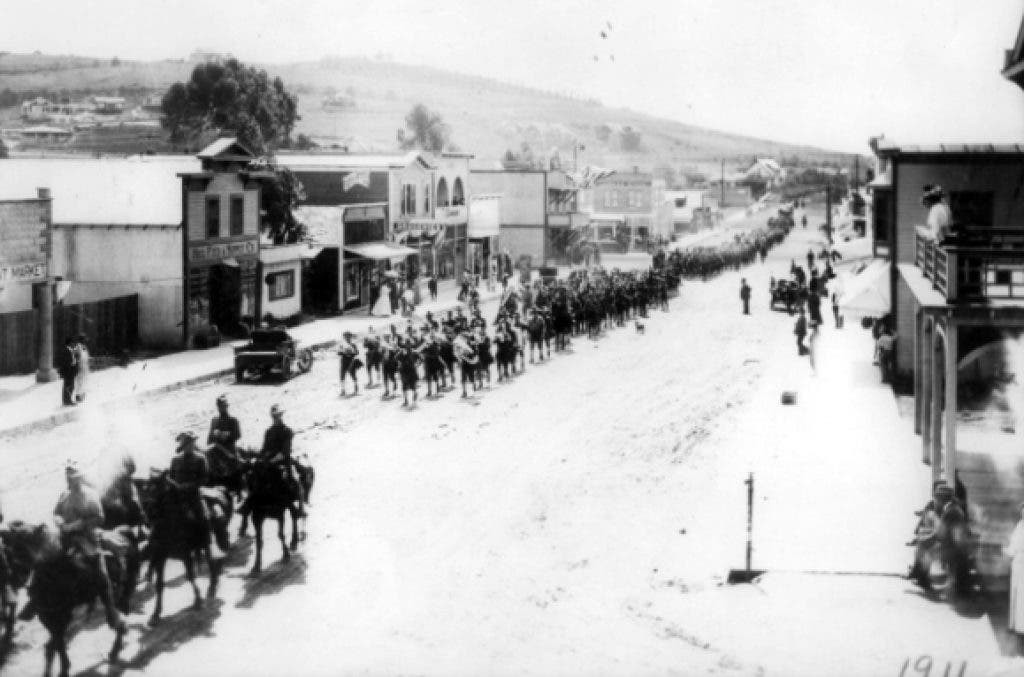


On the afternoon of April 4, 1911, some 1,200 U.S. Army troops marched down Lookout Avenue through the heart of La Mesa Springs—aiming to protect the county from the spillover of rebel combat in Mexico.
The town of 600-plus came out to see the “parade” of officers mounted on horses followed by the 8th and 30th Infantry Regiments on foot. The regimental bands led the way followed by the troopers, company by company, in formation. The troopers marched with rifles on shoulder, side arms and packs—ready for deployment into action.
Their destination was 8,000 acres just to the north of the newly named Grossmont Pass and Colony subdivisions (today’s Fletcher Hills).
Find out what's happening in La Mesa-Mount Helixfor free with the latest updates from Patch.
James Murray, financial partner of Col. Ed Fletcher in the Cuyamaca Water Co. and other investments, had bought the acreage with hopes of developing it. Murray had re-platted the original 1880s El Cajon Heights area, later known as the Alta Ranch, into a new tract called Murray Hill.
Fletcher—also an officer in the local San Diego militia, earning him the rank and lifelong title of colonel—had brokered the deal for leasing the Murray Hill land to the Army from April to June 1911, along with some of his and William Gross’ Grossmont property, for use in training maneuvers
Find out what's happening in La Mesa-Mount Helixfor free with the latest updates from Patch.
Part of the deal required the Army to put in water and sewer infrastructure to allow for a full regimental-scale encampment. Murray, Fletcher and Gross benefited from the improvements for their future developments.
The U.S. Army’s presence in La Mesa and the county was not a coincidence—or a planned visit.
U.S. Army Department of California commander Gen. Tasker Bliss had relocated the two regiments to San Diego from the Presidios in San Francisco and Monterey in early March.
Tasker’s orders were in response to the violent arrival of the Mexican Revolution to the border towns of northern Baja California in February 1911.
San Diegans—as with all American communities along the Mexico border—feared that the revolution and its violence would spill into the United States. Newspapers, such as the San Diego Union reported that “socialists, anarchists and rebels” were pouring across the line to join the revolution. Many feared that these “troublemakers” would return with similar anarchistic goals.
Fighting between the rebels, some of them Americans, and Mexican federal troops was reported in the streets of Tijuana. Over the next few months, armed combat would occur in local Mexican towns bordering California such as Tecate and Mexicali.
Other than local Army and Navy militia units, San Diego’s only permanent Army troops were the coastal artillery companies at Fort Rosecrans on Point Loma. These units were quickly assigned as support for the minimal number of U.S. Customs Agents whose previous focus was blocking cattle smugglers and Chinese immigrants from entering the country through Mexico (The Chinese Exclusion Act of 1884 restricted entrance.)
Bliss quickly arranged for space on the Point Loma military reservation to accommodate the two relocated regiments in a new facility named “Camp San Diego.” The suburban communities of Point Loma and Loma Portal were not conducive to large-scale military training, however.
These soldiers needed experience dealing with the rough and rugged mountainous backcountry borderlands of San Diego County and the Imperial County desert.
In stepped Col. Ed Fletcher with the offer of Murray Hill.
His ingenuity was noted in a March 18, 1911, editorial in the El Cajon Valley News that proclaimed “Hats off to Col. Ed Fletcher” for arranging the cooperative agreement that would protect East County’s communities and property.
Within a week of the announcement, an advance troop of Army construction workers arrived. Installing a new railroad siding at the recently renamed Grossmont Station of the San Diego and Cuyamaca Eastern Railroad (near the current entrance to Grossmont High School), the Army quickly shipped materials and equipment to the site.
New water pipes and extensions of telephone and telegraph lines from the station to the previous undeveloped property were quickly installed. On March 23, 1911, the San Diego Union reported that the camp was deemed ready to accept the regiments.
The Union reported that the soldiers spent their last week at Camp San Diego enjoying the mild climate as the “precipitous slopes of the Grossmont area” would require much work and “harden them” to the challenges that may await them in protection of the border.
On April 3, Gen. Bliss and his aide Lt. Arthur Pollian rode out the 19-mile route on horseback from Point Loma to “Grossmont Camp.” They joined the two companies of advance troops who were to prepare the provisional camp for the full regiments’ arrival and establish Gen. Bliss’ brigade headquarters at the site.
Bliss confirmed the route and approved the regiment’s move for the next day. The march from Point Loma led around the bay and up to Banker’s Hill, traveling east along Kalmia Street to Fifth Avenue, then turned north up to University Avenue.
From there the troops marched to the Normal School (later SDSU) at its Park Avenue intersection with El Cajon Avenue before following that official county road east through East San Diego, La Mesa Heights, La Mesa Springs and up the grade to Grossmont and Murray Hill.
At 7 a.m. April 4, troops of the 8th and 30th Infantry began their 19-mile march. The troops were on the road for more than nine hours, stopping only for lunch before arriving at their provisional camp after 4 p.m.
Here they would spend nearly a month in training maneuvers conducted amongst themselves—and with an enterprising, youthful and unexpected adversary.
Bliss Army Part 2: Young Scouts Outmaneuver Regulars at Grossmont Camp