Arts & Entertainment
A Look At The Modern Garden - Through the Looking Glass
The Tranquil Gardener takes frequent, close-up looks at the plots he tends. Even he is surprised at what he finds.
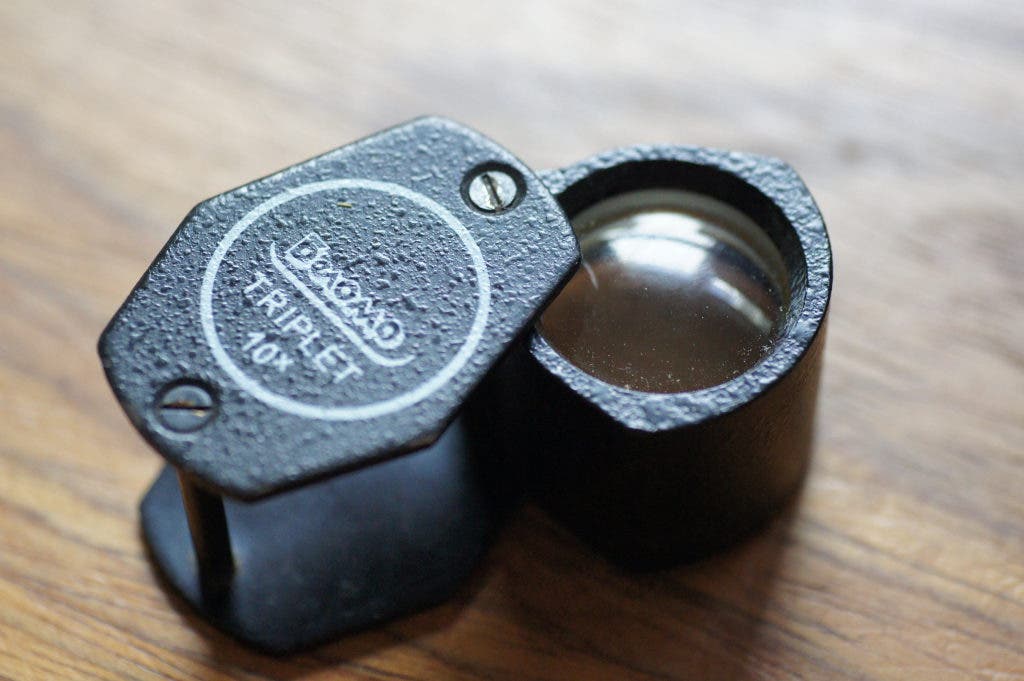
Among my essential gardening tools is a pocket magnifying lens. I bought my first one 30 years ago for the legendary Stew Winchester's plant ID course at DVC. In class I used it to look at the inner parts of flowers, stellate hairs on leaves, tiny plants like liverworts, ferns, and lichens, and tinier insects like aphids and mites. In between botanical scannings, I looked at my own craggy cuticles, rugged fingerprints, and jagged scratches on my hands. Though a bit of curved glass, I climbed onto a rarely seen strand of the complex web of existence.
Recently one of my clients asked me to diagnose a problem with her blackberries. The individual drupelets were ripening irregularly. The literature suggested that the problem could be redberry mites. These mites are so small that they can be seen only with a powerful lens. I took a 10x look. The blackberry drupelets were like big shiny red and black pillows. On these pillows I could see chunks of dust and sheets of organic matter and several large desiccated insect bodies. I spotted a few mites moving around that appeared to be predatory mites perhaps looking for some minute redberry mites to feast upon. I realized that every perfect-looking berry I'd ever plucked from the vine and popped into my mouth had tempted me only because I couldn't see what I was eating. In my life as a gardener I've eaten so many berries directly from the garden I must have consumed thousands of insect carcasses, pounds of dust and debris, and countless mites. As Walt Whitman wrote, “I contain multitudes."
There are those for whom the idea of eating insects is repulsive. They'd rather their fruits and vegetables were sprayed with chemicals than take the chance of consuming an unseen critter. I once worked at a tomato cannery where it was said that ketchup was graded by the number of insect fragments that could be seen under a microscope. While that no longer seems to be the case with ketchup, tomato paste and pizza sauce can contain as many as 30 fruit fly eggs or a couple of maggots per 100 grams. Insects are everywhere. Vegans would do well to avoid lenses.
Find out what's happening in Lamorindafor free with the latest updates from Patch.
I find the lens most useful these days to identify pests, to gauge the size and extent of an insect infestation and whether treatments have been effective, and to look for evidence of parasitism in colonies of aphids and scale. But sometimes I just like to explore, to get an ant's eye view of things. Just to take a close look at a tablespoon of garden soil is to realize there's an entire universe of living things under our feet.
If you plan on growing winter vegetables from seed, this is the time to sow them. In six weeks, they'll be ready for transplanting. The soil will still be warm and winter rains won't be far off. Asian vegetables grow especially fast and well in the fall. Gai lon, mizuna, bok choy, tatsoi, hon tsai tai, and all the big beautiful overwintering radishes can be started now. Kitazawa Seed Co in Oakland has a dazzling assortment. Seeds can be ordered online at http://www.kitazawaseed.com/index.html
Find out what's happening in Lamorindafor free with the latest updates from Patch.
Spring-flowering bulbs are starting to show up in the nurseries but you can find much more variety elsewhere. One mail-order source I highly recommend is McClure and Zimmerman, on the web at http://www.mzbulb.com/. Along with top-quality bulbs of the usual suspects - tulips, iris, daffodil, ranunculus - they offer crocus sativus for growing your own saffron and several unusual varieties of wild and heirloom tulips and daffodils. I've grown their collection of wild Mediterranean tulips and several of their species and wild daffodils. I found them all fascinating, tough but lovely and delicate. One caveat: they're scentless and short and often bloom for just a brief time. I'd suggest either planting masses of them or in a raised area where they might be closer to the eye and not be swallowed up by their bigger neighbors.
That's it for now, keep gardening!