Health & Fitness
Lamorindans Munching On Acorns? Not As Nutty As It Sounds...
Acorns make good eating as soon as you know how to wash away the tannins.

“Manna from heaven” in Lamorinda means it’s acorn season, at least that’s the way I think of it. As the acorns start to ripen I start racing the squirrels to gather my baskets.
Curious people stop and ask, “What are you going to do with those?” I smile and say, “Eat ‘em!”
They often look confused, sometimes horrified. “Eat them? You can eat them?”
It’s actually kind of a funny question, seeing as local residents of these parts ate them for centuries. As a matter of fact, they were their main food staple. Seems pretty silly that now people often consider them poisonous or harmful.
Now, granted they’re not simple to eat. You can’t just crack them open and toss them into your mouth. You’ve got to do a little more work than that, but it really is just a little bit more work. I’ve been experimenting with different ways to process them for the past six years and have hit upon some fairly simple ways to go from dropped seeds on the ground to food in my mouth in a matter of minutes.
I’ve taught classes to adults who were interested in learning in case the world was ending and they needed to survive in the forest. That’s an interesting concept in itself, with a lot of hope built in that the forests would still be there to support us, but that’s another story. And I’ve taught fourth graders who are studying California history because it is so much easier to learn history if you can eat it.
To eat an acorn you need to crack it, grind it, and then leach it. It’s both that simple and that complicated.
Cracking is easy enough with a nut cracker or a rock and a log. The grinding can be simple mortar and pestle grinding, a hand crank grist, or a food processor. They need to be ground to at least a coarse meal, if not a fine powder. The finer the better because it makes the leaching more effective.
They need to be leached because they’re full of tannins, or tanic acid, which is the same stuff that’s in the tea leaves or coffee grounds after you’ve made your tea or coffee. It’s bitter, awful tasting stuff that will make your stomach hurt (not to mention your tongue!) if you eat it straight. Without leaching acorns taste really horrible.
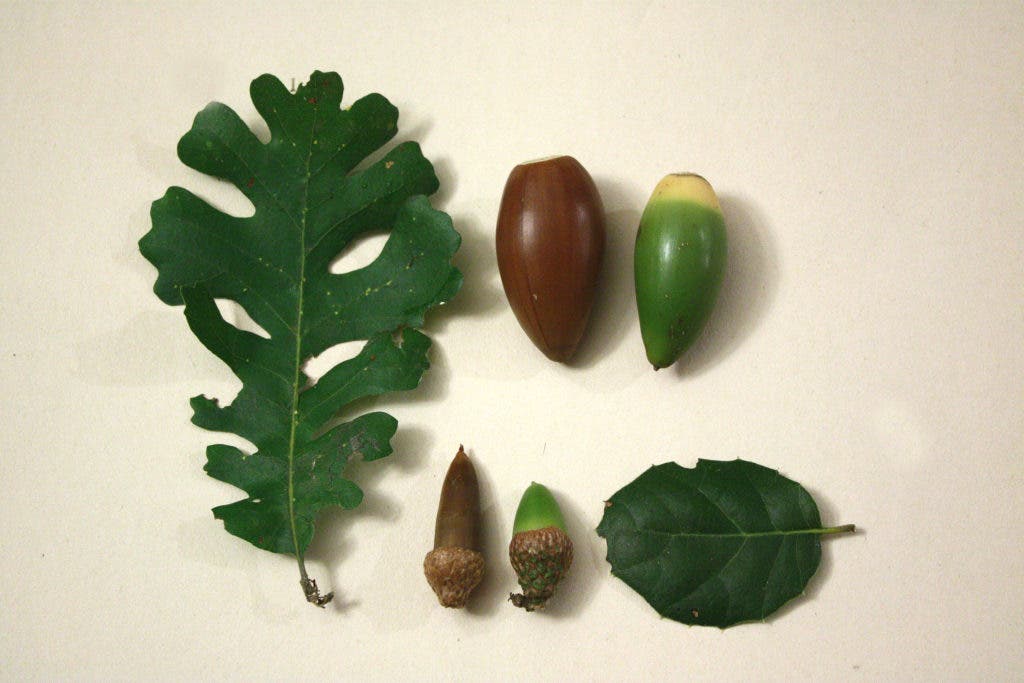
The acorns with the least amount of tannins, which consequently require the least amount of leaching, are the White Oak or Valley Oak acorns. Those acorns also happen to be the largest of all the acorns in the world. The natural competition for those acorns is pretty stiff. Everything wants to eat them from moth larvae to turkey and deer. Around here, the more abundant Coast Live Oak, the one with the rounded and spiky leaves, drops smaller acorns and has much more tannins than the Valley Oak.
The huge Valley Oak acorns are packed with nutrition protein, carbohydrates, fats, vitamins and minerals. They’re like Nature’s equivalent of a PowerBar.
In order to make all that goodness actually tasty, you’ve got to get it under running water. Native people used to put it in the creek, when the water wasn’t polluted with runoff from who knows what and they had all the time in the world to wait for their food to be ready to eat. Those of us who would rather not wait a few days to eat, or are in a hurry to teach anxious fourth graders, or survivalist adults, have to lean a little more heavily on technology.
I found that when the water is heated it leaches the acorns more quickly. After putting acorns in a coffee filter I ran a coffee pot as though I were making coffee, but threw out the tannin filled water and kept the acorn grounds in the filter and ran it again two more times. It seemed to take just three, sometimes four, runs through with the coffee pot before I had acorn mush that tasted a lot like hot GrapeNuts or Oatmeal. This seemed like a good amount for a sample, but when I’m trying to actually feed people other methods are called for.
My biggest collander, lined with cheese cloth, made a pretty good stand in for the coffee pot. I heated pots of water and slowly poured it over the ground up acorns. Again, it took three or four pours through before I had something that didn’t hurt my mouth, and tasted pretty good actually.
I’ve made acorn muffins, pancakes, and bread. All tasted remarkably good. After seeing the process my survivalist students seemed a bit disappointed, “That’s it? That’s all you have to do to make them taste so good? I thought it was going to be hard!” I felt like they thought I had tricked them into taking the class, but I was clear at the start, “It’s easy!” Funny how no one believes that until they’re eating one of my muffins.