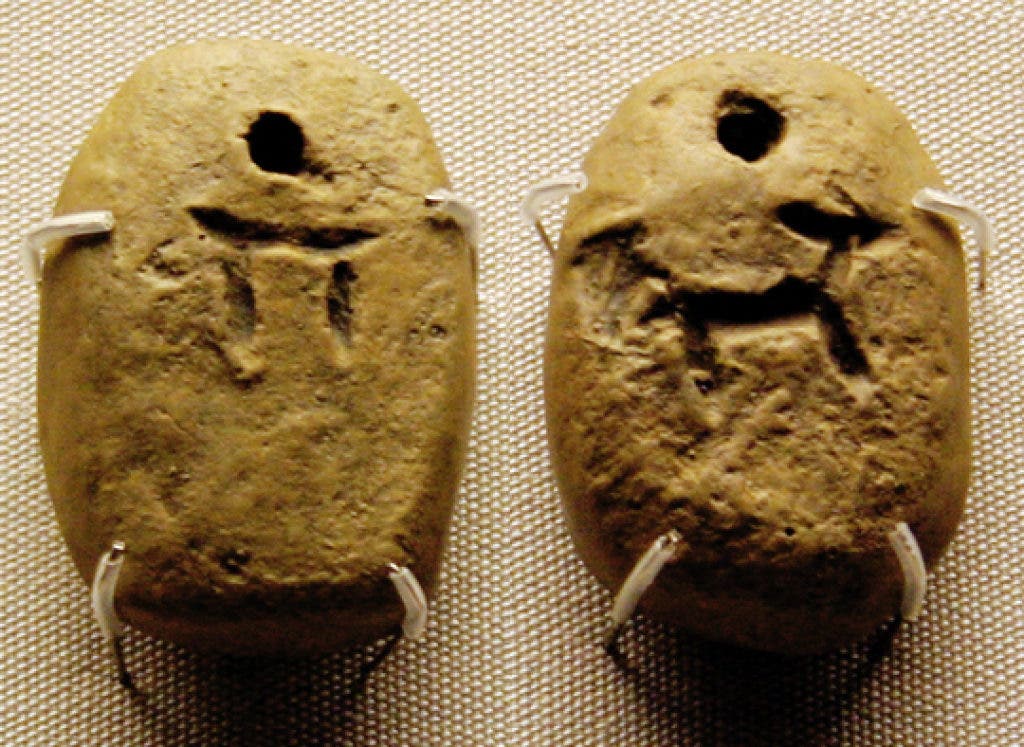
It’s quite possible that my interest in language began with the World Book Encyclopedia volumes that my sister and I pored over as young readers. Each volume begins with a brief exploration of the letter’s progression from a pictograph to a Roman letter, with explanations of meaning and usage. I was always intrigued by the five little drawings of the letters, labeled Egyptian, Sinai, Phoenician, Greek, and Roman; the first four of these mysterious “alphabets” were certainly a long way from the one we learned in kindergarten.
I still have the encyclopedia, so I pulled out the volume for A and read that “the first known alphabet” dates from about 1850 B.C. Now my faith in the World Book has been tested, because earlier this month, scholars at the University of Chicago completed work on a dictionary that has been 90 years in the making. The 21-volume work deciphers the language of ancient Mesopotamia and its Babylonian and Assyrian dialects, spoken as far back at the 24th century B.C.
The New York Times describes it as the language of Hammurabi and Nebuchadnezzar, and “probably the first writing system anywhere”. Cuneiform writing, deciphered in this new dictionary, was invented in the fourth millennium B.C. by the earlier Sumerians in Mesopotamia. (Experts may differ on this; linguist Geoffrey Nunberg puts the earliest cuneiform markings representing words at 3100 B.C., and the earliest instances of hieroglyphic writing in Egypt at 3000 B.C.)
Find out what's happening in Lamorindafor free with the latest updates from Patch.
Like the letters in my World Book volumes, cuneiform evolved from an earlier form of communication – ideograms, or marks made on clay tokens to record data such as commercial transactions. Going way, way back, some scholars maintain that cave paintings represent the first written form of communication.
At a cost of $1,995 for the full set, I won’t be adding the Chicago Assyrian Dictionary to my bookshelf. Not to worry; we word-freaks have lots of options for reading about language and words. For example, you could check out the The First Dictionary of Slang, published in the 17th century and reissued this past October. Or you could read about the history of writing implements, or peruse a visual history of the same topic. For an accessible approach to the history of our primary language, Bill Bryson has written The Mother Tongue: English and How It Got That Way.
Find out what's happening in Lamorindafor free with the latest updates from Patch.
Some innovators have come up with unusual approaches to explaining words; for example, there's a dictionary that uses video to define and provide context for words. In another realm, medical students at UCSF are helping to bridge the language divide between doctors and patients through a free mobile translation app they invented, which “allows health care providers to play medical history questions and instructions out loud, so far in five languages.”
Word-lover websites abound; one I like, which pointed me to a couple of these references, is the Wordnik blog.
A final tip of the hat: I learned to spell "encyclopedia" from the Mickey Mouse Club, long before Sesame Street’s debut. Anyone else remember that little song?