Neighbor News
Get Ready for the Unexpected With a Disaster “Go Bag”
— Don't think you need an emergency kit? Think again, say families who needed one.
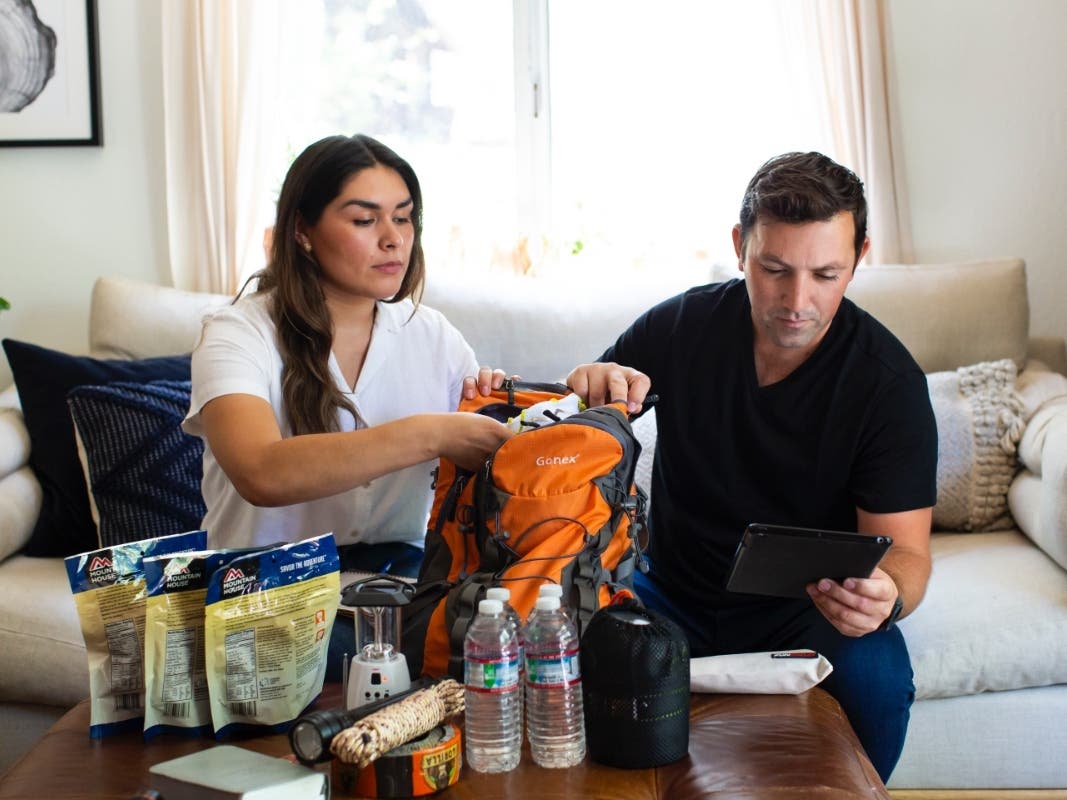
Jolted awake at 3 a.m. by a neighbor’s urgent knocking, Aaron and Jacqueline Pate were greeted by a horrifying sight — flames encroached on their neighborhood amid thick smoke and ash from the wildfire that had been miles away when they went to bed.
"We grabbed the ‘go bags,’ the kids, the dog and got in our cars and left,” said Aaron Pate of the fast-moving Woolsey fire that burned to within 100 feet of their Westlake Village, California home in 2018.
It was the deadliest and most destructive wildfire season the state has on record, but it’s been followed by record-setting hurricanes, winter storms, and other extreme and abnormal weather events in one place after another. Experts expect that such natural disasters will only become more frequent.
Find out what's happening in Larkspur-Corte Maderafor free with the latest updates from Patch.
Newlyweds Nate Lara and his wife, Jessica Lara, have lived in Marin County, the northwestern part of the San Francisco Bay Area for nearly a year. Nate Lara, who lived most of his life in Tiburon, is no stranger to the area. “The devastation caused by the wildfires in Paradise, California, really made an impact on us,” Jessica Lara said. “Although we weren’t directly impacted, it made us eager to have complete ‘go bags’ and a real family plan.”
“Growing up in the Bay Area, we’ve always been reminded to be ready for any seismic activity, and as of late, forest fires seem to have become the new normal. But even knowing that, it still seemed daunting to actually prepare a ‘go bag’ for any type of disaster. That all changed when we made use of the information on the website, jw.org. The entire process became effortless. JW.ORG really provided us with the most practical items to include in our ‘go bags’ and gave us simple, direct, and helpful recommendations,” Jessica Lara said.
Find out what's happening in Larkspur-Corte Maderafor free with the latest updates from Patch.
“Having a personal preparedness plan increases your chances of staying safe,” according to a training program from Columbia University’s National Center for Disaster Preparedness. Having supplies ready to go, it says, is one of the steps that provides “resilience to all types of emergencies.”
The Federal Emergency Management Agency (FEMA) recommends collecting what everyone in the household needs to survive for several days along with important documents into an easy-to-carry kit, often called a “go bag.”
The Pate family saw the value of these preparations. “Because we had ‘go bags,’ we weren’t running around trying to pack things at the last minute,” Jacqueline Pate said. “We had the time we needed to comfort our kids and get everyone safely into the car.”
The Pates credited the disaster-preparedness help they received as Jehovah’s Witnesses, both through periodic reminders at their congregation meetings and from tips for putting together “go bags” on the organization’s website, www.jw.org.
"Life is precious, so we encourage all to heed the Bible’s advice to take practical steps to protect ourselves from danger,” said Robert Hendriks III, spokesman for Jehovah’s Witnesses in the United States.
Just three miles east of the Pate’s residence, their fellow congregants Joseph and Chelsea San Roman also fled the Woolsey fire with their “go bags.” Although their home burned to the ground, Chelsea said they didn't even consider staying behind in hopes of fighting the flames. “There was no way we were going to risk our safety for material things,” she said. “We were ready to leave it all behind.”
“Go bags” also have proven useful in the opposite circumstances as “stay bags.”
When February’s Winter Storm Uri left millions of Texans without heat, electricity, and running water, many “go bags” there saw their first-ever use outside of hurricane season.
Northwest Houston residents Dan and Rhiannon Muey’s advance preparation enabled them to shelter in place for days, even as many in their area braved treacherous road conditions to scour barren store shelves for supplies.
“Our hurricane ‘go bags’ became our winter storm ‘stay bags,’ but we were so glad we had them,” Dan Muey said. “Instead of waiting in lines for hours to get basics like drinking water, we already had what we needed.”
Emergency kits provide not just practical but emotional value as well.
Lake Charles, Louisiana, residents Matthew and Daisy Gauthier regularly sit down with daughters Madison, 17, and Sadie, 15, to review and replenish the family’s emergency supplies. “We don’t look at it as a chore,” Matthew Gauthier said. “It’s quality time we can spend together. We look over jw.org's list of suggested items, and if we’re missing something, we add it."
The Gauthier’s efforts paid off last August, relieving stress as they prepared to evacuate ahead of Hurricane Laura.
“If we hadn’t already packed our ‘go bags,’ I would’ve been scrambling,” Daisy Gauthier said.
Being prepared meant the Gauthier family could leave the area before the evacuation order was issued. “Having our ‘go bags’ allowed us to act faster,” Matthew Gauthier said. “If we had to start from scratch and say, ‘OK, we need this, we need that,’ it would’ve slowed us down a lot.”
Two days later, Laura made landfall as a deadly Category 4 storm with the strongest hurricane winds recorded in Louisiana in over 150 years.
The Rinis family, also from Lake Charles, returned after the storm to find that their “go bags” had unexpected post-storm practicality.
“Our neighborhood looked like a scene from a disaster movie,” said Cullen Rinis, 13, of the splintered trees and mangled electrical towers the family passed on their drive home.
The Rinis’ property sustained only minor damage. Still, with no power or water and days of cleanup ahead, the family made immediate use of their emergency supply kit. “Within the first 36 hours, we used over half of our ‘go bags’ contents: cash for gas, a flashlight, duct tape, matches, bug spray, water, extra clothes, batteries, and so many other things,” Ashley Rinis said.
Today, these “ready bags,” as the Rinis family now calls them, occupy a place of honor in their home: their own shelf by the door. To anyone who has not yet assembled a “go bag,” 10-year-old Arden Rinis said: “You might not think you need one, but trust me—you really do!”
Disaster-preparedness suggestions and tips for putting together a “go bag” are available from FEMA at ready.gov and from Jehovah’s Witnesses at https://www.jw.org/en/library/magazines/awake-no5-2017-october/disaster-....