Community Corner
6 Wayward California Sea Lions We Love And Why We Should Be Worried For Them
What to do if you discover a pinniped, and the likely reasons behind the mass sea lion strandings along the California coastline.


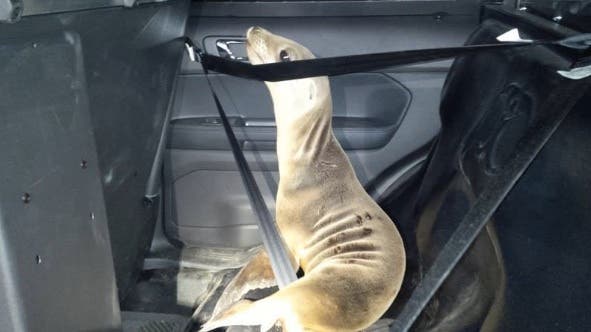
Bay Area police officers recently comforted a distressed baby sea lion discovered near a San Francisco stairwell. The adorable pinniped reportedly tried to warm itself next to the officers while they waited for marine mammal experts to collect the pup. Sadly, this is not the first case of a sea lion ending up far from its proper habitat.
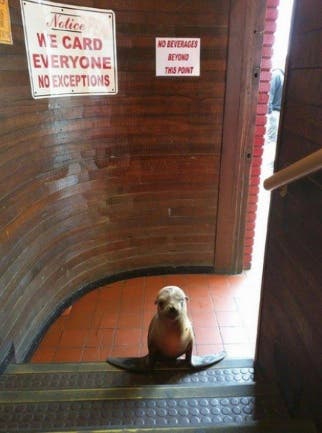
Pinnipeds have increasingly been found throughout the state in some very unexpected areas. A year ago, a young sea lion was discovered in a Newport Beach bar. No mackerel martinis for this thirsty little pinniped, though. Experts say he was probably looking for food.
Find out what's happening in Livermorefor free with the latest updates from Patch.
Photo of beach ball used with permission, courtesy Mike Glenn’s Save Newport Facebook page.
In Northern California last year, Mendocino County Sheriff’s deputies spotted a small animal moving slowly down a road and stopped to help. Turns out, it was a wayward sea lion pup. They were concerned he would be hit by a passing car in the dark, especially with dense fog in the area, so they gave him a lift. He made bail and was returned to the ocean.
Find out what's happening in Livermorefor free with the latest updates from Patch.
On the opposite end of the state, in early March of 2015, although it was not discovered on terra firma, a sea lion pup decided to enjoy some surfing in La Jolla in March of 2015.
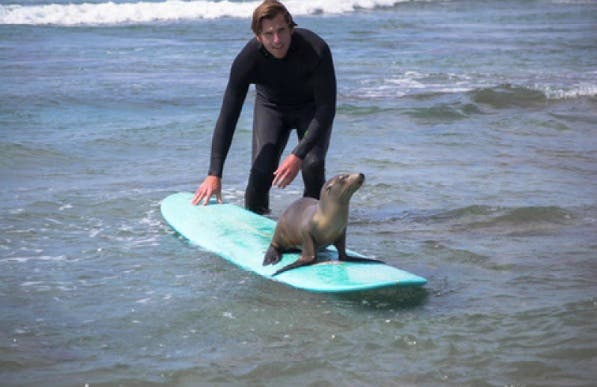
Another took a quick snooze during an impromptu sleepover on a boat in San Diego, and months later, a California sea lion was found trying to cross a Northern California road miles away from the Bay.
Although finding these curious creatures in unexpected places ranks high on the adorable scale, the sea lion crisis along the California coast is real and distressing. The number of rescued animals in 2015 topped 1,200, according to experts with the National Oceanic and Atmospheric Administration.
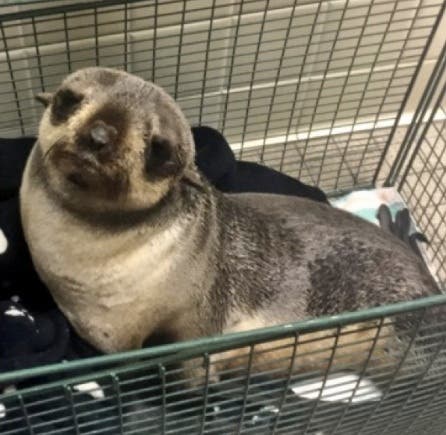
Photos courtesy Fremont Police
Officials with the The Marine Mammal Center in Sausalito say 2016 has been the fourth consecutive year of mass sea lion strandings along the California coast. So far, the Center has rescued more than 300 sea lions, with a majority of those being young pups or yearlings.
“Experts at NOAA Fisheries call it an 'unusual mortality event',” Marine Mammal Center spokesperson Lucy-Claire Saunders said. "Although there’s still much to learn about the causes of this unusual mortality event for our California sea lions, experts believe that lack of food is a pivotal factor.
"For more than a year now, unusually warm waters have been lingering off the coast of California, causing temperature-sensitive fish to move northward or offshore to cooler waters.”
The past few years, the stranding of sea lion pups by their mothers peaked in March and April.
Some pups that aren’t abandoned are striking out on their own to find food. Sea lion mothers typically leave their pups on the Channel Islands while they find food, as far north as Monterey Bay, returning in about two days to feed their pups. But sea lions are taking longer to find adequate food supplies, leaving the pups for up to five days. Some returning mothers aren’t able to find their pups because they’ve left.
Wendy Hawkins, the founder of HB Marine Mammal Safety Team, told Patch in a previously posted article the most important thing to remember about sea lions is they are usually in distress and they can bite. Hawkins urges anyone who finds a sea lion to call the proper marine mammal experts for help.
Get Free Local News Alerts for Your Town - Right to Your Inbox
“We are here to educate people,” Hawkins said. “We want to keep the sea lion safe from people and people safe from the sea lions.”
Hawkins says the babies generally nurse for a year to 18 months and cannot eat fish.
“Don’t feed them, don’t put water on them, don’t touch them,” Hawkins said. “They are already in distress and it is very traumatizing to them. People can be fined $10,000 for disturbing a sea lion.”
If you see a sea lion or other marine mammal in distress, phone the nearest marine mammal rescue center:
- The Pacific Marine Mammal Center, Laguna Beach, (949) 494-3050
- The Marine Mammal Care Center, San Pedro, (800) 399-4253
- California Wildlife Center, Malibu, (310) 458-9453
- Channel Islands Marine & Wildlife Institute, Ventura, (805) 5670-1505
- Northern California, The Marine Mammal Center (415) 289-SEAL
Get more local news delivered straight to your inbox. Sign up for free Patch newsletters and alerts.