Schools
Lawrence Livermore National Laboratory Scientists Hangout, Via Google, With Granada and Livermore High School Students
One of the scientists is a Livermore High School and Las Positas College graduate.

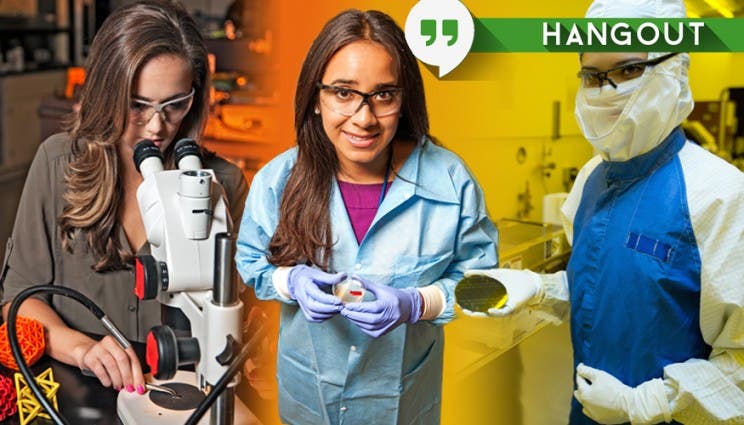
Photo: Lawrence Livermore National Laboratory engineers (from left) Julie Jackson, Monica Moya and Vanessa Tolosa spoke with students at Livermore and Granada high schools about their work in 3D printing, biotechnology and neural technology.
--
LIVERMORE, CA - What better way to get excited about science?
Lawrence Livermore National Laboratory (LLNL) scientists hosted a Google Hangout last week with students at both Livermore High School and Granada High School. The Google Hangout allowed LLNL Engineers to virtually enter the classroom using video conferencing.
Find out what's happening in Livermorefor free with the latest updates from Patch.
The Engineers broadcast from their laboratories. Students were able to speak directly to the scientists and ask about their research and career trajectory.
One of the scientists, Julie Jackson, is an Livermore High School alumna who spent three years at Las Positas College before transferring to U.C. Davis for a degree in bioengineering. She shared her professional career pathway with students. She advised students to be collaborative, take many classes, and don’t limit themselves to one label, as in “Don’t just be a biologist”. The program was organized as part of Science and Engineering Month, and held in honor of Engineer’s Week.
Find out what's happening in Livermorefor free with the latest updates from Patch.
Participating scientists included:
Monica Moya is a research engineer in the Lab’s Center for Micro and Nano Technology, Materials Engineering Division. Her focus currently is on the 3D printing of living cells to formulate working blood vessels and the human vascular system. The work is tied in with the iCHIP program, the in-vitro chip-based human investigational platform, which aims at reproducing the systems of the human body (i.e. the brain, heart, blood-brain barrier etc.) on a computer chip. The technology would be used for testing of new pharmaceuticals and chemicals to see how they react with the body without the need for human subjects.
Vanessa Tolosa is a principal investigator in the Center for Micro and Nano Technology, Materials Engineering Division. Her research has included work on neural interfaces (implantable devices in the brain), deep brain stimulation (DBS), and advanced prosthetics for the deaf and blind. The neural (brain) implants are designed to help veterans and others suffering from post-traumatic stress disorder (PTSD), traumatic brain injury (TBI), epilepsy, and Alzheimer’s disease by encoding and decoding electrical signals in the brain and “bypassing” damaged parts of the brain to promote normal functioning. Retinal and auditory implants have already successfully been used to restore sight and hearing in human patients and in animal studies.
Julie Jackson received her BS in mechanical engineering from UC Davis in 2013. Julie graduated from Livermore High School in 2008 and went to Las Positas Community College for 3 years before transferring to UC Davis. She started as a summer intern at LLNL in 2012. In 2014, she was hired as a staff engineer working in the Center for Engineered Materials and Manufacturing. Her research interests are in 3D printing, metamaterials, and mechanics of materials. Julie is currently pursuing a MS degree from UC Davis in Mechanical and Aeronautical Engineering as part of LLNL’s “Distance Learning Program,” which allows employees to complete graduate engineering and computer science programs over the internet.
Get more local news delivered straight to your inbox. Sign up for free Patch newsletters and alerts.