Health & Fitness
CA Has The Lowest Coronavirus Case Rate In The Nation
After weathering another summertime surge of COVID-19, the most populous state returned to having the lowest case rate in the U.S.


CALIFORNIA — While California endured yet another dire wave of coronavirus over the summer, the state returned to having the lowest case rate in the final weeks of the season.
Despite the presence of the highly contagious delta variant, which became the dominant strain in California just months ago, coronavirus infections began plummeting in recent weeks as vaccinations rose among residents.
The Golden State has reported some 110 new cases over seven days per 100,000 people, a 42 percent drop from the previous week, according to data from the Centers for Disease Control and Prevention.
Find out what's happening in Los Angelesfor free with the latest updates from Patch.
The state's positivity was 3 percent on Monday, down from 5.2 percent on July 23.
As of Monday, 82.8 percent of eligible Californians had received at least one dose of the coronavirus vaccine. The news comes as the state prepares to roll out booster shots for immunocompromised residents.
Find out what's happening in Los Angelesfor free with the latest updates from Patch.
But state officials are still urging unvaccinated residents to become inoculated against COVID-19 as more vaccine mandates take effect this week for business sectors in various counties across the state.
In Los Angeles County, a new county Health Officer Order issued Friday will require proof of vaccination for all customers and employees in public indoor settings. All patrons and employees will need at least one dose of vaccine by Oct. 7, and a second dose by Nov. 4. The order will recommend, but not require, vaccinations for people who visit indoor restaurants.
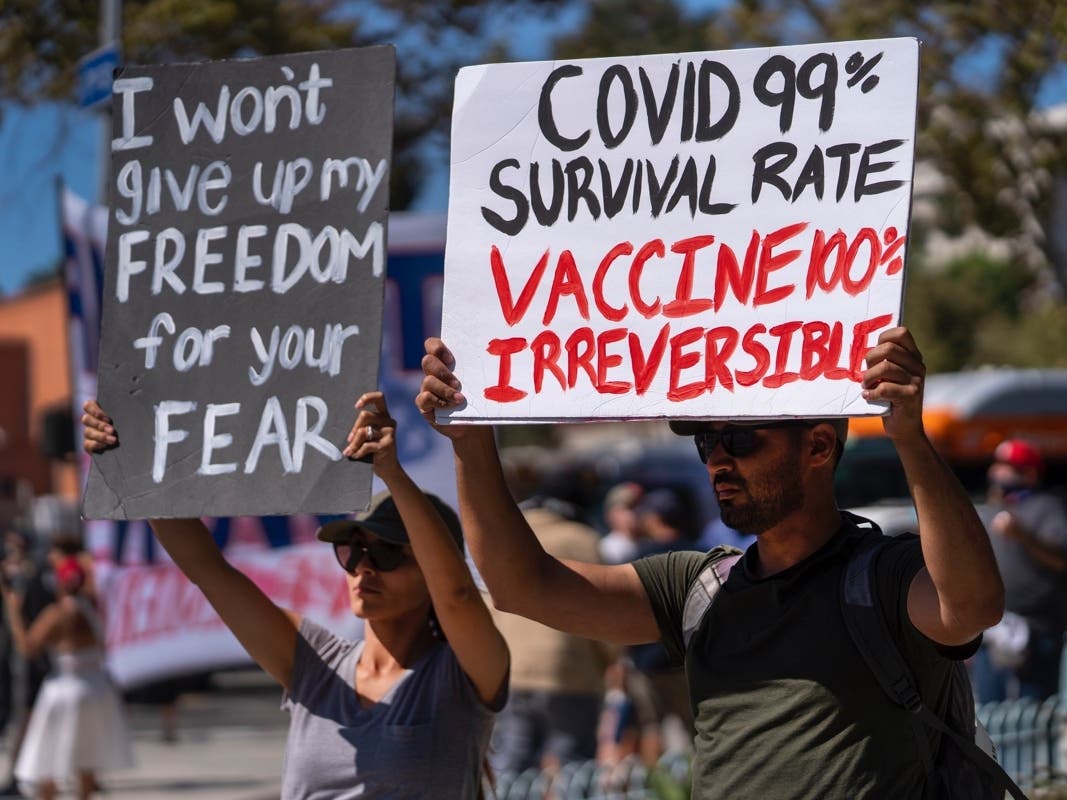
Hundreds of people against coronavirus vaccines gathered in downtown Los Angeles for a "World Wide Rally for Freedom" over the weekend, rallying against such mandates. Many carried American flags and toted signs that read "COVID 1984," "I Am Not A Lab Rat" and "Forced Penetrations Are Always Wrong," the Los Angeles Times reported.
"If you silence your voices, you are giving your power away to the authorities who pretend they have your best interest in mind," a woman told the crowd.
Local and state officials still maintain that vaccines are safe and necessary as they ramp up aggressive efforts to boost vaccination rates. Public health officials hope to stave off yet another fall-winter outbreak like the one that devastated California last year before vaccines were available. This summer, despite the prevalence of vaccines, the delta variant triggered a fourth wave of infections.
"We can't afford to be complacent with an average of 2,000 new cases and dozens of deaths each day. In order to be better prepared for the fall and winter, typically seasons when many viruses thrive, we need to immediately reduce COVID transmission," said Los Angeles Public Health Director Barbara Ferrer.
Mask mandates returned to the Golden State in mid-summer just weeks after they were lifted. Having to dig out masks again nearly two months after Californians were told to toss them aside was disappointing for many, to say the least.
"I think the one potential downside of mask mandates is: How does that impact the willingness of people to get vaccinated? If one of the reasons you were going to get vaccinated was you didn't have to wear a mask, and you take that reason away, then mask mandates are not a good thing," Dr. Timothy Brewer, a professor of infectious disease at the David Geffen School of Medicine at the University of California, Los Angeles, told Patch in a previous interview.
It remains unknown just when Golden Staters will be able to return to public settings without a mask again.
Although a surge of vaccinated Californians became ill with the virus this summer, it's the unvaccinated Californians as well as the amplifier of the highly transmissible delta variant that drove the summer surge, according to public health experts. Post-vaccination infections are officially recorded if a person tests positive for the coronavirus two weeks after receiving their final dose of Pfizer or Moderna or after getting the single-shot Johnson & Johnson vaccine.
For the week of Aug. 29 through Sept. 4, the average case rate among unvaccinated Californians age 16 or older was 71.03 per 100,000 per day. The average case rate among vaccinated Californians age 16 or older is significantly lower at 8.9 per 100,000 per day.
"The great majority of new cases are among unvaccinated individuals," officials said Monday. "The rate among the unvaccinated is 8 times the rate among the vaccinated."
Nearly 58 percent of California's nearly 40 million residents were fully vaccinated as of Monday, according to data from the Mayo Clinic. The state's coronavirus vaccination rate fell behind Washington, New Mexico, Maryland and New York.
"We are not the most vaccinated state," Dr. Kirsten Bibbins-Domingo, chair of UCSF’s Department of Epidemiology and Biostatistics, told the San Francisco Chronicle. "But we are also a state that has not completely abandoned the other mitigation methods."
NEW: Over 70% of Californians are vaccinated with at least one dose.
We now have the lowest COVID case rate in the nation.
Vaccines are how we end this pandemic.
— Gavin Newsom (@GavinNewsom) September 18, 2021
Get more local news delivered straight to your inbox. Sign up for free Patch newsletters and alerts.