Politics & Government
CA Primary Election Results: Bernie Sanders Wins Super Tuesday
Bernie Sanders won the biggest prize of the day, but Biden carried the momentum, prompting Michael Bloomberg to drop out.


LOS ANGELES, CA — As soon as the polls in California closed, Sen. Bernie Sanders was declared the winner.
According to Associated Press projections, Sanders was far enough ahead in early returns to be uncatchable in the Golden State. The big question is: can he get enough of the state’s trove of 415 delegates to turn back the momentum that former Vice President Joe Biden built up with a slew of wins in the South Tuesday. In the course of a day, Biden was propelled into frontrunner status. However, with California as his bulwark, Sanders is keeping this a two-man race.
According to several reports, voters were still in long lines at polling centers waiting to vote when the Associated Press called the winner. The Sanders campaign had filed a complaint in a bid to keep centers open for longer to accommodate the delays, according to the Los Angeles Times.
Find out what's happening in Los Angelesfor free with the latest updates from Patch.
In speeches to to their supporters Tuesday night, both candidates directed their fire at the opponent standing between them and the nomination.
“You cannot beat Trump with the same old, same old kind of politics,” Sanders told a gathering at his home state of Vermont, according to the New York Times.
Find out what's happening in Los Angelesfor free with the latest updates from Patch.
“People are talking about a revolution, we started a movement,” Biden told a crowd in Los Angeles while pointing out his strong performance among African Americans and Texas Latinos.
California is the biggest prize of Super Tuesday, and Sanders built his campaign around a big victory here. He's been building his ground operation in the Golden State since 2016 and spent more time campaigning here than any other candidate in the days leading up to the primary.
The nation watched closely to see if Sen. Bernie Sanders could run away with the primary or if the moderate wing of the party would unify around Biden. Biden stormed Super Tuesday, finishing first in at least eights states, according to early returns. Still, a commanding win in California may be enough to put Sanders back on top. It could be days before the final division of delegates is determined, however. With more than 70 percent of the precincts tallied Wednesday morning, three candidates appeared to be on track to meet the state's 15 percent threshold to earn a share of delegates: Sanders, Biden and former New York Mayor Michael Bloomberg. Sanders will walk away with, by far, the largest share of California delegates.
After a weak Super Tuesday showing, Bloomberg dropped out of the race Wednesday.
“I’ve always believed that defeating Donald Trump starts with uniting behind the candidate with the best shot to do it,” said Bloomberg, according to the Los Angeles Times. “After yesterday’s vote, it is clear that candidate is my friend and a great American, Joe Biden.”
Sen. Elizabeth Warren's campaign may also hang in the balance as she failed to win any states Tuesday.
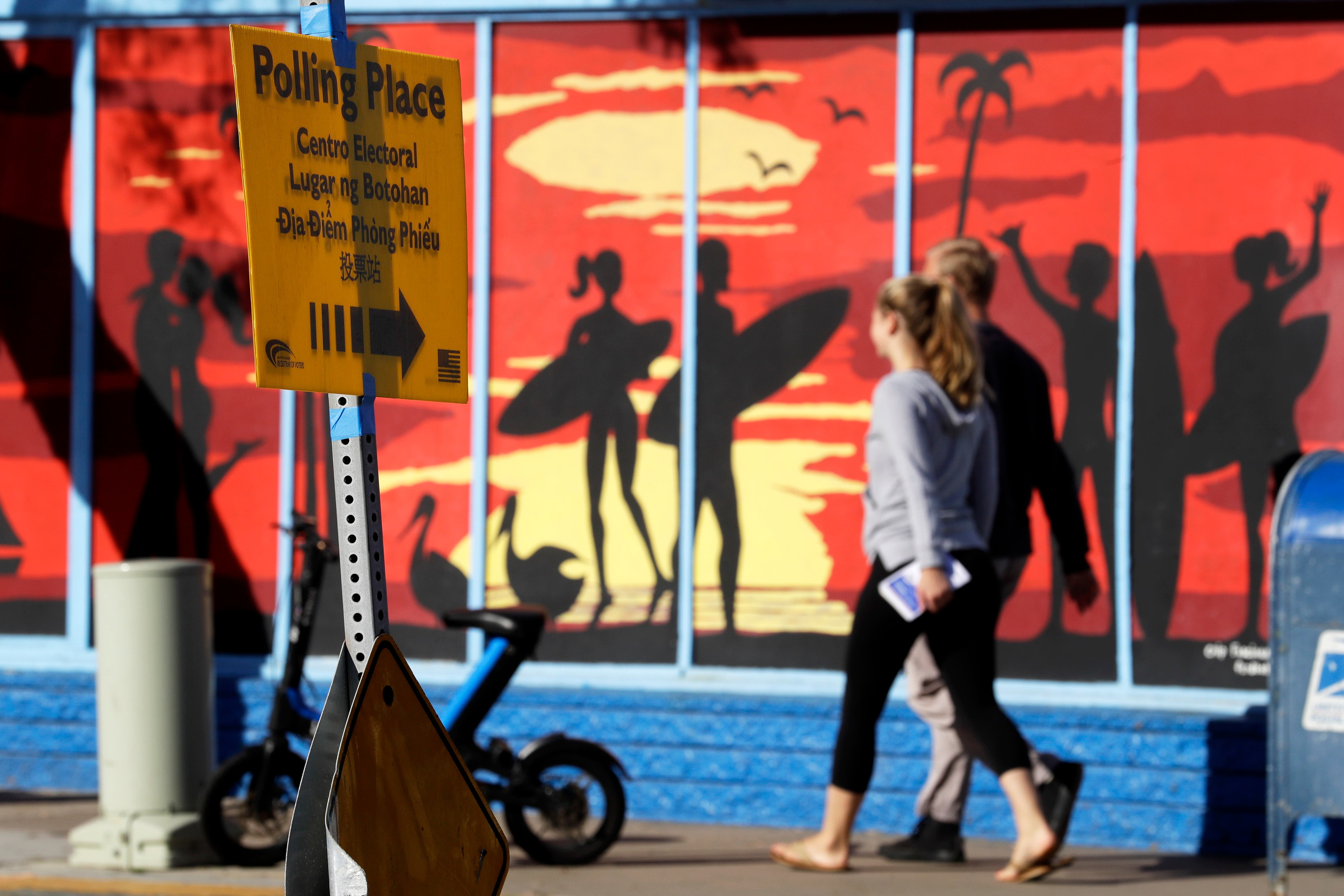
In California, there were some hiccups across the state as voters headed to the polls. Elections officials expect record turnout, and demand on the Secretary of State's website was so high, it crashed for hours election day. Long lines kept people waiting at voting centers, and residents arrived in droves at traditional polling places Tuesday only to find they weren't open this year as several major counties shifted to large voting centers.
SEE ALSO: Super Tuesday Nationwide Results: The South Goes Biden
As candidates drop out of the race, winnowing down the unwieldy field, it’s starting to look a lot like a tug of war for the soul of the Democratic Party. Is this the year the party shifts dramatically left with a liberal standard-bearer such as Sanders, or will a centrist prevail once again? And can the winner ultimately take down President Donald Trump?
“Everybody is a little humbled after 2016," said Fred Smoller, professor of political science at Chapman University. "In no way did I think the American people would choose Donald Trump to be the president.”
The Democratic establishment is deeply leery of having a self-described democratic socialist as the standard-bearer, Smoller said.
“They see it as a train to nowhere,” Smoller said. “We just don’t know. We keep voting for the centrist candidate … they don’t win.”
If Democrats are depending upon enthusiasm to take down Trump or to help the down-ballot candidates, there is work to be done to unify voters, Smoller said.
“If Sanders or Biden gets the nomination, they better pick someone younger or an African American — someone — to balance the ticket,” Smoller said.
Results will be updated here in real time. Refresh the page for the latest.
Change Is Coming
Heading into Super Tuesday, the polls had Sanders so far ahead in California that anything other than a Sanders victory would have been considered a major upset. He was largely expected to win at least half of the state’s 415 delegates.
But the national playing field leveled out some these past few days. No longer is the moderate wing of the party cannibalized by its own fractious field of contenders. Three moderate candidates dropped out since Saturday: Pete Buttigieg, the third-runner up in delegates heading into Super Tuesday, exited the race Sunday, as did billionaire Tom Steyer; and Sen. Amy Klobuchar ended her campaign Monday. Both Buttigieg and Klobuchar promptly endorsed Biden.
Bloomberg, was Biden’s remaining competition for the moderate vote. He faced enormous pressure to drop out this week before he even had his first contest, having skipped the early voting states in favor of a Super Tuesday campaign blitz. Bloomberg spent in excess of $538 million in advertising and field operations, banking on a strong Super Tuesday showing, according to Bloomberg News.
In a sense, it paid off. Bloomberg's performance in California was strong. Early returns had him in third place, nipping at Biden's heels. In many pockets of the state, he surpassed the state's 15 percent threshold, syphoning off delegates from Biden and Sanders. But having made the case that a moderate is needed to beat Trump and that he's the only moderate who can beat Sanders, he was left in a bad spot. Biden proved himself able to beat Sanders in most states voting Tuesday.
Super Tuesday's results are bound to reshape the primary. Elections were held in Alabama, American Samoa, Arkansas, California, Colorado, Maine, Massachusetts, Minnesota, North Carolina, Oklahoma, Tennessee, Texas, Utah, Vermont, and Virginia. In all, 1,357 pledged delegates will be awarded from Super Tuesday — 34 percent of the total. However, the final results could take weeks to be tallied and certified.
What About Warren?
It wasn’t so many months ago that Warren led California in the polls. Warren, Biden and Sanders are the only three candidates left who have enjoyed front-runner status, however fleeting. Warren’s team acknowledged this week that it’s unlikely she can win the delegate race at this point. With nearly three-quarters of the precincts counted in California Wednesday morning, it doesn't appear that she will win any delegates from the Golden State. So where does she go from here?
Warren is considered the other progressive in the race competing with Sanders for the liberal, white college-educated voters. However, her supporters see a difference between the two, and she may have incentive to continue in the race as long as she has the funds to do so.
“Elizabeth Warren is not identical with Bernie Sanders,” said Robert Shrum, director of the Center for the Political Future at USC Dornsife. “She is not simply a left candidate. She is more than that. She is a capitalist.”
According to Shrum, Warren’s standing in the polls slipped as her message shifted.
“She hasn’t had a consistent message. She started off with reining in corporations,” he said. “She got all caught up in 'Medicare for All' and how to pay for it… I think that hurt.”
One area where Warren has remained consistent in the polls is as a “second choice.” For months, the senator has polled as Democratic voters’ top second choice if their candidate doesn’t win. That position in the polls and the influence it could give her over the party platform and as a potential running mate, may be enough to keep her in the race even if she doesn’t win any states on Super Tuesday.
Voter Turnout
According to Secretary of State Alex Padilla, “We’re expecting super turnout on Super Tuesday.”
The volume of voters checking out their polling places and voter registration apparently overloaded the secretary of state's website.
For hours Tuesday morning and afternoon, residents looking up their voter and polling information on the state website were met with an error message. As of 3 p.m., the site remained down, and state officials directed voters to the Get To The Polls website for polling place information. Additionally, a connectivity issue involving the California Secretary of State’s voter file database caused delays at vote centers in 15 counties, according to the Sacramento Bee.
As of Feb. 18, there were 20,660,465 registered voters in California, an increase of 2,745,412 registered voters over the same point in the last primary. Now, 81.82 percent of eligible Californians are registered to vote. Thanks a trend toward voting by mail and the rollout of early voting centers in several counties, many Californians voted weeks before Super Tuesday, which means many voted for candidates no longer in the race.
More than 3 million Californians had voted by Sunday before Buttigieg, Steyer and Klobuchar dropped out.
In Los Angeles County, nearly 575,000 vote-by-mail ballots had already been received as of Monday night, according to Registrar-Recorder/County Clerk Dean Logan.
Logan and the Secretary of State's Office stressed on their social media accounts Monday that there is no "do-over" for people who cast early ballots for candidates who have since dropped out of the race.
Since vote-by-mail ballots are accepted up to three days after the election — as long as they are postmarked by election day — final results from Tuesday's vote may not be known for weeks, potentially leaving the exact division of the state's presidential delegates in limbo until early April.
Democratic Gov. Gavin Newsom has not endorsed a candidate in the primary, although his wife is backing Warren and spoke at her rally Monday night at East Los Angeles College. Newsom was an early backer of his longtime political ally Sen. Kamala Harris, but she suspended her campaign in December.
California's Heated Congressional Races
The White House wasn’t the only House at stake as voters headed to the polls Tuesday. Once again, the battle for control of the House of Representatives goes right through California. The fate of many Congressional candidates could rest on the shoulders of the parties’ standard-bearers.
“It depends who the Democrats nominate,” Smoller said. “The best thing that is going to happen if you are a Republican candidate in this is if Bernie Sanders is the nominee.”
That’s because moderate Republicans and independents in purple districts might vote for a moderate Democrat over Trump, who remains extremely unpopular in California, Smoller said.
“What these people want is stability. They want quiet competency,” he said. “They would hold their nose and vote for Bloomberg. They would never vote for Sanders, but they could vote for a Bloomberg.”
If Trump were to win re-election, he’s likely to have some very long coattails, Smoller added. The Republican establishment is watching who comes out of the congressional primaries very closely.
“Right now, they aren't going to waste any resources, but they are going to be watching for who emerges from the primaries,” Smoller said.
About seven freshman Democrats rode into office on California's "blue wave" in the 2018 midterms in newly "purple" district’s such as Orange County. All face tight re-election campaigns in November, but two appeared stunningly vulnerable with a majority of the precincts tallied Wednesday morning. Gil Cisneros trailed Republican challenger Young Kim in Orange County's 39th District and incumbent TJ Cox appeared to be trounced by Republican challenger David G. Valadao in the 21st District. Those results are bound to rattle their campaigns, especially considering that the contested Democratic primary would seem to induce Democrats to turn out to vote at higher rates than Republicans.
There is no blue wave this time around, Smoller said. Republicans see a chance to pick off those vulnerable freshmen.
“The seven Democrats who won ran with a blank slate in 2018 now have to run on their records,” Torunn Sinclair of the National Republican Congressional Committee told KTLA. “They have to answer for why nothing is getting done.”
Whereas seven seats flipped from Republican to Democratic in California last election season, no seats in the state are considered toss-ups this time around, according to the Cook Political Report. Still, five seats — all currently held by Democrats — are considered competitive. Though prognosticators may give the Democratic incumbents the edge, their Republican challengers have a shot at unseating them just as they all did to Republican incumbents two years ago.
The five California districts the Cook Political Report lists as competitive include:
- The 10th District seat in the northern San Joaquin Valley held by Democrat Josh Harder
- The 21st District seat also in the San Joaquin Valley held by Democrat TJ Cox
- The 39th District in northeastern Orange County held by Democrat Gil Cisneros
- The 45th District in inland south Orange County held by Democrat Katie Porter
- The 48th District in coastal Orange County held by Democrat Harley Rouda
California's 25th District
California’s 25th District straddling Los Angeles and Ventura counties is listed by Cook as likely Democratic, but it’s shaping up to be a highly competitive race since incumbent Katie Hill resigned amid allegations of sexual misconduct. Now, 13 candidates are vying for her seat — including a Trump aid imprisoned in the Russia scandal and Stephen Knight, the former Republican congressman Hill unseated in 2018.
All five incumbents hold seats in districts that were red just three years ago, and Porter and Rouda hold office in districts where Republican voters outnumber Democrats. Cisneros’ district is fairly evenly split among Republicans and Democrats. Of the vulnerable incumbents, only Cox and Harder hold seats in districts where their party makes up a majority of the voters.
SEE ALSO:
Get more local news delivered straight to your inbox. Sign up for free Patch newsletters and alerts.