Arts & Entertainment
‘The Christophers’ Review: Steven Soderbergh’s Witty Dark Comedy Explores Truth, Illusion And A Fading Legend
Ian McKellen and Michaela Coel are superb in a darkly funny chamber piece about mythmaking and deception.


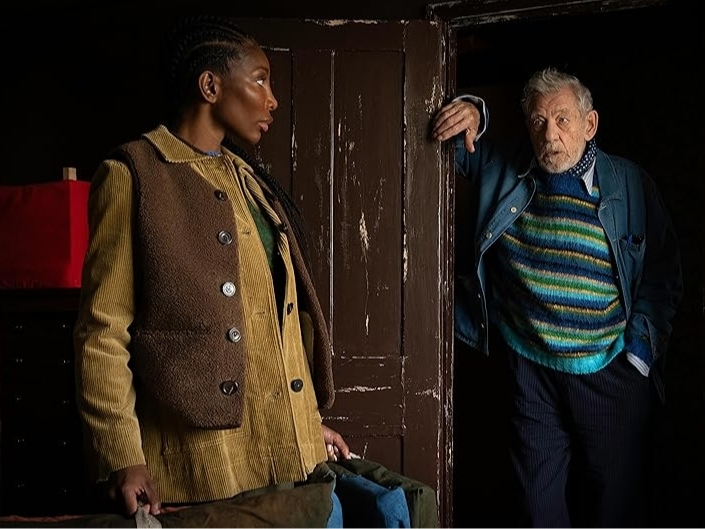
LOS ANGELES, CA — In Steven Soderbergh’s “The Christophers,” verity begets cruelty, deception harbors revenge, and a fading icon quietly recedes into the dim corners of his own legend undone by the very myths he built to give his life meaning. Unfolding with a slow, deliberate sting, the Oscar-winning director’s latest effort emerges as a dark-comedy chamber piece — funny, cutting and quietly mournful beneath its lacquer of wit.
A house in London. Dust gathering on canvases long abandoned. Julian Sklar (Ian McKellen), a once‑revered painter now curdled into theatrical decay. He was the art world’s own Simon Cowell — a caustic, self‑anointed arbiter on the reality show “Art Fight,” firing off venomous barbs that passed for discernment.
Nowadays, he languishes inside his conjoined townhomes, numbing himself and recording personalized insults for paying strangers — each cameo a miniature performance of disdain. He is a relic, a has-been who refuses to admit it.
Find out what's happening in Los Angelesfor free with the latest updates from Patch.
Into this crumbling den of self-pity and irrelevance strides Lori Butler (Michaela Coel), hired under false pretenses by Julian’s estranged children, Barnaby (James Corden) and Sallie (Jessica Gunning). Their scheme? Locate the eight unfinished paintings from “The Christophers,” secretly complete them, and unveil the set as Julian’s final masterpieces after his death.
The series — Julian’s celebrated ’90s portraits of a figure from his past — captures a tender, ultimately painful emotional terrain he’s spent years trying to outrun. The siblings' elaborate plan, grotesque as it is, becomes equal parts inheritance grab and emotional revenge — a last attempt to profit from a father who gave them nothing but contempt. However, in enlisting Lori, they unwittingly set in motion the very reckoning Julian has spent a lifetime avoiding.
Find out what's happening in Los Angelesfor free with the latest updates from Patch.
Eventually, Lori secures a position as Julian’s assistant, navigating Julian's labyrinthine ego — wounded, vulnerable, and rebelliously alive. What begins as a deception evolves into a duel of artistry and will between the aging maestro and the con artist — exchanges of wit and intellect as tender as they are wary, all of it orbiting the ghost of Christopher, the lover whose absence haunts every unfinished brushstroke.
McKellen is extraordinary, playing Julian with the same remarkable nuance he brought to “King Lear”— savoring every acidic line while revealing the bruised longing beneath the brittle bravado. His unmistakable voice rumbles and cracks through registers of anger, calm and resentment, exposing the vulnerability Julian works so hard to bury. His gaze flickers between conceit and fear — the look of a man wrestling with time undone.
Coel, by contrast, is a revelation, matching McKellen’s gravitas with an incisive, grounded performance. Her Lori is stoic, impatient, and hard to read — a woman whose guarded exterior barely conceals a slowly, deepening empathy for Julian.
Together, their chemistry mesmerizes with an interplay that is adversarial yet affectionate, forging a fascinating counter‑rhythm of artistic impulses: predator and prey, provocateur and saboteur, two artists locked in creative tension.
Soderbergh threads the film with the same sly caper energy he brought to “Ocean’s Eleven” — a game of feints and reversals, schemes within unseen schemes, each exchange a scintillating emotional push‑pull. Ed Solomon’s script sharpens that tension, giving the leads dialogue that maps the film’s emotional arc — Sklar and Lori’s shared wounds, ambitions and small triumphs in the bruised, melancholic world of the arts.
Tonally, the film walks a tightrope between farce and elegy, its sharp, playful banter carrying both mischief and the ache of artistic regret as it shifts from playful deception to hushed introspection without ever losing its balance. If there’s a gripe, it’s that this exquisite control can occasionally leave the film just out of emotional reach, its immediacy softening at the very moment it seems to be reaching for something rawer.
In the end, “The Christophers” settles into a clear‑eyed meditation on truth and illusion, anchored by two extraordinary performances. Soderbergh and Solomon paint a canvas where those forces blur until what remains is simply what’s real.
Within that frame, Sklar’s admission — “You have a relationship with the canvas. I’ve said what I have to say to it. Take that. It goes.” — becomes a parting simple acceptance, a recognition that life can no longer pretend to be anything other than what it is.
Get more local news delivered straight to your inbox. Sign up for free Patch newsletters and alerts.