Politics & Government
COVID-Infected Nurses Working At Short-Staffed Nursing Homes
About 11,500 long-term care center workers are now sick with COVID. "It's been like one coworker after another, after another..."

January 24, 2022
In summary
Find out what's happening in Los Angelesfor free with the latest updates from Patch.
About 11,500 long-term care center workers are now sick with COVID. “It’s been like one coworker after another, after another, everyone getting sick,” one nursing assistant said.
Four days after Celine started working as a nursing assistant in the COVID-19 unit at a Placerville nursing home, she tested positive for the virus. She was fatigued, weak and had a dry cough — but she kept working. She said she has worked 13 days in the last two weeks, frequently taking care of more than a dozen patients at a time or working a double shift when asked.
Find out what's happening in Los Angelesfor free with the latest updates from Patch.
“I’d have to sit down at least 10 minutes because I just get tired, and I’m still tired honestly,” said Celine, who asked not to be fully identified because she fears losing her job.
Severe worker shortages — worsened by the omicron surge — have forced some of California’s long-term care facilities to rely on COVID-positive staff for patient care. According to state data, 11,500 long-term care center workers are currently infected with COVID — even though 93% are fully vaccinated. Although only 8% of the workforce is infected today, it’s 48 times more than at the beginning of December, when omicron appeared.
The California Department of Public Health earlier this month quietly issued controversial emergency guidelines allowing infected health care employees with no symptoms to continue working. And at facilities with the most severe staffing shortages, symptomatic staff are allowed to work with COVID patients.
Since the emergence of omicron, Celine said she’s worked more overtime and cared for more patients than usual at the Pines at Placerville Healthcare Center.
“There really wasn’t a lot of staff at the beginning to work the COVID unit, so that’s why I continue to work,” she said. “It’s really hard to get staff in the building because a lot of people are afraid. If (workers) did not feel well enough, they didn’t force anybody to work.”
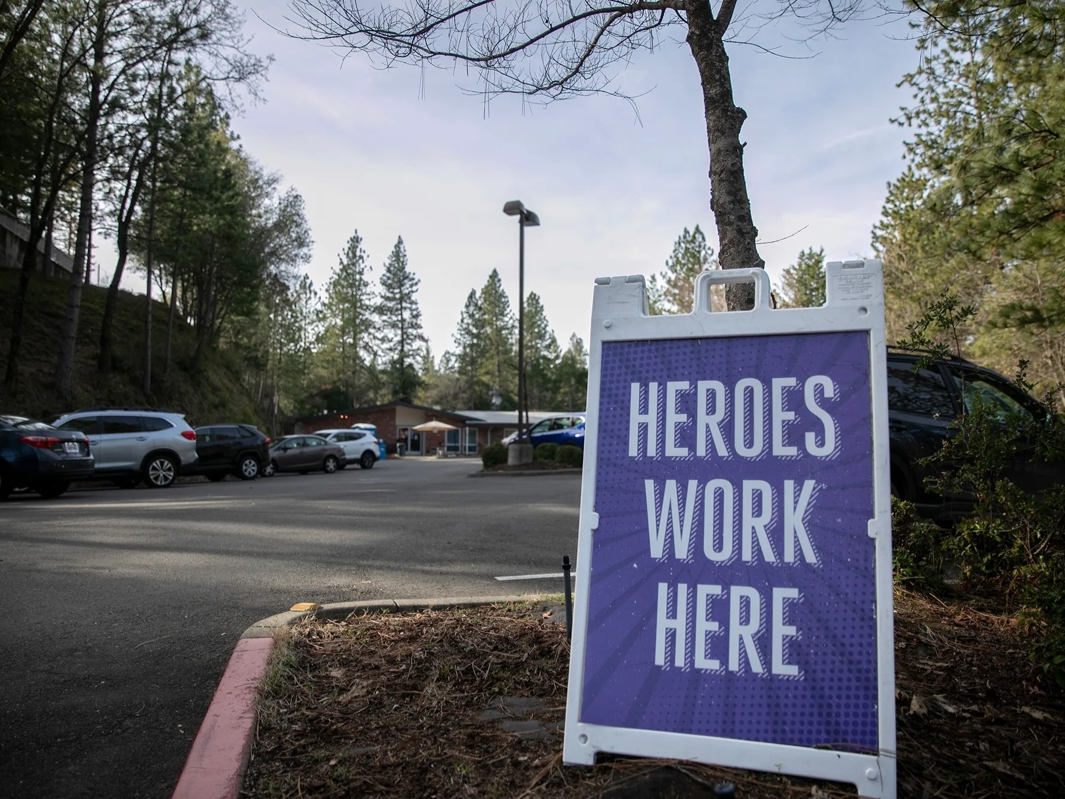
So many workers are sick that the company installed a portable potty in the parking lot for them to use away from the nursing home’s residents, she said. Water pumped in for handwashing freezes at night and some colleagues go home or to a nearby McDonalds to use the restroom, she said.
The Pines at Placerville did not respond to multiple requests for comment.

At another facility in Mountain View, a certified nursing assistant said she was asked to return to work five days after contracting COVID-19. State and federal health guidelines have okayed five-day quarantines or shorter at facilities with critical staffing shortages, but her lingering cough and body aches convinced her to say no.
Now, three weeks later, she is back at work, surrounded by colleagues who tell her they are COVID-19-positive, she said.
Health workers who test positive for COVID-19 are required to wear N95 masks, but the infection is still sweeping through staff and residents at the Grant Cuesta Sub-Acute and Rehabilitation Center in Mountain View.
“It’s been like one coworker after another, after another, everyone getting sick,” said the certified nursing assistant, who asked to remain unidentified to protect her job.
“For me, I think this wave was a shocker only because it swept through boosted and vaccinated people.”
Christina Lockyer-White, nursing assistant in Bakersfield
Nine residents also have the virus, and the facility has set up an isolation ward.
“No matter how much you protect yourself, we’re still eating in the same dining room. You know, we’re still sharing the same restroom. So what’s the whole point?” she said. “It’s almost like they don’t care about us getting sick.”
Grant Cuesta did not respond to multiple requests for comment.
California’s 1,200 residential care and skilled nursing facilities, home to more than 400,000 people, have been the epicenter of COVID-19 outbreaks since the beginning of the pandemic. Their residents and workers accounted for nearly 70% of outbreaks among all health care settings in the state last year.
While vaccination and testing requirements have helped bring those numbers down, the omicron surge is now hampering facilities’ ability to prevent infection from spreading through their often elderly and vulnerable residents.
“For me, I think this wave was a shocker only because it swept through boosted and vaccinated people,” said Christina Lockyer-White, a certified nursing assistant at Kingston Healthcare Center in Bakersfield.
Staff members there are required to wear full protective equipment including face shields, gowns, gloves and N95 masks throughout the facility, but several have tested positive regardless, Lockyer-White said.
“We didn’t think we’d be in this position, and here we are,” Lockyer-White said. “It’s like reliving a nightmare.”
‘Help wanted’: Long-term shortage of workers
Workplace shortages have plagued nursing homes, memory care and assisted living centers for years, driven by an aging population, stagnant wages and dwindling training programs.
“I’ve been a nurse in long-term care for over 25 years, and there’s never been a time where we haven’t had a ‘help wanted’ sign out in some form,” said Claire Enright, workforce specialist at the California Association of Health Facilities, which represents skilled nursing facilities.
“Five to six years ago, there were over 600 training programs for (certified nursing assistants) in the state. We’re down to around 300,” Enright said.
Skilled nursing facilities provide 24-hour medical care for sick residents who require constant monitoring or rehabilitation. Other long-term care facilities, such as assisted living, memory care and some retirement homes, are for residents who need help with some daily activities.
Most long-term care facilities struggle to hire enough staff like certified nursing assistants and registered nurses, and the pandemic has brought these chronic issues to a breaking point. Nationwide nursing homes and assisted living facilities have lost approximately 259,000 workers since 2019, more than any other health care sector, according to the American Health Care Association/National Center for Assisted Living.
“I’ve been a nurse in long-term care for over 25 years, and there’s never been a time where we haven’t had a ‘help wanted’ sign out in some form.”
Claire Enright, the California Association of Health Facilities
State officials do not track data on workforce losses in long-term health care, Enright said, but nursing homes are operating at lower capacity than usual, in part because there isn’t enough staff to open more beds. Before the pandemic, most nursing homes operated at about 88% capacity. Now that’s down to 70 to 75%.
Enright said the association has heard of some long-term care facilities relying on COVID-19-positive employees during this surge, but she said there’s no way of telling how many of the 11,500 sick workers are caring for patients.
Families worry more about staff shortages than sick workers
Omicron has been a nightmare for families of residents, too.
Two weeks ago, Miriam Raftery’s 91-year-old mother Mary contracted COVID-19 in her La Mesa memory care facility. She’s in an isolation room by herself, and Raftery said she isn’t allowed to visit.
“It is scary. They say dry cough, but who knows. At 91, she’s very frail. It’s frightening,” Raftery said.
What frightens Raftery even more, however, is Mary being left alone in isolation. During last winter’s surge, most long-term care facilities implemented strict lockdown measures.
“When she was in that first place, she would just cry. They’d let me have window visits. She couldn’t really hear me very well, but she would just cry and plead with me to take her home. She didn’t understand what was happening,” Raftery said.
Now, with Mary in the isolation room, Raftery is concerned she will get depressed again or fall if left unattended.
Raftery said Mary has dementia and is a high-fall risk — she forgets that she can’t walk unassisted. Without constant supervision of her mother in the isolation room, Raftery was so concerned about her falling that she hired a private caregiver to sit with her for eight hours a day.
“I felt like I had no choice,” Raftery said. “It’s costing me $5,500 to do this for her, but given her history of serious falls and winding up in hospital multiple times from falling out of bed at these other places, you know, when she was left unattended during the day.”
Raftery said Mary already has experienced the consequences of understaffed facilities. She’s been in four homes in the San Diego area since February, moving each time Raftery discovered possible signs of neglect. When Raftery questioned the places about why no one was monitoring her mother, she said she was told there wasn’t enough staff.
“The facilities she’s been in, they were all losing people because certain people didn’t want to get vaccinated or they were just fed up,” Raftery said.
Families and advocates say staffing shortages caused by the omicron wave are a Catch-22: Sick workers risk spreading the disease to elderly and vulnerable residents but understaffing leads to neglect and inadequate care.
“I get why (the state health department) has opened the doors to asymptomatic workers, but it’s still highly transmissible, whether we’re asymptomatic or not, whether we’re vaccinated or not, right? So it’s a scary proposition,” said Maitely Weismann, co-founder of the Essential Caregivers Coalition.
Maitely Weismann visits her 79-year-old mother Celia at her Los Angeles nursing home. Celia narrowly dodged a COVID-19 outbreak at the facility last year. Courtesy of Maitely Weismann
Weismann’s 79-year-old mother Celia lives in an assisted living facility in the Los Angeles area. There was an outbreak in her facility last year that her mother narrowly avoided during an unrelated hospital stay. Now she’s worried Celia will catch COVID this time around.
Even though her mother is vaccinated and boosted, Weismann said she hears about people with similar conditions and disabilities dying from COVID-19.
The state health department has come under fire for insufficient oversight of nursing homes where families allege residents died of COVID-19 after sick staff were forced to work.
“Personally, if someone’s positive and comes in, I’m OK with that because I would rather my mom have the care that she needs than have her be neglected.”
Angela Trivonovich, Daughter of nursing home resident
But for some, having reliable, COVID-positive staff available to care for their relatives is better than no one at all.
“Personally, if someone’s positive and comes in, I’m OK with that because I would rather my mom have the care that she needs than have her be neglected,” said San Diego resident Angela Trivonovich. “I’ve seen the results of neglect and not a lot of care in a nursing home. I would rather her not get severe diaper rash. I’d rather her not get a bed sore.”
At the nursing home where her 84-year old mother Rae lives, patients’ families were notified that 22 workers have tested positive in two weeks, Trivonovich said.
“If people feel good and they come in positive, I don’t know if that’s going to spread it any more than it does already. And I think the residents need all the care they can get,” she said. “They’re desperate.”
more on nursing homes
California oversight of nursing homes called ‘befuddling,’ ‘broken’
A CalMatters investigation reveals an opaque licensing process for California nursing homes, rife with indecision and contradictions. Officials have let the state’s largest nursing home owner and his companies operate 18 homes for years while failing to decide whether to grant the required licenses.
by Jocelyn Wiener
April 6, 2021
‘People are dying as we wait’: Bid to tighten California nursing home oversight sputters
Lawmakers say they’ll take no action this year on a bill requiring nursing home owners and operators to get state approval before they acquire, operate or manage a nursing home.
by Jocelyn Wiener
April 16, 2021
Licensing by clerical error: How the state’s mistake decided the course of two nursing homes
California Department of Public Health officials say they cannot fix their mistake, amid cries the licensing system for nursing homes is “broken and ineffective.”
by Jocelyn Wiener
August 19, 2021
Shlomo Rechnitz nursing home suit over COVID deaths reflects ‘broken state licensing’
A lawsuit describes nursing home magnate Shlomo Rechnitz and his companies as the “unlicensed owner-operator” of a troubled Redding facility.
by Jocelyn Wiener
October 4, 2021October 4, 2021
State health department blasted over nursing home oversight
The California Department of Public Health blames staffing shortages, turnover, training and pandemic pressures at Tuesday’s hearing at the Capitol.
by Jocelyn Wiener
October 6, 2021October 6, 2021
From maggots to sex abuse, nursing homes sue California to overturn citations, fines
California nursing homes have filed more than 400 lawsuits since 2016 to appeal state citations and fines alleging poor patient care. Regulators downgraded nearly a third of sanctions involving a death. Advocates say the appeals system favors nursing homes.
by Barbara Feder Ostrov
December 6, 2021
The case of the vanishing fine: How a massive nursing home penalty eluded consumer detection
A Fresno nursing home was fined more than $900,000 in 2018 for poor patient care, but consumers have been hard-pressed to find any public record of the massive penalty or many other big fines.
by Jocelyn Wiener
December 15, 2021
No way out: How the poor get stranded in California nursing homes
In a parallel problem to patient ‘dumping,’ many poor nursing home residents find themselves stuck inside facilities and unable to return home.
by Jesse Bedayn
January 20, 2022
We want to hear from you
Want to submit a guest commentary or reaction to an article we wrote? You can find our submission guidelines here. Please contact CalMatters with any commentary questions: commentary@calmatters.org
CalMatters.org is a nonprofit, nonpartisan media venture explaining California policies and politics. Sign up for our newsletters and follow us on Facebook, Twitter and Instagram.