Neighbor News
Interactive kiosk that teaches lifesaving skill debuts at LAX
American Heart Association Hands-Only CPR training kiosk permanently housed at Tom Bradley International Terminal
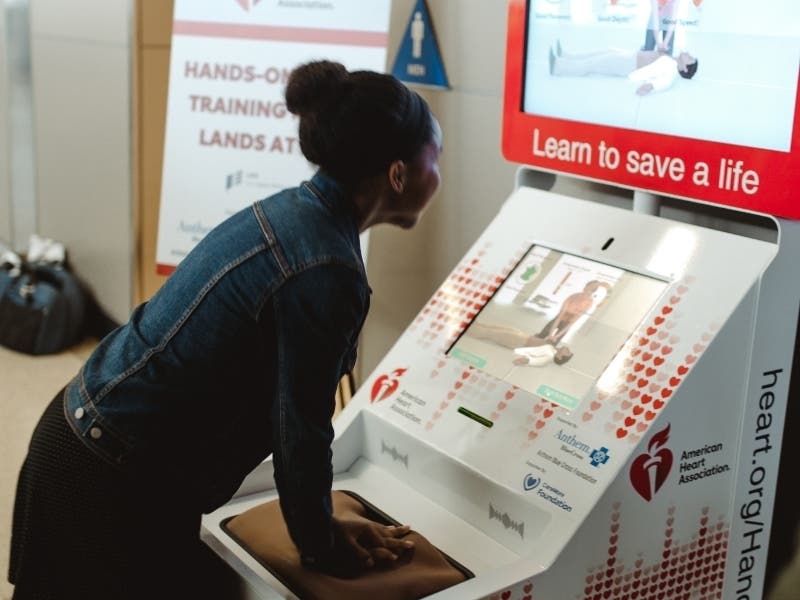


Amid expected record-high airline travel this season, the American Heart Association, the world’s leading voluntary health organization devoted to world of longer, healthier lives, unveiled a Hands-Only CPR training kiosk today at the Los Angeles International Airport (LAX) during National CPR and AED Awareness Month, an annual observance that brings attention to how lives can be saved if more Americans know how to perform CPR and use an AED, or automated external defibrillator.
The Hands-Only CPR training kiosk, operated by the American Heart Association and supported by the Anthem Blue Cross Foundation and the CareMore Foundation, is located near Gate 150 at the Tom Bradley International Terminal, which served more than 17 million passengers in 2018. Travelers can get trained in Hands-Only CPR in about five minutes while they wait for their flights. Through the Anthem Blue Cross Foundation and American Heart Association partnership, the LAX kiosk becomes the third to be housed in a California airport, joining others located in the Oakland International Airport and John Wayne Airport.
“Every second counts when a person suffers a cardiac arrest, which is why bystander CPR must start immediately until professional help arrives,” said cardiologist Dr. John Harold, president of the American Heart Association Los Angeles Board of Directors. “But bystanders may be reluctant to perform CPR because of lack of training or they may be fearful. The kiosks will help the public acquire a comfort level with performing chest compressions without the stress of an actual medical emergency, so they’ll feel empowered to spring into action if they witness a cardiac emergency.”
Find out what's happening in Los Angelesfor free with the latest updates from Patch.
Every year, more than 350,000 cardiac arrests occur outside the hospital, and about 20 percent occur in public places such as airports. CPR, especially if performed immediately, can double or even triple a cardiac arrest victim’s chance of survival. Yet less than half of cardiac arrest victims receive CPR from a bystander.
“Anthem Blue Cross Foundation is committed to supporting important initiatives that can have a positive impact on the health and wellbeing of the communities we serve,” said David P. Pryor, M.D., M.P.H., Regional Vice President and Medical Director at Anthem Blue Cross. “Making the Hands-Only CPR training kiosks available at the airport enables travelers to make the most of their time by providing greater access to this valuable life-saving skill that can make a difference in the lives of Southern California residents and beyond.”
Find out what's happening in Los Angelesfor free with the latest updates from Patch.
Zach Gingold is proof of the lifesaving power of CPR. Ten years ago, at the age of 14, the Los Angeles resident collapsed on a hotel lobby floor in Israel after coming back from a bus tour. Two bystanders immediately ran to his rescue, performed CPR and administered an AED. Gingold survived and went on to graduate from high school, then college, and become a real estate investment banking professional.
“I was extremely fortunate to receive CPR immediately,” said Gingold. “Less than half of cardiac arrest victims receive CPR from a bystander, according to the American Heart Association. Survival rates can triple when bystanders perform CPR. I hope this powerful machine compels the public to learn Hands-Only CPR. Cardiac arrest can strike at any time. You never know when you may need to perform this life-saving skill on a best friend, a spouse, a coworker or stranger.”
Hands-Only CPR has two simple steps, performed in this order: when you see a teen or adult suddenly collapse, call 911. Then, push hard and fast in the center of the chest at a rate of 100 to 120 beats per minute until help arrives.
Each kiosk has a touch screen with a short video that provides an overview of Hands-Only CPR, followed by a practice session and a 30-second test. With the help of a practice manikin the kiosk gives feedback about the depth and rate of compressions, as well as proper hand placement – factors that influence the effectiveness of CPR. Kiosk visitors can select to do the training in English or Spanish. The training also has closed captioning to make the instruction available to everyone.
"When emergencies occur, being prepared can mean the difference between life and death," said Keith Wilschetz, Deputy Executive Director of Emergency Management and Operations, LAWA. "We encourage all guests traveling through LAX’s Tom Bradley International Terminal to take a few minutes to use our new hands-only CPR training kiosks to learn the skills needed to save a life when someone is in cardiac arrest."
"The LAFD firefighter/paramedics who serve LAX appreciate any effort that enhances a cardiac arrest victim’s chance of survival,” said Dr. Marc Eckstein, LAFD Medical Director and EMS Bureau Commander.
There are an additional 35 kiosks across the United States, 18 of which are located at several U.S. airports. More than 200,000 people have been trained across all the kiosks.
For more information, visit heart.org/handsonlycpr.