Community Corner
'Never Forget, Never Repeat:' Griffith Park Remembers LA Internment Camp With New Sign
A World War II internment camp once stood on the site of what's now Travel Town in Griffith Park.


LOS ANGELES, CA — Then a young girl, Sigrid Toye was in bed when authorities came to her family's Los Angeles home, raided the house and apprehended her father in December 1941.
"I heard a siren, I came down, and my mom was alone on the couch crying. I said 'where's daddy?' And she said 'he's gone.' She didn't know where he was taken, she wasn't told where he was taken for some time after," Toye said.
Toye's German-immigrant father was among the thousands who were sent to internment camps in the wake of the attack on Pearl Harbor. As it turns out, Toye's father spent some of the 2 1/2 years he was incarcerated not far from her home — at the Griffith Park Internment Camp.
Find out what's happening in Los Angelesfor free with the latest updates from Patch.
"He was a proud man. The experience, he didn't speak of it. He told me to never speak of what happened to us during the war because there was so much shame involved," Toye said.
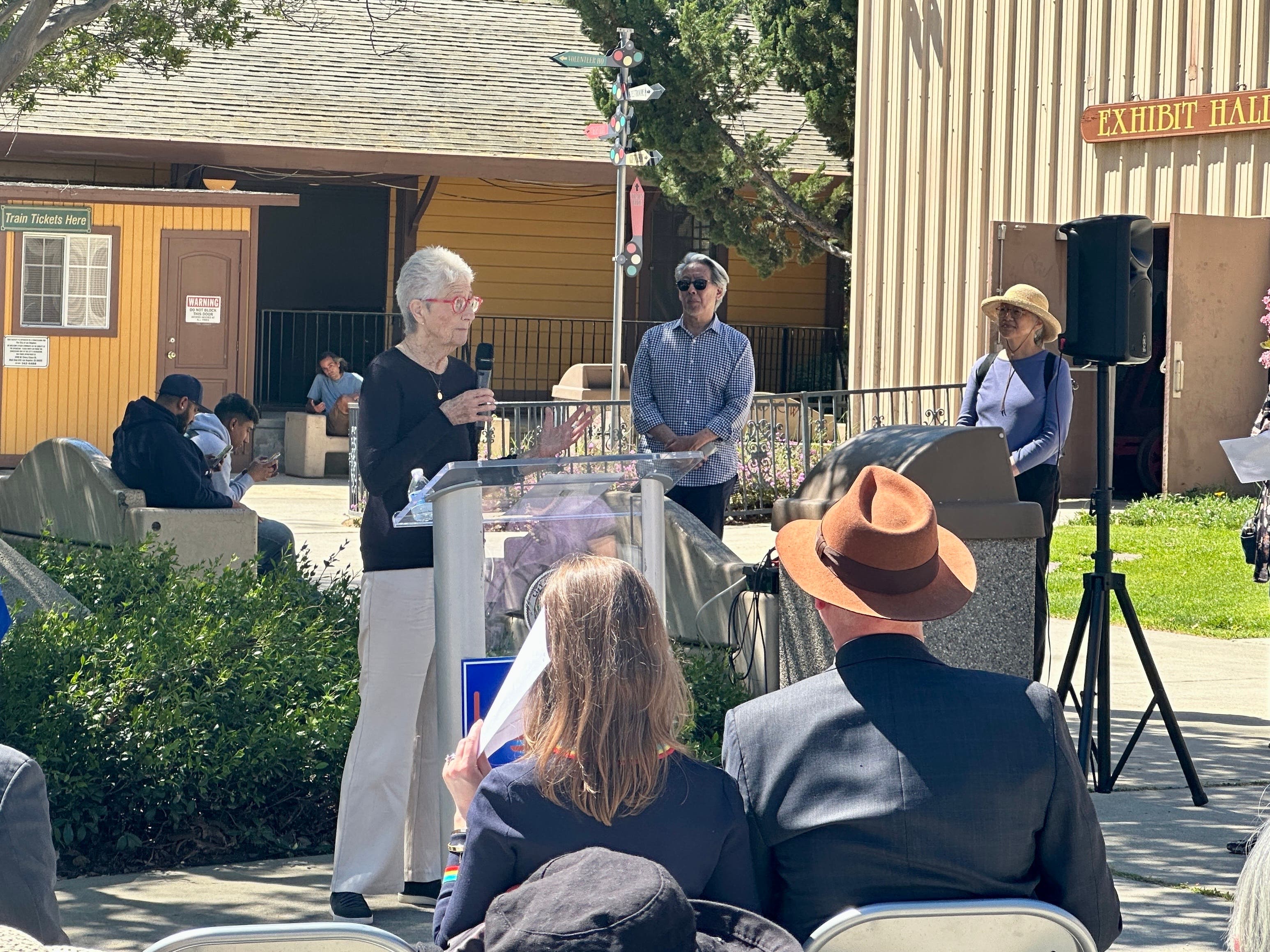
Toye was joined by city officials and other family members of those sent to the Griffith Park camp on Thursday, when an educational sign memorializing the internment facility was unveiled. The sign stands in the courtyard of Travel Town, around the area where the camp once stood.
Find out what's happening in Los Angelesfor free with the latest updates from Patch.
Mirroring families' past reluctance to speak about their loved ones' time at internment camps, Griffith Park's status as a camp site had previously been little known to the public.
"I never knew that my grandfather was here at Griffith Park," Kathy Masaoka said. Masaoka, who said she was involved in the movement for redress and reparations for those incarcerated, said she just happened to spot her grandfather's name on a memorial wall at the better-known Tuna Canyon Detention Center in Tujunga, which led to her learning about his time imprisoned at Griffith Park.
"I knew other peoples' stories but I really didn't know our own family's stories," she said.
The day after the 1941 attack on Pearl Harbor, the federal government earmarked money to build the Los Angeles camp. The facility was used to detain first-generation immigrants from Axis countries.
Researchers, led by internment camp scholar Russell Endo and Griffith Park historian Linda Barth, over the last year have focused their efforts on unearthing the history of the camp. They've identified by name 101 Japanese, 21 Germans and 4 Italians who were housed at the camp so far, according to Endo.
Those people were detained for periods between one night and several months; it was not used for long-term detention. The Army closed the site in 1943 to reallocate military guards needed elsewhere, according to city documents.
The new sign focuses on the stories of two people. One is Yasaburo Saki, who was arrested by authorities due to his alleged affiliation with a Japanese language school — which officials believed spread Japanese government propaganda. The other is fisherman Ralph Averga, whom authorities believed was sympathetic to Italy's fascist regime, information they gleaned from an anonymous tipster.
"As an immigrant, as an Asian immigrant to this country, I feel particularly grateful for this moment. I hope that this sign is a commitment to never forget and to never repeat," Councilwoman Nithya Raman, whose district includes the park, said at Thursday's ceremony.
Get more local news delivered straight to your inbox. Sign up for free Patch newsletters and alerts.