Politics & Government
Supreme Court Declines Former Sheriff Lee Baca's Appeal
Former Sheriff Lee Baca has delayed his three years in prison for obstructing a federal investigation into inmate abuse at Los Angeles jails


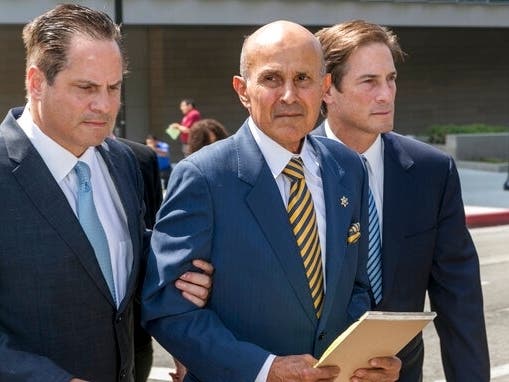
LOS ANGELES, CA — The U.S. Supreme Court has refused to hear former Los Angeles County Sheriff Lee Baca's appeal of his conviction on charges of obstruction of justice and lying to the FBI, according to court reports.
The 77-year-old former Los Angeles sheriff, who has Alzheimer's disease, was sentenced in May 2017 to three years in federal prison. Still, he has remained free pending appeal.
The denial of that appeal by the Supreme Court sets the stage for a Los Angeles federal judge to officially establish a surrender date.
Find out what's happening in Los Angelesfor free with the latest updates from Patch.
"The Supreme Court missed an opportunity to right the significant legal wrong that occurred in Sheriff Baca's case," Nathan Hochman, an attorney for Baca, told City News Service on Monday.
The case now returns to the U.S. 9th Circuit Court of Appeals in Pasadena, which first rejected Baca's appeal. The circuit court will then hand the case back to U.S. District Judge Percy Anderson, who is expected to schedule a date for Baca to turn himself in to begin his sentence.
Find out what's happening in Los Angelesfor free with the latest updates from Patch.
The Supreme Court's denial was expected since the high court only agrees to hear a small percentage of the appeals it receives.
Baca was found guilty of conspiracy to obstruct justice, obstruction of justice and making false statements in 2017. During his two trials, prosecutors described the ex-lawman as being the top figure in a multi-part conspiracy, which also involved his former right-hand man, Paul Tanaka, and eight deputies who took orders from the sheriff.
Baca— who ran the nation's largest sheriff's department for more than 15 years —was first tried in December 2016 on obstruction of justice and conspiracy to obstruct justice counts, and prosecutors had planned a second trial on the false statements count.
But a mistrial was declared after jurors deadlocked 11-1 in favor of acquittal, and the judge in downtown Los Angeles combined all three counts in the retrial that ended with Baca's conviction. Baca did not take the stand in either trial.
The charges stemmed from events nine years ago when a cell phone was discovered in the hands of an inmate/informant at the Men's Central Jail. Sheriff's deputies quickly tied the phone to the FBI, which was conducting a secret probe of brutality against inmates.
At that point, sheriff's officials closed ranks and began an attempt to halt the formerly covert investigation by concealing the inmate-turned- informant from federal prosecutors, who had issued a summons for his grand jury appearance, prosecutors said.
Baca was elected sheriff in 1998 and re-elected three times. He was poised to run again in 2014. Still, federal indictments unsealed in December 2013, related to excessive force in the jails and obstruction of that investigation, led him to retire the following month.
In addition to the ten people convicted in connection with the Baca conspiracy case, 11 other now-former sheriff's department members also were convicted of various crimes uncovered during the FBI investigation.
During arguments before the Pasadena appeals panel, Baca attorney Benjamin Coleman alleged that Anderson, the trial judge in the case, had abused his discretion by barring jurors from hearing evidence of the former sheriff's Alzheimer's diagnosis.
Coleman argued that the ruling could have affected all of Baca's criminal convictions and urged the appellate panel to overturn the guilty verdicts.
But the court found that the trial court did not abuse its discretion by rejecting as unreliable testimony about the extent of the disease's impact on Baca when he lied to investigators.
Coleman argued that Baca's conviction for making false statements during an FBI interview in 2013 was the direct result of mild impairment caused by the early stages of Alzheimer's disease. Baca was diagnosed with the disease in May 2014.
During the FBI interview, which focused on events in 2011, Baca was found guilty because he "couldn't remember every single little detail from two years earlier," Coleman alleged.
Prosecutors responded that while Baca may have been in the early stages of the disease in 2013, the defense's expert witness could not prove that the ex-lawman was likely to have been suffering from memory loss at the time of the interview.
"What the jury decided, ultimately, was that this was a man who believed he was above the law but wasn't," Assistant U.S. Attorney Bram Alden said during the appeal.
City News Service, Patch Editor Ashley Ludwig contributed to this report.
Get more local news delivered straight to your inbox. Sign up for free Patch newsletters and alerts.