Neighbor News
Twenty-One Years Later, Brad Sherman Returns to UCLA With the Same Warning on AI
"Artificial Intelligence Could Change Everything"
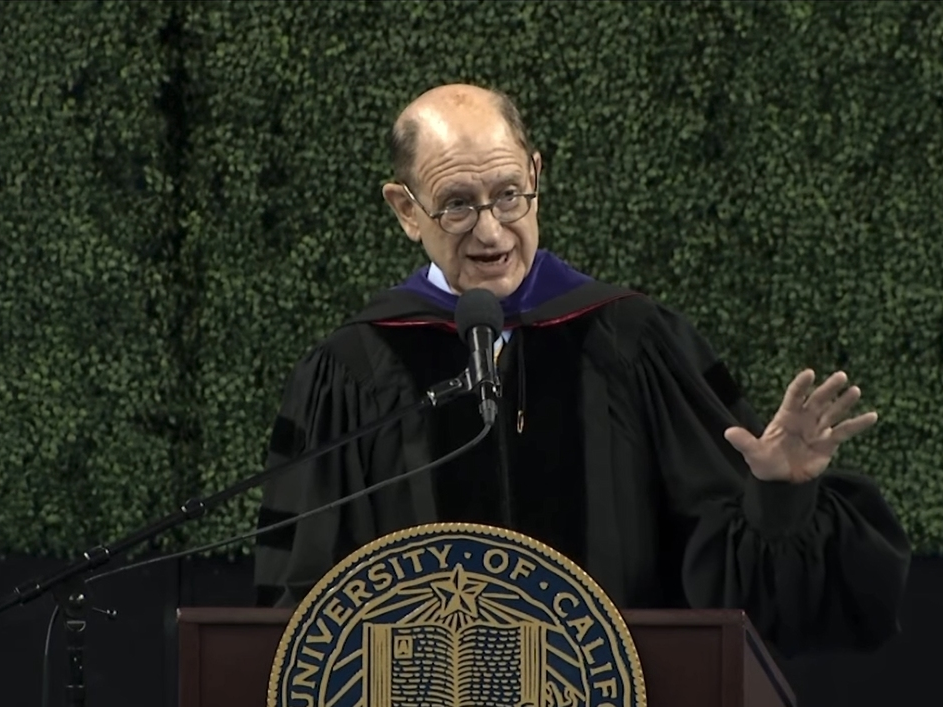
LOS ANGELES — Most commencement speakers spend their precious minutes dispensing familiar advice: follow your dreams, embrace uncertainty, seize the day.
Congressman Brad Sherman had little interest in any of that.
Standing before graduates at UCLA's Department of Political Science commencement ceremony Sunday, Sherman instead used the occasion to revisit a prediction he made from the same campus stage more than two decades ago — and to argue that the warning he delivered then has only become more urgent.
Find out what's happening in Los Angelesfor free with the latest updates from Patch.
"Don't mention artificial intelligence," Sherman joked he had been advised before the speech.
He ignored that advice.
Find out what's happening in Los Angelesfor free with the latest updates from Patch.
Just as he did in 2005.
Twenty-one years after delivering a UCLA commencement address in which he warned that computer engineers were decades away from creating machines with intelligence surpassing human capabilities, Sherman returned to Pauley Pavilion to make the case that society remains dangerously unprepared for the consequences of its own technological ambitions.
The result was a commencement address unlike most graduates are likely to hear.
Rather than offering career guidance or reflections on public service, Sherman delivered what amounted to a policy speech on the future of civilization itself — a sweeping meditation on artificial intelligence, genetic engineering, and whether humanity can maintain control over technologies it is racing to create.
The speech also represented a remarkable full-circle moment for the congressman, a UCLA alumnus whose parents were Bruins and whose father studied political science at the university.
Few public officials have the opportunity to return to the same institution, speaking to a new generation of graduates, with the chance to evaluate a prediction made twenty-one years earlier. Fewer still are able to argue that the prediction may have aged surprisingly well.
In 2005, artificial intelligence remained largely the domain of researchers and science fiction writers. Today's graduates enter a world in which AI systems write essays, generate images, produce software code, and increasingly influence everything from education to national security.
Sherman's message was not that AI will fail.
His concern is that it will succeed.
"The most powerful thing on Earth is intelligence," Sherman argued, warning that humanity is investing trillions of dollars into making intelligent systems more powerful while devoting comparatively little effort toward ensuring they remain controllable.
The congressman framed AI and genetic engineering as twin technological revolutions that could ultimately produce forms of intelligence rivaling or surpassing humanity itself. While much of Silicon Valley focuses on innovation and competition, Sherman urged graduates to think in civilizational terms.
In a notable departure from the optimistic tone often associated with discussions of emerging technologies, Sherman argued that the defining political challenge of the coming decades may not be how nations compete in developing advanced AI, but how they cooperate to prevent it from becoming uncontrollable.
His answer is more regulation, more research into AI safety, and eventually the kind of international framework that once emerged to address nuclear weapons.
The comparison was intentional.
Sherman noted that previous generations grappled with Nazism, world wars, and the nuclear age. Today's graduates, he suggested, may face a challenge that is even broader: ensuring that humanity remains the dominant intelligence on the planet.
Whether one agrees with that assessment or not, the speech underscored how dramatically public debate around artificial intelligence has shifted since Sherman first raised the subject at UCLA in 2005.
Back then, concerns about superintelligent machines sounded speculative.
Today, they are increasingly voiced by leading researchers, technology executives, and governments around the world.
Sherman's speech was notable not because it offered a detailed roadmap for solving those problems, but because it highlighted the persistence of a concern that has followed him for more than two decades.
Commencement addresses are often forgotten by the time graduates leave campus.
This one may be remembered for a different reason: it was less a celebration of achievement than a warning about the future.
And for Sherman, it was a warning he felt compelled to repeat twenty-one years after first delivering it in the very same room.
"The future belongs to you," he told graduates in the obligatory portion of his speech.
The rest of the address was devoted to explaining why that future may be far stranger — and far more consequential — than anyone in the audience can yet imagine.