Politics & Government
Ballona EIR Part Two: Our Road Trip Begins
Five Part Series Explaining the Ballona EIR Matter in Plain English, Part Two: Mapping our Road Trip, Planning a Route and Choosing a Car

Last Sunday in Part One, I discussed Our Planning Foundation for the Ballona Wetlands Restoration (https://patch.com/california/m...). This week, I move into the EIR process, where we map out the route of our road trip (note: figures are numbered sequentially for all five parts of this article, so today's first figure is Figure 3).
Recall from Part One that our road trip destination - California's long-established purpose, need and regional goals for Ballona - are that Ballona shall be restored and that an abundance of high quality, productive wetland and upland habitats shall be created, enhanced or preserved, accessible by regulated public access. How shall we reach that destination?
The California Environmental Quality Act (CEQA) requires that a project proponent advance at least one alternative project plan that satisfies the purpose and need of the project; the regional goals. Usually, more than one viable alternative is proposed, as well as a “No Project” alternative. “No Project” at Ballona means we will not perform any wetland creation or enhancement of existing wetlands, nor build new trails or public access. We will do nothing.
Find out what's happening in Marina Del Reyfor free with the latest updates from Patch.
Since doing nothing won’t meet our state’s long-established goals for accessible tidal wetlands in public ownership, the No Project route is not a viable alternative. However, if any of the other project alternatives cause significant adverse environmental impacts, and those impacts cannot be reduced (mitigated) in some acceptable way, then those alternatives also become inviable and No Project becomes the default (the law allows some exceptions).
The Ballona Project proponents, California Fish and Wildlife, examined twelve different project alternatives, then carried forward and published only three project alternatives in their Draft Environmental Impact Report (DEIR), plus No Project. Our laws and courts allow alternatives to be discarded early if they have fatal flaws.
Find out what's happening in Marina Del Reyfor free with the latest updates from Patch.
The three "finalist" plans range from a limited re-introduction of tidal functions, to an extensive re-contouring of the entire 577 acres, including removing part of the Ballona Creek concrete channel and replacing it with a meandering vegetated earthen channel (Figure 3).
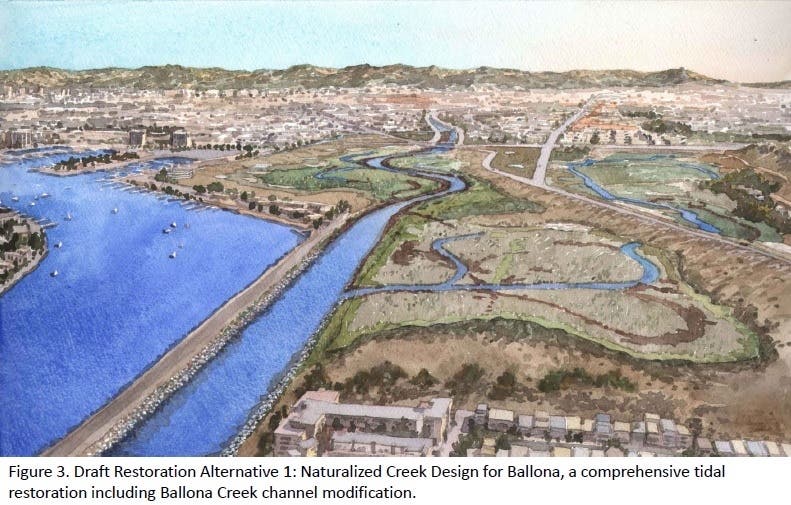
As early concepts, these three and the other twelve now-discarded alternatives were scrutinized during several public workshops for scientists to obtain input on the opportunities or constraints presented by each. Now, with the supporting (and rather exhaustive) scientific analyses contained in the DEIR - analyses which identify the potential environmental impacts of each finalist alternative - these three options constitute the lawful environmental analysis required by CEQA.
You may recall back in 2013 we officially kicked off the CEQA process by publishing a Notice of Preparation (NOP), which is the legal notice that we’ll prepare an Environmental Impact Report (EIR). The NOP phase was our first opportunity under CEQA, both during a public comment period and at public gatherings, to tell the state what alternatives to consider in the EIR, and what potential environmental impacts should be analyzed for each. The EIR must examine the potential impacts of various restoration alternatives brought forward by the state, which must be defended by facts.
Four years later, the public now has additional opportunity to review and comment upon the final three project alternatives analyzed in the DEIR and argue which should be preferred. The state must consider all substantive comments, written and verbal and address them in the Final EIR (FEIR) some months later, which is the end of the CEQA documentation process. However, we will also have additional opportunity later to comment, and persuade revisions to whatever proposed project emerges from the FEIR, during the California Coastal Commission’s subsequent permit proceedings. There is also an opportunity for litigation throughout the approval process (which I’ll discuss in Part Four).
Alternative 1 is The Way
California Department of Fish and Wildlife states that its DEIR does not recommend a “preferred” alternative, but in the same breath names Alternative 1, Full Tidal Restoration, as the Proposed Project. Well, you can argue semantics, but that sounds like a preference to me! Alternative 1 is the preferred way to reach our road trip destination.
A coalition of prominent environmental groups recently established restoration principles for Ballona (http://wetlandsrestoration.org/), which clearly support Alternative 1 over the others. So, I’ll refer to Alternative 1, Full Tidal Restoration, also known as Naturalized Creek, as both the Proposed and Preferred Project.
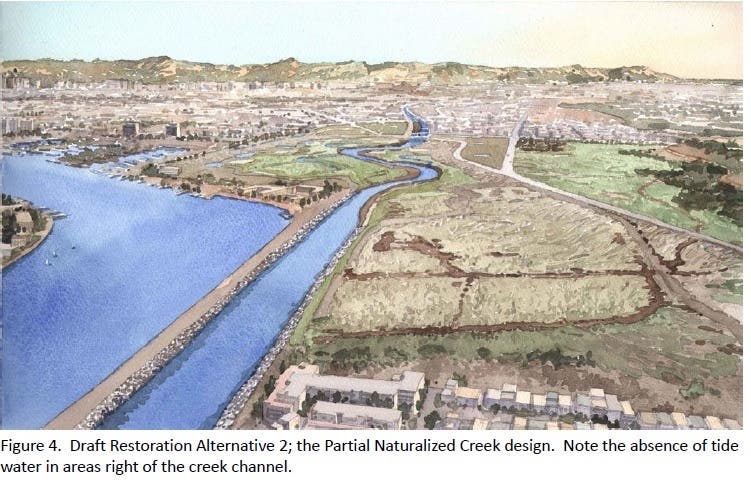
What about the other alternatives? Alternative 2 is similar to Alternative 1, but with no tidal restoration to areas south of Ballona Creek (Figure 4). This alternative would not restore full tidal flow to those southern areas which have been choked off from nourishing daily tides by Jefferson and Culver Boulevards, roads protected from flooding by old tide control gates. Alternative 1 protects those roads from flooding by other new means. Alternative 2 does not get us to our road trip destination; only part way.
Alternative 3, known as the Oxbow Alternative, would tidally restore only former wetland areas north of the creek where dirt dredged from Marina Del Rey construction was dumped in the 1950s (Figure 5).
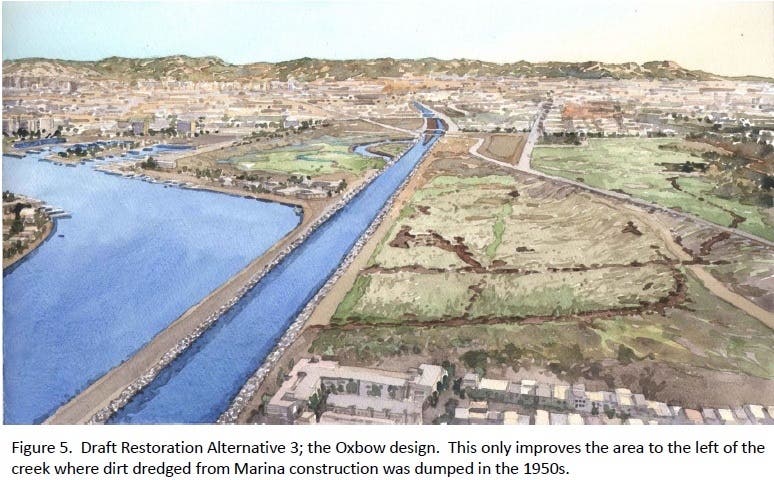
This plan lacks the removal and re-contouring of the Ballona Creek concrete channel and like Alternative 2, also leaves degraded southern wetland areas largely unrestored and parched. Obviously, Alternative 3 also strands us on the highway, far short of our road trip destination. A No Project alternative is also addressed in the EIR.
The Ballona DEIR Alternative 1, Full Tidal Restoration or Naturalized Creek, resembles in terms of habitat proportions and construction effort both the early conceptual plan from the Friends of Ballona Wetlands non-profit group (Figure 6) and the alternative that was ultimately constructed in Del Mar at San Dieguito Wetlands, known as the Mixed Habitat Plan (Figure 7).
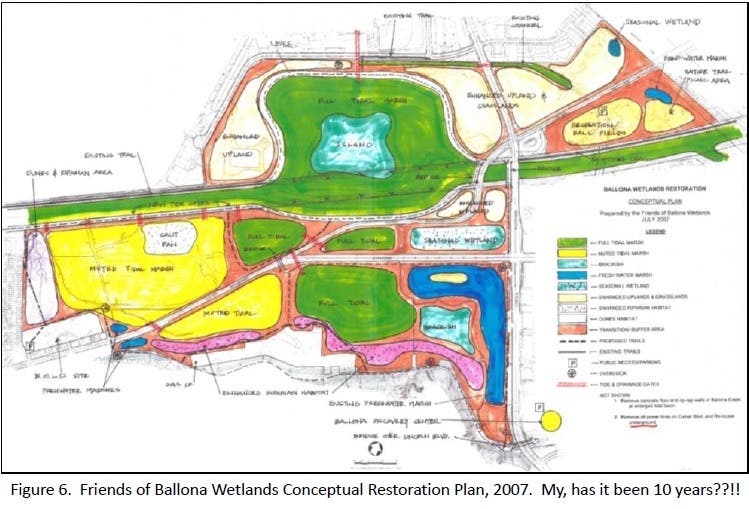
All three plans incorporate a mix of off-channel subtidal basin areas (subtidal=always blue water), intertidal saltmarsh areas of varying elevations (green areas), and non-tidal upland areas (brown) that incorporate public access in roughly equal proportions.
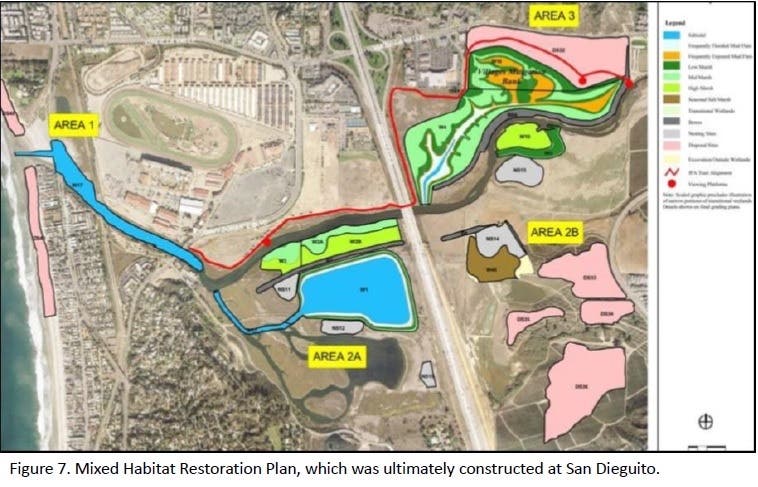
These design elements emerge due to physical constraints of the landscape and existing conditions at the unrestored sites. For example, both Ballona and San Dieguito contain areas where historical infilling has occurred, either partially (leaving degraded wetland) or completely, leaving only upland. As at San Dieguito, subtidal wetlands could be constructed in areas completely in-filled at Ballona by simply excavating the old fill dirt, re-grading and planting, while areas of degraded wetland could be enhanced by subtle grading and tidal channel enhancement.
Both Ballona and San Dieguito are bisected by major transportation routes and existing river channels; one channel natural and Ballona’s concrete-lined, but both constrained by bridges. San Dieguito’s “soft” sandy ocean inlet remains, but Ballona’s historical inlet was long ago replaced by rock jetties extending into the ocean. Neither Ballona nor San Dieguito resembled the natural wetland area that hasn’t existed in either area for over 60 years, and both are hemmed in by dense suburban development. These similarities make the now-restored San Dieguito Wetlands an excellent lessons-learned example for the coming Ballona project, and represents an “Alternative No. 1” already completed and very successful.
Nix the "Community" Alternative Idea
Some individuals have for years proposed for Ballona what I will call the “community” Alternative, since their statements have generally advocated very little tidal or freshwater marsh restoration using only low-impact construction methods (volunteers with hand tools, or very little mechanized earth-moving). They have also advocated additional unspecified land purchases and call for storm water runoff treatment wetlands in the design. None of the final three DEIR Alternatives, save the No Project plan, represents what these folks have advocated. The DEIR did analyze an Alternative 5, which does not use mechanized earth-moving (bulldozers and scrapers, etc.). This plan and eleven other Alternatives were rejected early and not carried forward, because, among other reasons, they simply cannot be accomplished in a reasonable amount of time, and California's Coastal law requires that. More importantly, these "community" Alternatives barely get us out of our driveway on our road trip, never enabling us to reach our destination.
A “community” Alternative does not meet the regional goals of a Ballona restoration, simply because it does not restore tidal function to a large enough area of our state-owned property, at least half of which was filled in by the dirt dredged from the Marina Del Rey construction in the 1950-60s. For this same reason, I would expect the DEIR Alternatives 2 and 3 to not be selected as the “preferred” plan. They simply leave us stranded well short of our original goals.
Since a so-called “community” Alternative has vocal backers, the DEIR analyzed Alternatives 2 and 3, as well as conceptually analyzing Alternative 5 and others not carried forward into the DEIR. Not doing so might have left us feeling that we never gave the “community” Alternative idea a hard look in the context of a lawful and scientific review, and there would forever be second guessing. Also, you never know what good ideas will emerge from a non-viable alternative until you scrutinize it at the EIR level. Some of those ideas may improve the remaining viable alternatives as well, though I have yet to see that occur. Now that we've given it a hard look, it is time to put the "community" Alternatives concept behind us.
Returning to our road trip analogy to sum things up, we have decided the destination of our Ballona journey is a comprehensive tidal restoration. We have not decided how to get there, but we know we will likely drive some late model car, and we could take the highway or local roads. We know there will be obstacles we must avoid or remove. However, a few vocal folks are still arguing that we should not go to that destination at all, and that wherever we go, we walk or ride bicycles to get there. That’s neither a feasible nor lawful path and would be great opportunity lost. I’ll discuss that in Part Three next Sunday, so stay tuned.
If you missed Part One, see it at the link: https://patch.com/california/m...
About the author:
Dr. David W. Kay earned Bachelors, Masters and Doctorate degrees in biology and environmental science from UCLA and CSUN, and has worked professionally in environmental management at Southern California Edison for 33 years. He served on the Board of Directors of the non-profit Friends of Ballona Wetlands from 2007-13, and as its Board President from 2012-13. In 2006-12, he managed the comprehensive restoration of the 440-acre San Dieguito Wetlands complex in northern San Diego County on lands historically infilled by an airfield, waste treatment lagoons and agriculture. Dr. Kay lives in Playa Vista