Politics & Government
The Ballona Wetlands Restoration Project: An Abstract
Wondering what this project is all about? Read here the Abstract from California's Environmental Impact Report


Here’s a summary below of California’s Ballona Wetlands Restoration Project, published as the “Abstract“ in the project’s Environmental Impact Report. Did you know the project will create the second largest publicly accessible open space natural area in Los Angeles? Can you guess which is the largest (answer at the bottom)? Here’s the Abstract:
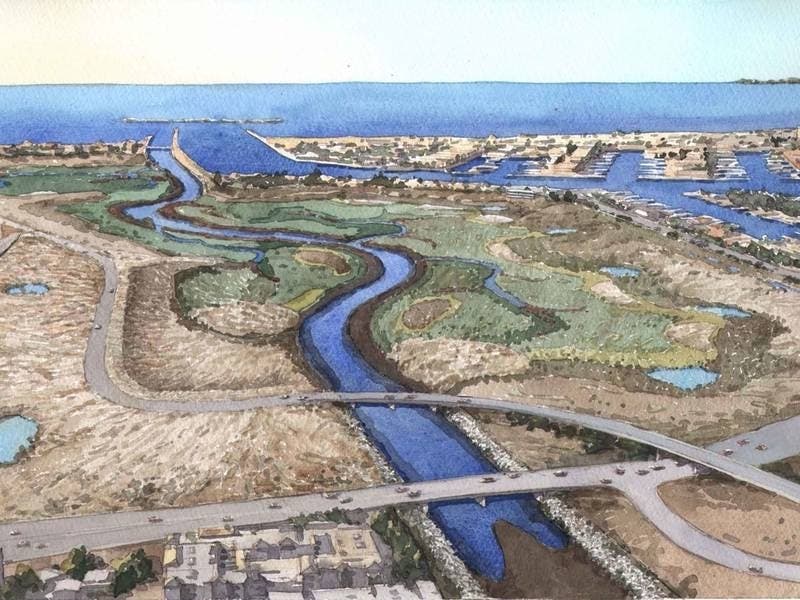
The Ballona Wetlands Ecological Reserve, located in the City of Los Angeles and partially within unincorporated Los Angeles County, California, is bisected by and includes a channelized reach of Ballona Creek. It is traversed by Culver, Jefferson, and Lincoln Boulevards. What once were more than 2,100-acres of marshes, mud flats, salt pans, and sand dunes currently provides approximately 153 acres of wetland habitat, as well as 83 acres of non-wetland waters of the U.S. (including navigable waters of the U.S.). All aquatic resources within the reserve are degraded. The California Department of Fish and Wildlife (CDFW) proposes a large-scale restoration that would entail enhancing and establishing native coastal aquatic and upland habitats within the Ballona Reserve. The proposal is intended to return the daily ebb and flow of tidal waters where practically feasible to achieve predominantly estuarine conditions, maintain freshwater conditions, and enhance physical and biological functions within the Ballona Reserve. To implement the proposal, CDFW is working with the Los Angeles County Department of Public Works-Flood Control District (LACFCD) to modify Los Angeles County Drainage Area (LACDA) project features (Ballona Creek channel and levee system), a Federal flood risk management project operated and maintained by LACFCD, within the Ballona Reserve.
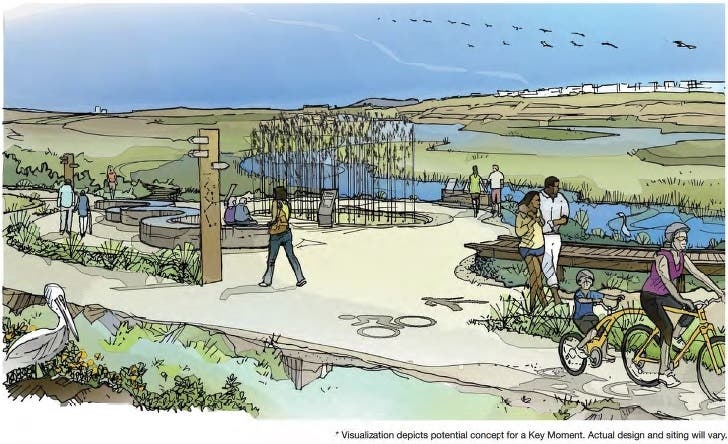
This Draft EIS/EIR evaluates the potential environmental effects of three alternatives to restore wetlands, other aquatic resources, and adjacent habitats within the reserve (Alternatives 1, 2, and 3) and a no Federal action/no project alternative (Alternative 4) that reflects conditions that would result (including from sea level rise) if no Federal, state, or local discretionary approvals were authorized. To varying extents, each of the restoration alternatives would enhance and create native coastal wetland, other aquatic resources, and upland habitats; improve flood and storm water management in the surrounding area; provide public access and visitor amenities; and modify infrastructure and utilities within the reserve to support the restoration efforts.
Find out what's happening in Marina Del Reyfor free with the latest updates from Patch.
Alternative 1: Full Tidal Restoration/Proposed Action would be implemented within an approximately 483 acre area and would remove existing levees, create a sinuous (i.e., non-linear) Ballona Creek channel with two primary meander-shaped bends, restore contiguous tidal wetlands and other aquatic resources north of Culver Boulevard, and enhance managed wetlands south of Culver Boulevard. Alternative 2: Restored Partial Sinuous Creek would occur in an approximately 426 acre area. It would realign the channel in a manner similar to
Alternative 1, but would only restore full tidal wetlands in a portion of the area relative to Alternative 1. Alternative 3: Levee Culverts and Oxbow would occur in an approximately 163 acre area, but would not remove existing levees (leaving the channel as-is). It would focus restoration efforts north of the channel and west of Lincoln Boulevard. Alternative 4: No Federal Action/No Project would have no active restoration or enhancement and would maintain existing activities and conditions.
Answer: Griffith Park!
Find out what's happening in Marina Del Reyfor free with the latest updates from Patch.
Enjoy your Ballona Wetlands!