Politics & Government
Ballona Wetlands Restoration Project: Toward a Final EIR
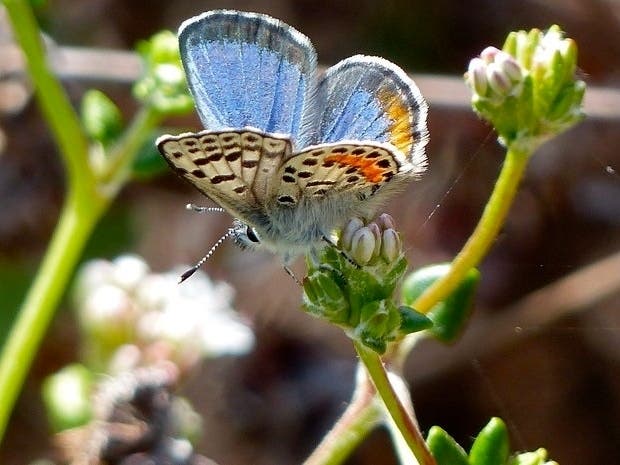
Comments on the El Segundo Blue Butterfly Highlight the EIR Process



Most people know that an Environmental Impact Report (EIR) is a key step to ensure that a major project – whether a roadway, housing project or wetlands restoration – proceeds in a way that is least harmful to the environment. People also generally know there is a period during which any member of the public may comment on an EIR. However, I have found that the entire EIR process is not widely understood, mainly because folks think it's not all that relevant to the general public’s interest or participation. In short, it can be pretty boring stuff.
A project’s EIR must follow the regulations, guidelines and case law of California's Environmental Quality Act (CEQA), thoroughly refined since enacted in 1970 (1). CEQA requires that an EIR analyze the proposed project and a reasonable number of feasible alternatives to the proposed project, including a No Project alternative. The analysis must be factual, credible and must identify the project’s impacts on the environment; impacts including but not limited to traffic, air quality, water quality, visual resources and biological resources, to mention only a few. The EIR need not analyze the impact of the environment on the project. For example, sea level rise may impact a proposed coastal project in the future, but that impact need not be analyzed in the project EIR (although it may be analyzed for other purposes). Also, if an EIR finds that a project may impact the environment, that does not mean the project may not go forward. In fact, the EIR process includes developing project requirements that will minimize or eliminate impacts and allow the project to proceed.
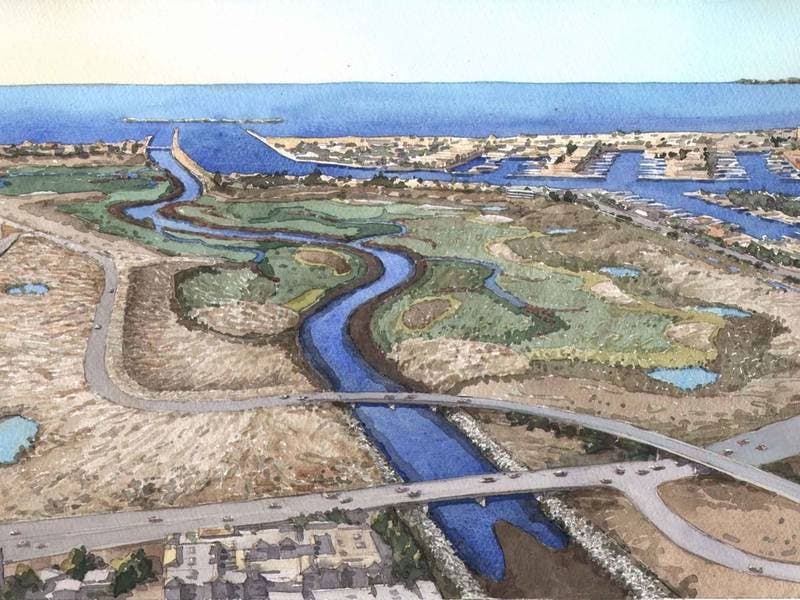
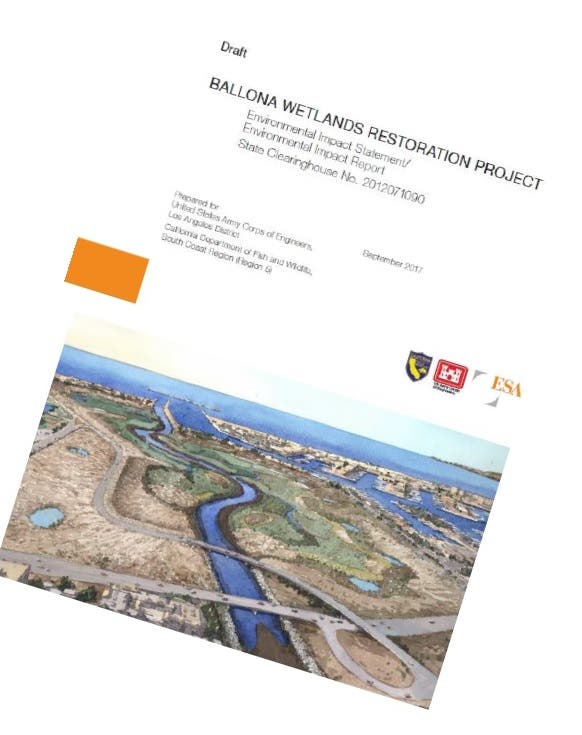
For the Ballona Wetlands Restoration Project, the Draft EIR was published in 2017, opening a public comment period of several months (a minimum of 30 days is required). Today, the California Department of Fish and Wildlife (CDFW), the project proponent and lead agency under CEQA, is hopefully finishing its review of received comments. CDFW writes responses to each and every comment received, and publishes those responses in the Final EIR, which I hope will be approved before year's end.
Find out what's happening in Marina Del Reyfor free with the latest updates from Patch.
CDFW may write a brief or lengthy response, depending on the comment. CDFW may add information to the Final EIR as a result of technical points raised in a comment that might not have been considered or thoroughly addressed in the Draft EIR. In the end, the EIR must fairly consider and respond to all reasonable comments, but our courts have said a Final EIR need not be “perfect”. How close to “perfect” an EIR must be is usually the basis of an EIR lawsuit, and will likely be the case for Ballona. This typically adds a few years to a project schedule, but ensures a court-decided “end” to the EIR process.
Once approved and litigated, the EIR serves as an informational document on which various regulatory agencies base permits they may issue to allow the project to proceed, either in its proposed form or with modifications. For the Ballona Wetlands Restoration Project, the Coastal Commission must issue a Coastal Development Permit, which will contain conditions including, but not limited to, any requirements deemed by the Final EIR as necessary to minimize the project’s environmental impacts. These “conditions” are known technically as “mitigation measures.” For example, a typical mitigation measure for air quality in a Final EIR might read that dirt roads be periodically watered to prevent dust from construction vehicles.
Find out what's happening in Marina Del Reyfor free with the latest updates from Patch.
The CDFW will also need to grant itself a permit for construction in wetlands, as well as an Incidental Take permit, which allows an endangered species or its habitat to be harmed as an unintended or unavoidable consequence of the project.
CDFW and its sister federal agency, the U.S. Fish and Wildlife Service (USFWS), routinely issue Incidental Take permits. Put simply, incidental "take" of an endangered species or its protected habitat is allowed only if the impact will not significantly adversely affect the species’ long-term survival, and if mitigation measures designed to prevent or minimize take are imposed. Agency experts on the specific species decide these matters based on field data and knowledge of the condition of the species (2).
The El Segundo Blue Butterfly, a federally-listed endangered species, provides a good platform for examining the public comment and CDFW response part of the Ballona project EIR process; the period which we presently find ourselves in. Last week, I wrote a Patch article (3) on the butterfly’s recovery at the Ballona Dunes, and I received comments on the article. What follows below are those comments (paraphrased), followed by my responses.
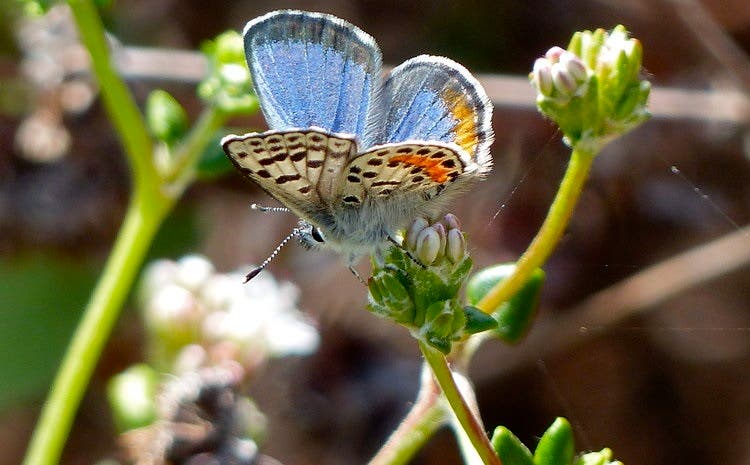
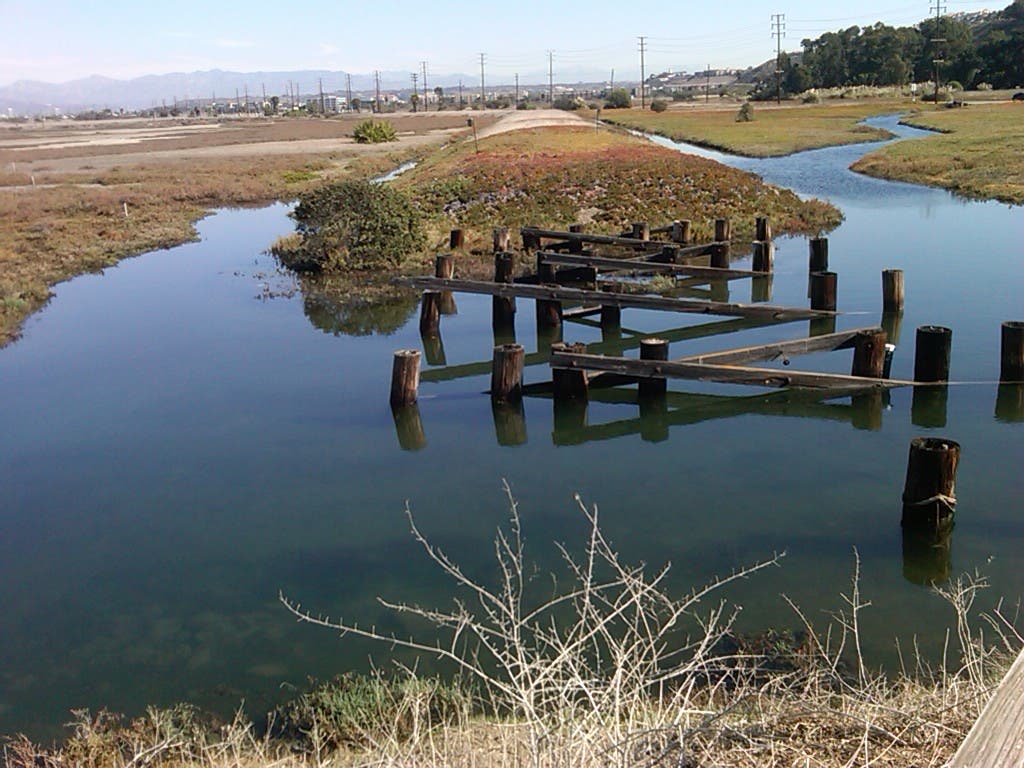
These few, narrowly focused comment/response examples will be multiplied by the hundreds in the CDFW’s Final EIR for the Ballona Wetlands Restoration Project. This should give you a good sense of the extent to which our regulatory agencies analyze a project’s potential impacts to the environment before they even consider issuing or seeking a permit for a project to proceed. For the San Dieguito Wetland Restoration Project near Del Mar, a project of comparable size and scope to Ballona, the lead agency received hundreds of individual comments and prepared 122 pages of comment responses (4). I expect the effort for Ballona will be far greater.
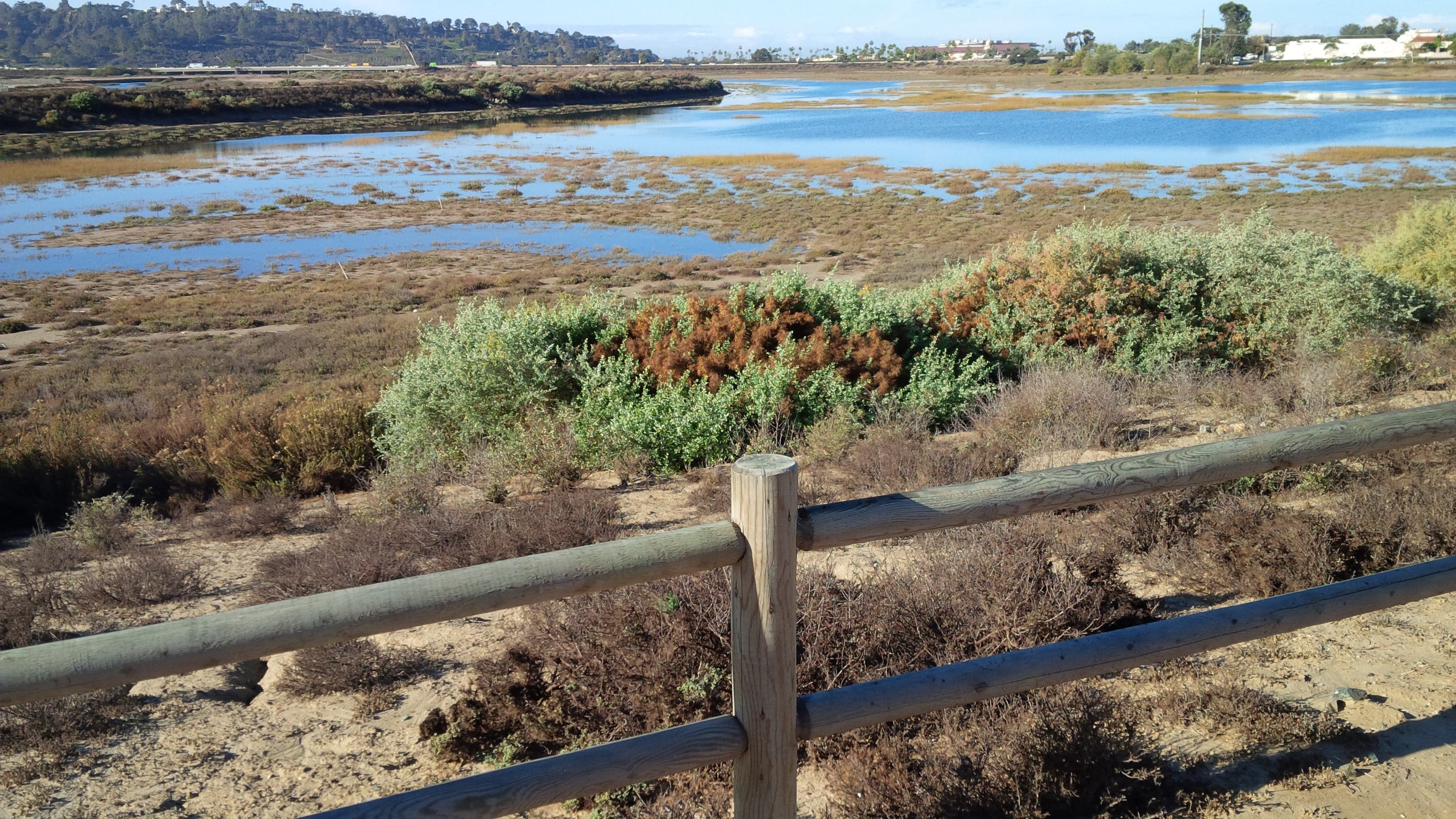
Above: The eastern third of the San Dieguito Wetlands Restoration Project, near Del Mar, as seen from a public trail constructed as part of the project. Note the vegetated flood control levee in the photo at upper left.
Blue Butterfly Comment and Response Examples
Comment: I differ with your opinion that [the Ballona Wetlands Restoration Project] will not impact El Segundo Blue Butterfly (ESB).
Response: It's important to distinguish "impact" from "adverse effect." The Ballona project may indeed adversely affect individual ESB larvae, adults, or buckwheat plants upon which they depend, but those effects do not constitute a significant impact. Table ES-1, Page ES-21 of the EIR states that impacts to the El Segundo Blue Butterfly (ESB) would be “Less than Significant” if mitigation measures BIO-1b-i, ii and iii are implemented. These measures are spelled out at the end of References below, and are similar to mitigation measures customarily required of virtually all projects having potential to impact species listed as endangered by either the California or Federal Endangered Species Acts (CESA/FESA). When followed, the mitigation measures ensure that impacts to the species at issue are reduced to a level of either “Less Than Significant” or “Not Significant”, both terms which are defined in state and federal law, and by longstanding case law. These terms do not mean that a single or even multiple individuals of the endangered species will not be harmed. It means that such harm, should it occur, would not jeopardize the continued existence of the species or its target population.
Comment: The [EIR] assumes that there are "unoccupied" buckwheat plants at the Dunes. The butterfly dispersed from LAX to the wetlands, it certainly will be using all of the plants at Ballona and at the very least they must be assumed to be occupied.
Response: Page 3.4-89 of the EIR states that no direct impacts to suitable or occupied habitat for El Segundo blue butterflies would occur. That ESB will occupy all available buckwheat plants at the Dunes is speculative. Nevertheless, even if all buckwheat plants at the Dunes and elsewhere in the Reserve are assumed to be occupied by ESB, this would not change the EIR conclusion of Less than Significant impact if mitigated, as noted above. Minor removal of or other adverse construction effects to buckwheat, occupied or not, is not significant per the meaning under CEQA, the FESA or the CESA unless it “jeopardizes the continued existence” of the local ESB population. In the Case of the Ballona Project, the impacts do not create such jeopardy (EIR Pages 3.4-78 and 3.4-89).
The judgment of Less than Significant impact may also consider the potential net benefits to ESB from the expansion of coastal sage scrub (CSS) habitat created by the proposed Ballona Wetlands Restoration Project. Nearly 100 acres of new CSS habitat will be created in Area C North and South, and on the upper (+5’ elevation) slopes of all constructed levees. Buckwheat is a dominant species of CSS native seed mixes (5) used for revegetation, and the ESB will benefit when buckwheat plants mature. The proper approach for any major habitat restoration project of this type is to ensure that existing natural habitat areas are expanded where possible, even if smaller existing habitat areas are converted for other uses (such as for flood control and recreational access, at Ballona).
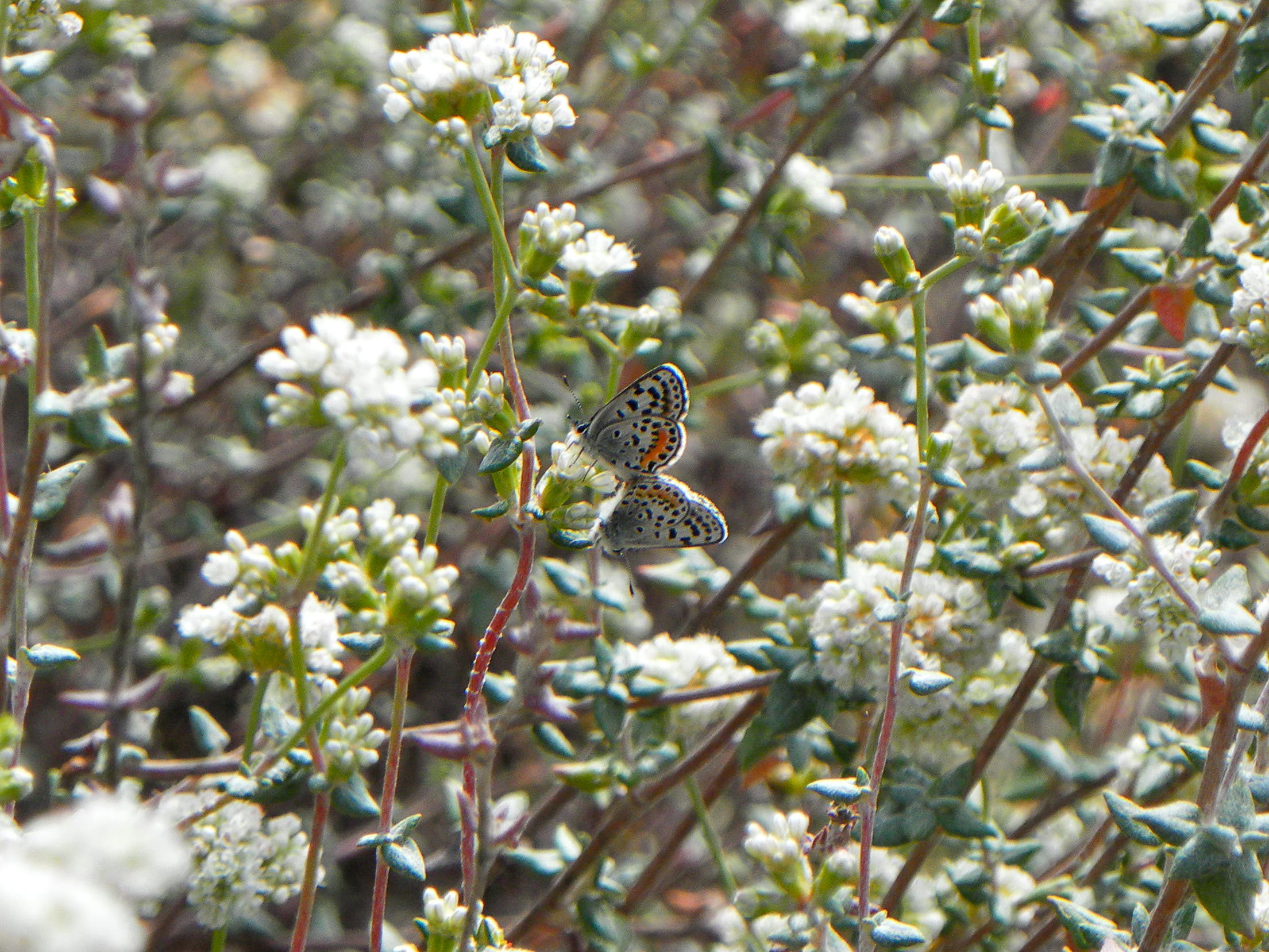
Above: Coastal Buckwheat, the foodplant of the El Segundo Blue Butterfly.
Comment: The tall levees that would be constructed between the dunes and the wetlands would extend up to and over some patches of foodplant [buckwheat]. It would be impossible for the project not to have "take" of the butterfly's foodplant, even before considering the footprint of impacts during construction as opposed to the design extent.
Response: There is no federally designated critical habitat anywhere within the Ballona Wetlands Restoration Project Area (6)(EIR, Pages ES-20,21). Therefore, project impacts to buckwheat (foodplant) there would not constitute take as defined by the CESA and FESA. Take of an endangered species’ habitat (and let’s assume all buckwheat at Ballona is occupied, as asserted) is still appropriate and permissible by law if such take will not jeopardize the continued existence of the species or population at issue. This holds true even if the habitat is officially designated and mapped as critical habitat by USFWS (7).
Based on surveys performed by permitted ESB experts employed for the EIR studies, no such significant adverse effects to ESB will occur as a result of the Ballona Wetlands Restoration Project, provided the aforementioned mitigation measures are implemented. As an added factor of safety for ESB, CDFW and USFWS must revisit and reaffirm this determination during the course of consultation under Section 7 of the federal Endangered Species Act. This consultation must take place in advance of issuing Incidental Take permits, and only after the Final EIR is approved and litigated to closure.
Comment: The project management plan acknowledges that pesticides will be used to control mosquitoes, midges, and/or black flies at the Ballona site but does not say where. The plan describes the use of Bacillus thuringiensis (Bt) as a control agent. Bt is a known pathogen of lycaenid butterflies (the group that El Segundo blue belongs to), and lycaenid larvae exposed to Bt experience mortality in a dose-dependent relationship (that is, more Bt kills more larvae). Until it is clarified that Bt or other pesticides would never be used anywhere near the ESB habitat, this impact could be assumed.
Response: This is true. Consequently, the Incidental Take permit (ITP) ultimately issued for the Ballona Wetlands Restoration Project covering ESB may contain a mitigation measure requiring that certain pesticides injurious to ESB not be used in or near areas of known ESB occupation, and/or during the species’ vulnerable life cycle periods. The ITP may additionally require that occupation be determined annually through species-specific protocol surveys. The Coastal Development Permit could also include an identical condition.
ESB can be protected simply by thoughtful, science-based operation and maintenance practices on the Reserve Lands, as routinely practiced by CDFW at ecological reserves across California. Los Angeles County’s West Vector Control District (LACWVCD) must also adhere to conditions or restrictions placed on Reserve lands. As stated in the Ballona EIR, “all monitoring and management of special-status species would conform to the policies and guidelines set by CDFW and the U.S. Fish and Wildlife Service (USFWS).” The CDFW additionally states on Page 2-157, “it is CDFW’s intent that future vector control activities within the Ballona Reserve would be coordinated between LACWVCD and CDFW.”
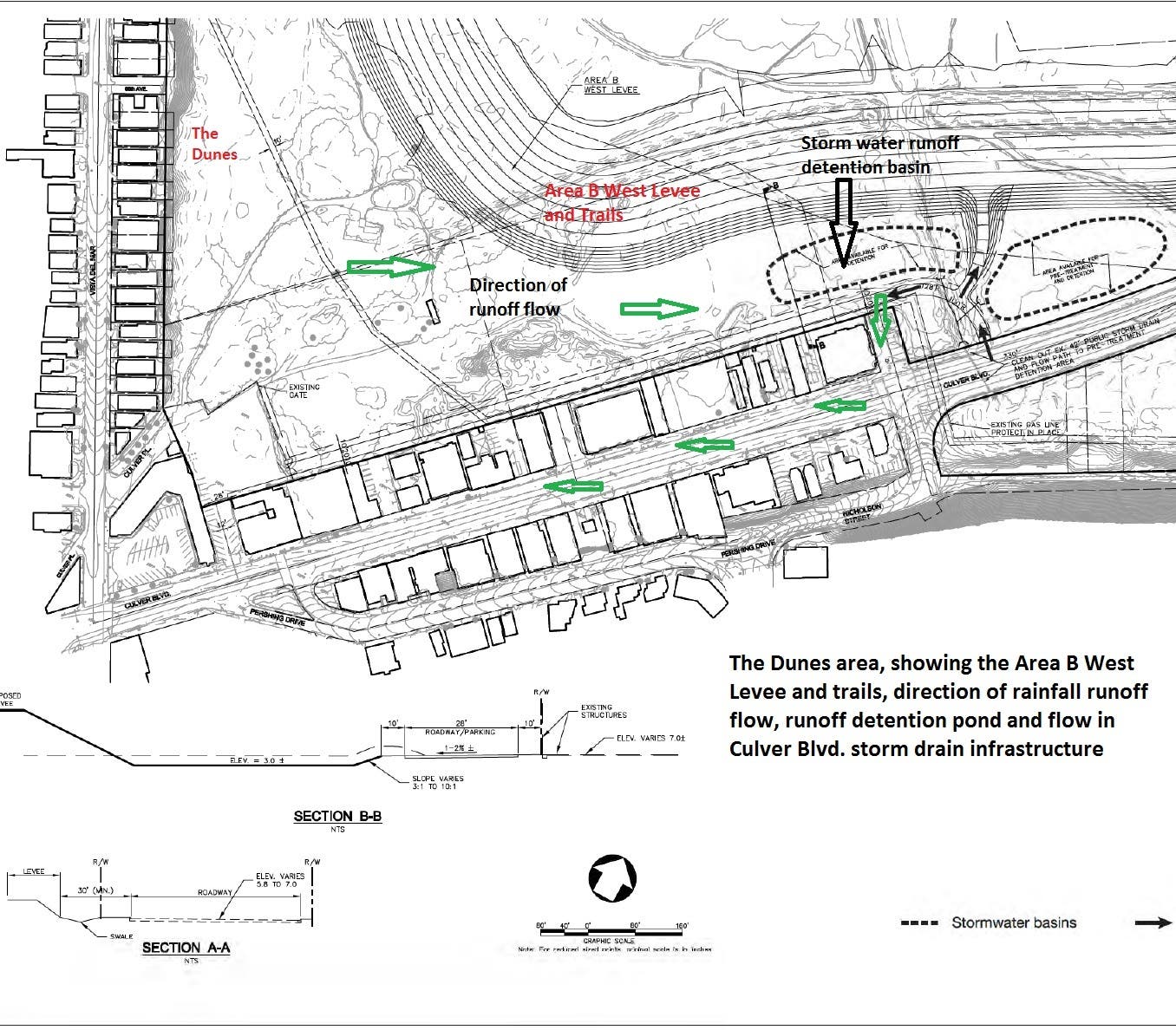
Above: Diagram of the Dunes area grading plan and storm water runoff management.
Comment: The project would construct a levee that would block water from the dunes area from flowing down into the wetlands (you'd have to climb up over the levee to be able to get to the wetland) and storm water would have to drain through a pipe under the levee. If that pipe were ever blocked, the dunes area would flood, and the pupae of the ESB with it. This concern, along with the others was raised in comments on the Draft [EIR].
Response: The Dunes area is highly permeable windblown sandy soil where standing water remains only very briefly, and only after heavy and extended rainfall. Adapted for in-soil residence throughout the wet winter months, ESB pupae are not vulnerable to infiltrating rainfall or even occasional sheet flow runoff during heavy rains. Regardless, how actual rainfall runoff presently flows from the Dunes area, how it will flow through new infrastructure after the Area B West Levee is constructed, and standards for drainage infrastructure maintenance do not support your comment.
First, grading plans in the EIR show no drain pipes installed beneath the Area B West Levee near the Dunes (See figures 2-14 and 2-15 of the EIR/S). No drain pipes can be placed through the Levee adjacent to the Dunes because that structure is designed to prevent Ballona Creek flood flows and tidal inundation from reaching lower Playa Del Rey. A drain pipe through the levee at the Dunes would defeat the levee’s primary flood protection purpose.
Second, simple inspection of the grading plans and inspection of Google Earth GIS shows the entire Dunes existing trail at 7 feet elevation and the Dunes themselves higher still, while the areas to the south and east at elevation 6 feet and lower. In the event of a runoff-producing rainfall event, water will not accumulate in the Dunes area, since water tends to flow downhill. Water will drain south and east into Culver Boulevard’s existing storm water catch basins via new 20-30 foot wide bio-swale cleansing and detention basins proposed for the Project (see Figure 2-15, and Page 2-69 bio-swale).
From the detention basins, rainfall runoff at the Dunes will eventually flow through existing storm water capture and conveyance infrastructure, and then west into the ocean, as it does today. The levee will not hinder rainfall runoff drainage in the Dunes area or cause ponding, except in the bio-swale constructed for that purpose. There will be no future change to Dunes area rainfall runoff flow from the present condition due to the Project.
Third, drainage infrastructure “clogging” assumes that no routine maintenance of the Culver Boulevard storm drain infrastructure will occur. Culverts and street catch basins in particular are routinely inspected and cleaned, and additionally cleaned on an emergency basis during storms in flood-prone areas such as western Culver Boulevard. As noted on Page 2-156 of the EIR, the City and County infrastructure maintenance that occurs today will continue to be performed after the Area B West Levee and new drainage infrastructure are operational.
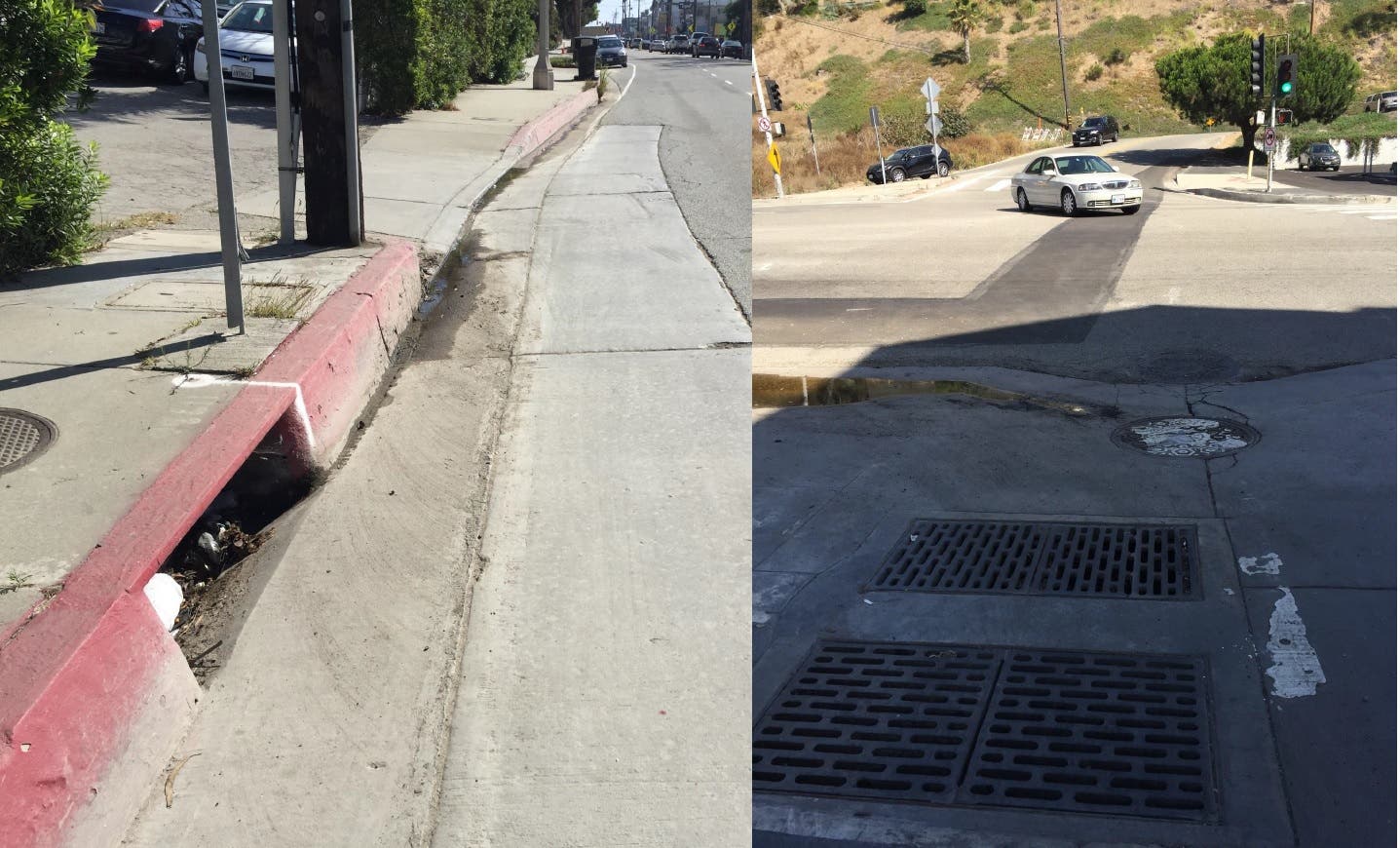
Above: Storm water conveyance infrastructure west of Nicholson Ave. carries all runoff west of that street to the ocean.
Comment: [Not] everyone would enjoy the Dunes as much if the view to the wetlands were cut off by a huge levee as is proposed under the State's preferred alternative.
Response: This is true. The Area B West Levee will be approximately eleven feet above existing grade and approximately 250 feet away from the Dunes area presently accessible by footpath. While correct that someone visiting the Dunes might object to seeing a 3:1 vegetated slope in the distance versus the existing saltmarsh view, the law requires that aesthetic impacts be evaluated objectively in the context of various federal, state and local land use and scenic ordinances, and for the project as a whole. The EIR considers this context using a customary, rational evaluation employing widely accepted methods (EIR Section 3.2.5), including the use of before/after photo/simulation pairs at Key Observation Points (EIR, Section 3.2). Two Key Observation Points (KOP), Nos. 9 and 10, are located atop the proposed levee adjacent to and at the Dunes, respectively.
For the Ballona Wetlands Restoration Project as a whole, this evaluation concludes that the project would not have a substantial adverse effect on a scenic vista, would not damage scenic resources, and would not substantially degrade the existing visual character of the site and surroundings. Readers can inspect the before/after photo/simulation pairs below for KOPs 9 and 10, and decide for themselves.
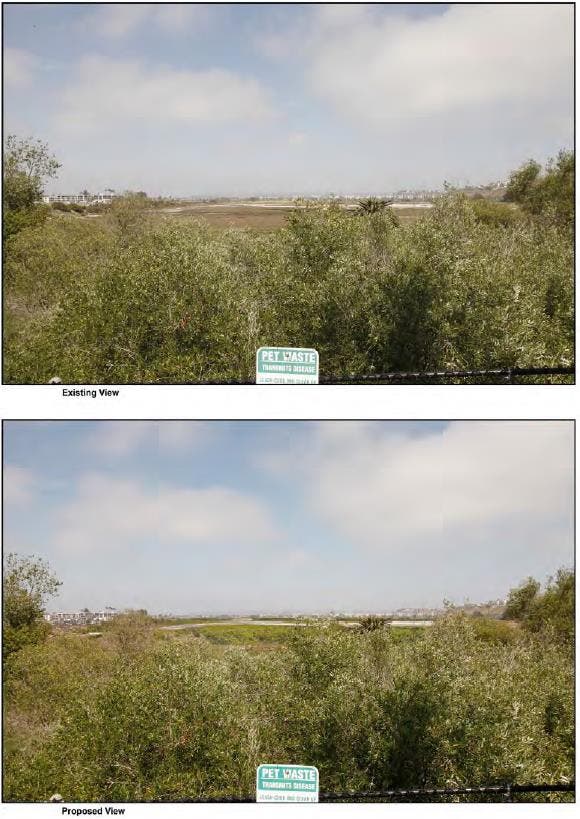
Above: KOP No. 10. before/after photo/simulation of the eastward view from the Dunes area.
The Area B West Levee will also support a new bike and pedestrian pathway connecting the Dunes area to the existing coastal bike path as well as to adjacent restored wetland areas to the east. This access does not currently exist and will afford users new, unobstructed wetlands views in all directions for the roughly 6000 foot length of the new combined levee/trail. The photo/simulation pair from KOP No. 10, taken from the existing observation platform atop the historic railroad grade, represents the view from this future levee-top trail adjacent to the Dunes area.
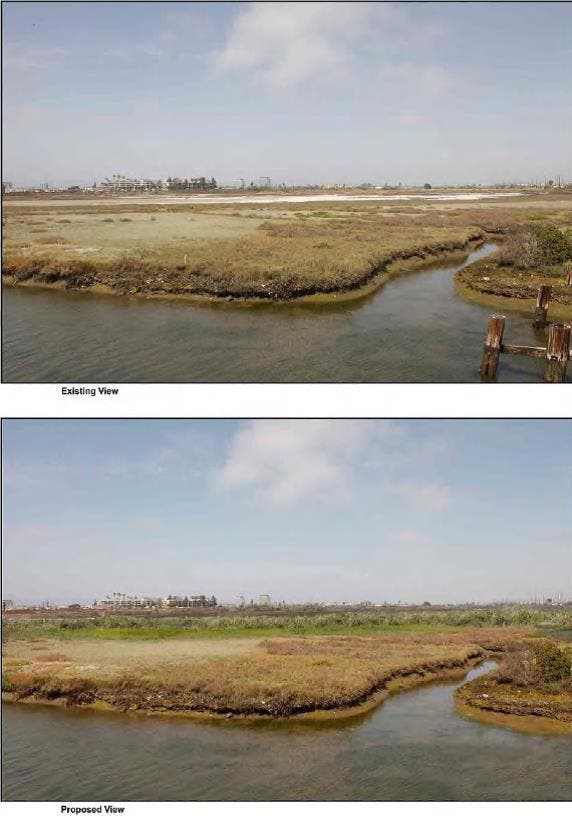
Above: KOP No. 9. Before/after photo/simulation of the eastward view from the future bike/foot path to be built atop the Area B West Levee.
To balance public interests affected by a major project such as the Ballona Wetlands Restoration, policymakers weigh the recreational and aesthetic benefits to the many people who will ride or walk through the Dunes area against the visual impacts perceived by perhaps the fewer who are presently familiar with existing eastward views from the Dunes area. Individual perceptions of visual impacts are important and must be considered, but do not necessarily override broader considerations of land improvements made in the public interest. Even in cases where the courts have ruled in favor of “lay public opinion” regarding visual, aesthetic impacts, only widespread public opinion persuaded the court, and then only to force a city to prepare a project EIR and analyze aesthetic impacts (8). A project EIR with such analyses has, of course, already been prepared for the Ballona Wetlands Restoration Project.
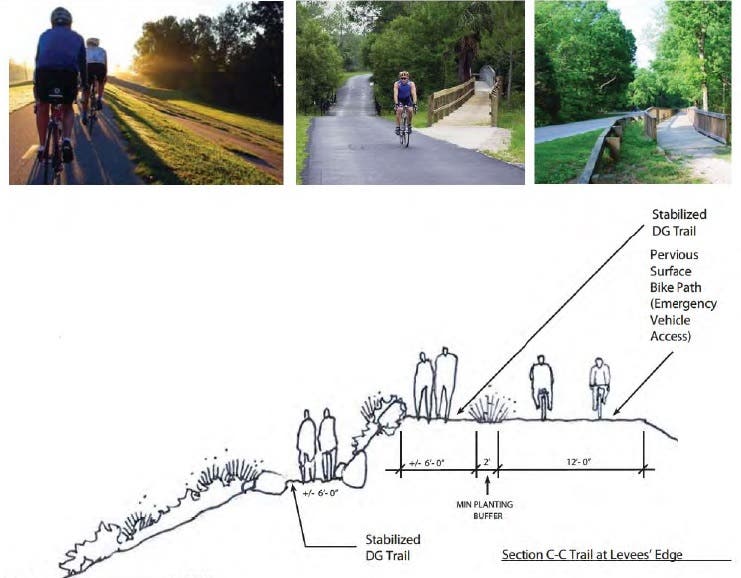
Above: Multiple Use trail design for the top of the Area B Levee will allow 360 degree views of the Ballona Ecological Reserve.
Aside from aesthetics, a broader perspective is proper for a project of this magnitude and regional importance when considering a design element such as the Area B West Levee. The Levee performs four critical functions without which the State of California’s stated goals for Ballona simply cannot be achieved. The levee (1) protects lower Playa Del Rey from tidal flooding when the existing tide gates are removed, (2) allows for removal of those tide gates to ensure full tidal exchange for presently degraded saltmarsh to the east, a longstanding key state goal for any Ballona Restoration plan, (3) facilitates the aforementioned new bike and pedestrian paths, required by public access policies of the Coastal Commission and pursuant to the Coastal Act, and (4) repurposes fill dirt excavated from Areas A and C, thereby preventing significant, unmitigatable air quality, traffic and transportation impacts were the fill dirt to be transported by trucks out of the area for disposal.
Enjoy your Ballona Wetlands!
References
(1) California Natural Resources Agency. CEQA. http://resources.ca.gov/ceqa/more/faq.html
(2) California Department of Fish and Wildlife. Incidental Take Permits. https://www.wildlife.ca.gov/Conservation/CESA/Incidental-Take-Permits
(3) Endangered blue butterfly recovery continues at Ballona. Marina Del Rey Patch. July 13, 2019. https://patch.com/california/marinadelrey/endangered-blue-butterfly-recovery-continues-ballona
(4) U.S. Fish and Wildlife Service and San Dieguito River Park Joint Powers Authority. 2000. Environmental Impact Report/Environmental Impact Statement (EIR/EIS) for the San Dieguito Wetlands Restoration Project. State Clearinghouse No. 98061010.
(5) Las Pilitas Nursery. Coastal Sage Scrub. https://www.laspilitas.com/nature-of-california/communities/coastal-sage-scrub
(6) California Department of Fish and Wildlife and U.S. Army Corps of Engineers. 2017. Environmental Impact Statement/ Environmental Impact Report for the Ballona Wetlands Restoration Project. State Clearinghouse No. 2012071090 https://nrm.dfg.ca.gov/FileHandler.ashx?DocumentID=149710&inline
(7) USFWS. 2016. Critical Habitat Portal. http://ecos.fws.gov/crithab/.
(8) Arthur F. Coon. Miller Starr Regalia, December 18, 2018. When CEQA gets ugly: Third District holds lay public opinion supports fair argument that project may have significant aesthetic effect requiring EIR. https://www.ceqadevelopments.com/2018/12/18/when-ceqa-gets-ugly-third-district-holds-lay-public-opinion-supports-fair-argument-that-project-may-have-significant-aesthetic-effect-requiring-eir/
Appendix - EIR Mitigation Measures for the El Segundo Blue Butterfly:
Mitigation Measure BIO-1b-i: Special-Status Plants. Known special-status plant populations shall be flagged by a qualified biologist/botanist prior to the start of vegetation or ground-disturbing activities, and shall be avoided to the extent feasible. Prior to any vegetation or ground disturbance, a qualified biologist/botanist shall conduct rare plant surveys at the appropriate time of year to determine whether special-status plant populations have established, expanded and/or migrated on-site. If new individuals or populations are identified during the rare plant surveys, they shall be flagged for avoidance to the extent feasible.
During site restoration, qualified biologists, or experienced contractors with supervision by a qualified biologist, shall re-establish impacted species in restored habitat on site at a minimum ratio of 1:1 (number of plants established: number of plants impacted). Perennial species such as woolly seablite shall be salvaged and transplanted wherever feasible. For both perennial and annual species, seed shall be collected prior to restoration during the appropriate time of year (August/September for woolly seablite and May/June for Lewis’ evening primrose). Seeds shall be propagated in a local nursery and incorporated into seed mixes for suitable habitat types (transition zone seed mix for woolly seablite and upland/dune seed mix for Lewis’ evening primrose).
Re-establishment and subsequent monitoring efforts for impacted special-status plant species shall be implemented as described in the Habitat Restoration and Monitoring Plan (Habitat Restoration and Monitoring Plan), and in accordance with appropriate local, state, and Federal policies or regulations. The Habitat Restoration and Monitoring Plan shall provide methodologies covering, but not limited to, collection of seeds or other propagules, storage of salvaged materials, locations of salvaging efforts, timing of salvaging efforts, monitoring of salvaged materials, success criteria, and remedial actions, and include the mitigation requirements described in this mitigation measure.
Mitigation Measure BIO-1b-ii: Biological Monitoring. A qualified biologist(s) approved by USFWS and/or CDFW shall monitor restoration activities, such as ground and vegetation disturbance, for the duration of the Project to ensure that disturbance of habitat and special-status species within and adjacent to work areas is being avoided to the extent practicable. Attempts shall be made by the biologist to salvage all native wildlife species of low mobility that may be killed or injured prior to and during Project-related vegetation or ground disturbances. Salvaged species should be relocated to adjacent suitable habitat not subject to site disturbances. Any non-native flora or fauna can be abated by the biologist through any legal means available to CDFW. Additionally, ongoing monitoring and reporting shall occur for the duration of the restoration activity to ensure implementation of best management practices (BMPs).
Mitigation Measure BIO-1b-iii: Noxious Weed Control Plan. A Noxious Weed Control Plan shall be prepared by a qualified biologist for CDFW approval prior to the start of restoration. The plan shall ensure that noxious weeds do not spread or otherwise prevent the establishment of native vegetation. The plan shall also be implemented during all restoration-related activities, and shall include, but not be limited to, the following: 1) control measures for selected invasive plant species on the site (potentially including herbicide use), 2) Project-specific procedure for handling noxious/invasive plants to prevent sprouting or regrowth, 3) Project-specific equipment cleaning procedures, and 4) Project-specific transportation of vegetation debris off site. The Noxious Weed Control Plan shall be reviewed during the WEAP training. (Page ES-21).