Business & Tech
Smog-Producing Hydrocarbons Leaking from Refinery
Maximum penalties for Chevron plant set at $25,000 a day.
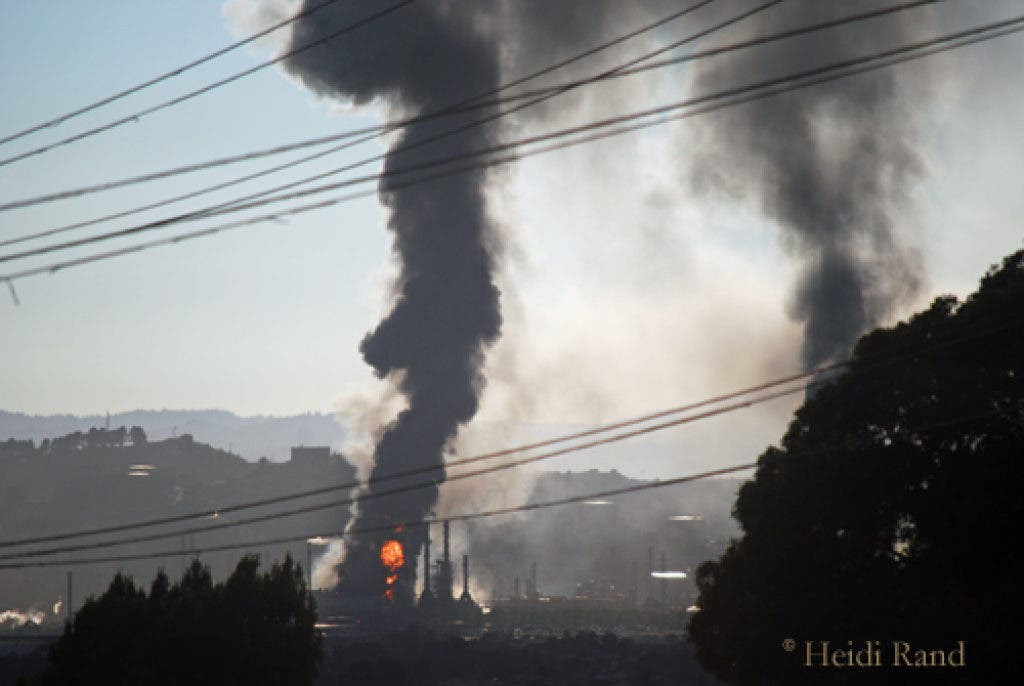
Smog-producing hydrocarbons are still leaking at unlawful levels at the Chevron oil refinery in the wake of the Aug. 6 fire there, but pollution control officials said they expect to stop it by tomorrow.
Chevron could face fines of $25,000 for each day per violation.
"The leak has been isolated, and will stop as soon as tomorrow," said Dan Tillema, a chemical incident investigator for the U.S. Chemical Safety and Hazard Investigation Board, during a public briefing about government inquiries into the refinery disaster at the Richmond City Council Chambers. While the exact size of the hydrocarbon leak has yet to be verified, the Bay Area Air Quality Management District estimates that it is 5,000 parts per million, a low level still considered a violation of federal air quality standards that are monitored by the district.
Find out what's happening in Martinezfor free with the latest updates from Patch.
"We are going to look at all of (Chevron's) processes and all of their equipment and set the maximum penalties," said Jack Broadbent, the district's chief executive officer, who added that the maximum fine is $25,000 for each day pollution standards are violated. Tillema and Broadbent were among four representatives of city, county and federal agencies who discussed the progress of investigations into the refinery fire today before more than 100 people at Richmond City Hall.
Four separate government agencies have launched probes into the fire, including the U.S. Environmental Protection Agency, California Occupational Safety and Health Administration, the chemical safety board and the air quality district. Chevron is also investigating the accident at its facility.
Find out what's happening in Martinezfor free with the latest updates from Patch.
Melissa Ritchie, spokesperson for the company, acknowledged that hydrocarbons were still leaking from the plant, but that company structural engineers say it is too unsafe to go near the facility's crude unit, where the leak is coming from.
"We are cooperating with all of the investigative agencies," Ritchie said. "Once we learn the cause of the incident, we want to make sure that this will never happen again."
Daniel Meer, assistant director of the EPA, told the audience the agency's efforts center on whether Chevron violated Section 112R of the federal Clean Air Act, which could result in fines and court-imposed changes to its operation of the refinery. Officials believe the refinery accident happened when crude oil escaped through a corroded pipe, triggering a huge blaze that sent large plumes of sulfur-infused smoke and soot that drifted into Richmond and neighboring cities. Odors from the plumes were noticed as far away at San Joaquin County.
Within days, nearly 15,000 people were admitted to area hospitals, complaining of ailments such as breathing problems and eye irritation.
Before the accident, the Richmond facility could process up to 248,000 barrels of crude oil a day, mostly to produce gasoline. Part of the refinery is still operating, producing transportation fuel, Ritchie said.
Government investigations into the fire will examine the crude unit, where gas, oil, diesel, kerosene and naphtha are separated during a heating process. The air quality district also will scrutinize the role the refinery's flare -- a tall stack with a burning flame used as a safety device -- played in the blaze, Broadbent said.
For his team to look into the Chevron blaze, Tillema chose three people who investigated the Deepwater Horizon offshore oil spill that erupted in flames, killing 11 workers and sending nearly 5 million barrels of oil into the Gulf of Mexico off the Louisiana coast in 2010.
"The goal is to learn what can be done to avoid a future similar incident," said Tillema, who estimated that the probe would take 12 to 18 months. "It's a very broad, holistic look and not just on the pipe at this point."
He described communications between the chemical safety board and Chevron as "excellent." His team has so far interviewed 70 refinery employees and received 20,000 pages of documents from the company. Residents of Richmond and neighboring areas expressed outrage, saying the Chevron refinery has visited decades of illness and respiratory problems upon residents. It took the disaster for government agencies to kick into gear.
"How come you are not helping the people of Richmond?" Gerald Johnson, of Richmond, asked the panel. Johnson claimed that leakages from the Chevron plant are responsible for higher instances of diabetes and asthma in Richmond.
Communities for a Better Environment, an Oakland-based advocacy group, claimed today that based on its study of federal statistics, Chevron increased sulfur content in crude oil processed at the Richmond refinery from 1995-2012, which "can lead to leaks, spills, fires and other pollution incidents."
The air quality district's board plans to meet in San Francisco on Sept. 10 to consider enforcement and other actions concerning the refinery accident, Broadbent said.
-- Bay City News Service