Politics & Government
All Volunteer Fire Brigade In San Mateo County Wins Senator's "Oughta Be A Law ... or Not" Contest
State Senator Jerry Hill says under the proposed legislation, all-volunteer fire departments wouldn't have to pay sales tax on fundraising.


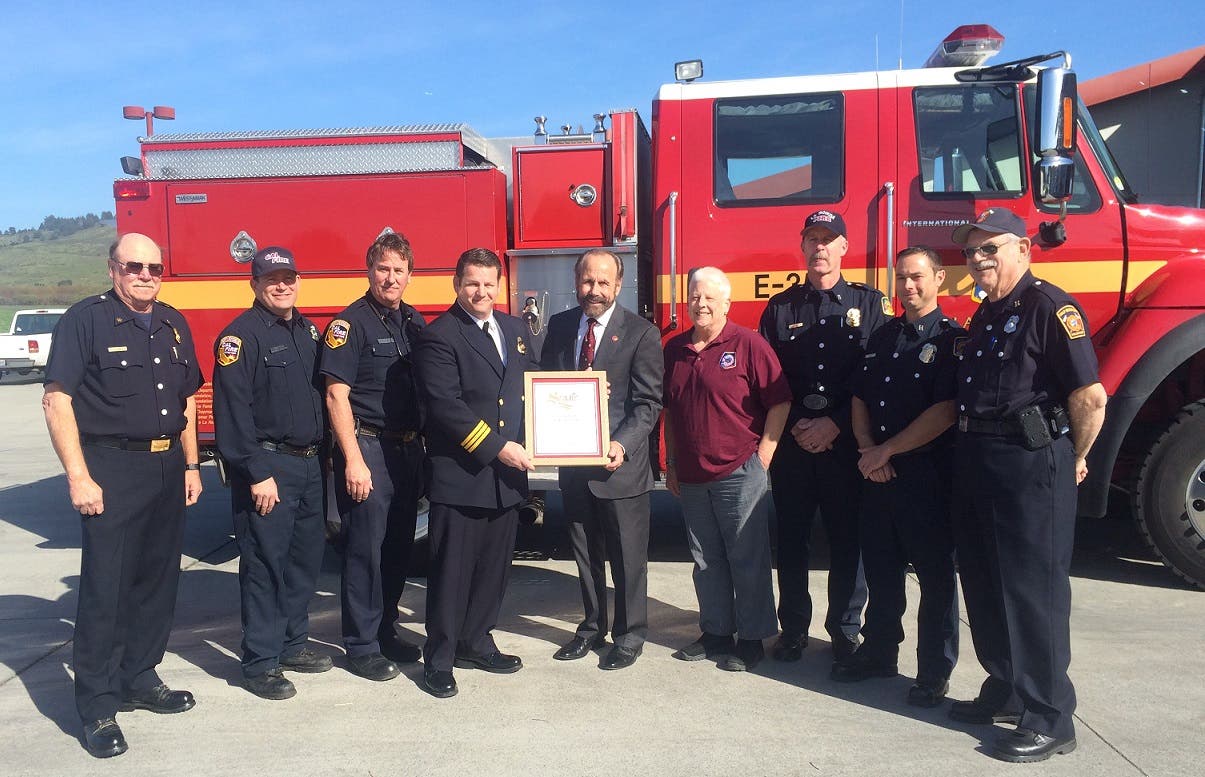
PHOTO: Senator Hill, joined by a CalFire representative and volunteer firefighters from Half Moon Bay, presents certificate to the La Honda Fire Brigade in recognition of their winning entry.
The following was submitted for publication by the office of Senator Jerry Hill:
Senator Jerry Hill, D-San Mateo County/Santa Clara County, Friday introduced legislation that would exempt California’s roughly 250 All-Volunteer Fire Departments from sales tax on fundraising activities. Senate Bill 598 was suggested by the La Honda Fire Brigade, the winner of Hill’s seventh annual “Oughta Be A Law … or Not” contest.
Find out what's happening in Menlo Park-Athertonfor free with the latest updates from Patch.
About 25,000 volunteer firefighters currently serve California. But unlike other non-profits, their departments have to pay sales tax for fundraising activities like pancake breakfasts, barbecues and T-shirt sales, which siphons critical dollars that could be used for equipment and other expenses to enhance their primary mission to protect lives and property.
The La Honda Fire Brigade in San Mateo County, for example, currently nets only $907.50 on a $1000 fundraiser (San Mateo County has a sales tax rate of 9.25 percent). If SB 598 is approved by the Legislature and signed into law by the governor, the brigade would get the full $1000.
Find out what's happening in Menlo Park-Athertonfor free with the latest updates from Patch.
Four of the six past winning entries of Hills contest have been signed into law. The La Honda Fire Brigade – which beat out nearly 400 entrants in this year’s competition – was honored by Hill on Thursday during an awards presentation at a fire station in Half Moon Bay.
Twenty-nine percent of California’s 835 fire departments are All-Volunteer Fire Departments, according to the California State Firefighters Association. These departments rely primarily on membership drives and fundraising activities to support their operational budgets. Passage of Hill’s legislation would allow these departments to better utilize scarce resources by exempting them from sales tax on income including, but not limited to, hot prepared food product sales and clothing sold in fundraising activities.
As a primary source of revenue, these fundraisers allow volunteer fire departments to purchase much needed building improvements, life-saving apparatuses, and fire engines to provide their services. La Honda’s department, for example, is currently raising money to replace its 26-year-old fire engine with a new one priced at $500,000. The department previously used fundraising events to purchase a $30,000 fire station roof. Additionally, volunteer departments continually need to purchase lifesaving breathing apparatuses, fire fighter suits and equipment priced between $4,000 and $6,000 per unit.
Under California law, not for profit organizations selling tangible personal property may qualify for an exemption for a specific activity if they operate in the public interest. These exemptions are justified based on the expectation that the forgone tax revenue will promote the public interest by allowing these organizations to sustain and develop their programs and public mission.
Examples of exemptions include nonprofit veterans’ organizations selling American flags and any charitable organization selling bracelets to commemorate Prisoners of War. Additionally, all organizations that sell food or personal property for programs to fund youth sports programs are exempt. Also, religious organizations selling prepared food are exempt from paying sales tax.
Below is a list of past winners of Hill’s “There Oughta Be A Law … Or Not Contest”:
2014 – Senate Bill 915
Mills High School parents Christine Noma and Paul Seto submitted the idea that led to legislation to establish further Advanced Placement testing procedures that prevent testing administration mistakes from negatively affecting students, schools and testing agencies. In July 2013, 641 Advanced Placement exams taken by 286 Mills High students were invalidated, despite the fact that no evidence of cheating was reported or found. The scores were thrown out on a technicality – a small handful of students, through no fault of their own, were seated incorrectly. Students were not provided an opportunity to retest until mid-August – months after the tests were given and too late for some graduating seniors to participate. SB 915, which was signed into law on August 22, 2014, requires a testing agency to immediately initiate an investigation upon learning of a complaint of inadequate or improper test conditions. The bill also requires a retest to be offered within 30 days of the completion of the investigation, if the testing agency determines that scores need to be cancelled. And the bill requires that seating charts be filled out for each test administered.
2013 – Senate Bill 589
Menlo Park resident Dan Hilberman submitted the bill idea that inspired legislation enabling individuals who vote by mail to confirm that their ballots were counted. “I’ve voted by mail for over a decade, but do not know if my vote counts because the registrar does not acknowledge my vote,” Hilberman wrote in offering his idea. SB 589 creates a “free access” system and provides county registrars with flexibility to determine how they want to comply with the legislation: They may notify voters on a walk-in basis, over the phone, or online. “The 2012 general election was the first time a majority of voters in California cast their ballots by mail,” said Hill. “As more voters chose this option, it’s critical that they be able to confirm their vote was counted.” Governor Brown signed SB 589 on September 9, 2013. The law takes effect on January 1, 2014.
2012 – Assembly Bill 2309
Corey Geiger and Alan Talansky submitted the 2012 winning idea, which was to create a pilot program linking the state’s community colleges with local chambers of commerce to promote business development and job creation. AB 2309 would have boosted business development by helping early stage business ventures with new ideas to either find funding or to reach the point of operating stability. The idea for a competitive grant program was intended to also recruit and coordinate businesses and investors from local communities to provide funding, sponsorship and internships. The bill passed the legislature with bipartisan support, but was vetoed by Governor Brown.
2011 – Assembly Bill 459
The constituent who won the 2011 contest asked to remain anonymous. The idea implemented the National Popular Vote for President, which reforms the Electoral College so that it guarantees the presidency to the candidate who receives the most votes nationwide. All of the state’s electoral votes would be awarded to the presidential candidate who receives the most popular votes in all 50 states and the District of Columbia. The bill would take effect only when enacted, in identical form, by states possessing a majority of the electoral votes—that is, enough electoral votes to elect a president (270 of 538). The bill has passed 30 legislative chambers in 20 states and is supported by more than 70 percent of people nationwide. The measure was signed by Governor Brown.
2010 – Assembly Bill 2654
The brainchild of Stan Fetterman of Millbrae, Assembly Bill 2654 would require firms that send solicitation letters appearing to be on behalf of government agencies to include a disclaimer atop the first page stating: “This product or service has not been approved or endorsed by any government agency.” Fetterman proposed the law after noticing that a property management firm that employs him had received a pile of official-sounding letters that, in one instance, demanded companies make a $225 payment to fulfill a supposed state requirement, which was bogus. Under the bill, these letters would be required to include the disclaimer and violations would be a misdemeanor punishable by up to six months in jail and a $2,500 fine. The measure passed the legislature but was vetoed by the governor in 2010. The bill was reintroduced as AB 75 in 2011 and was signed by Governor Brown.
2009 – Assembly Bill 1379
Eda Cook of Half Moon Bay and Scott Buschman of San Bruno were named co-winners of the 2009 contest for their proposals addressing the problem of spilled debris from trucks on highways and roads. The bill increased the base fine for spilling debris from commercial trucks. According to the California Highway Patrol, since 2003 there were over 7,000 collisions caused by spilled loads in California resulting in 10 fatalities. The measure passed the legislature but was vetoed by the governor.
Get more local news delivered straight to your inbox. Sign up for free Patch newsletters and alerts.