Schools
Breeding Young Scientists at Oak Knoll
The annual Science Fair gets young children interested in science, without turning it into a competition.




They’d been brainstorming, planning and researching for months—and this week, it all became worth it. It was their time to shine.
A full crowd of students and their families packed the new multipurpose room of on Wednesday and Thursday evenings for the school’s annual Science Fair. In the four years the event has been taking place, it has grown by leaps and bounds, this year attracting roughly 150 young entrants.
The one thing families don’t see at the Oak Knoll Science Fair, though, are judges.
Find out what's happening in Menlo Park-Athertonfor free with the latest updates from Patch.
Many parents say, one of their favorite aspects of the annual event is that it’s not a competition. Every child who enters receives a medal, certificate, and even a white lab coat that says “Oak Knoll Scientist” on it, just for putting forth the effort and participating.
“I actually like it, because it is a non-competitive environment,” said Monica Bosch, whose eight-year-old daughter and 10-year-old son both entered projects in the fair this year. “I think it's an excellent way for kids to learn and explore science without that extra pressure, and it's very interesting how much fun all the kids have.”
Find out what's happening in Menlo Park-Athertonfor free with the latest updates from Patch.
For the fair, students submitted their project ideas back in January, including the statement of a problem, test variables, a hypotheses as to the conclusion, and a description of their procedures.
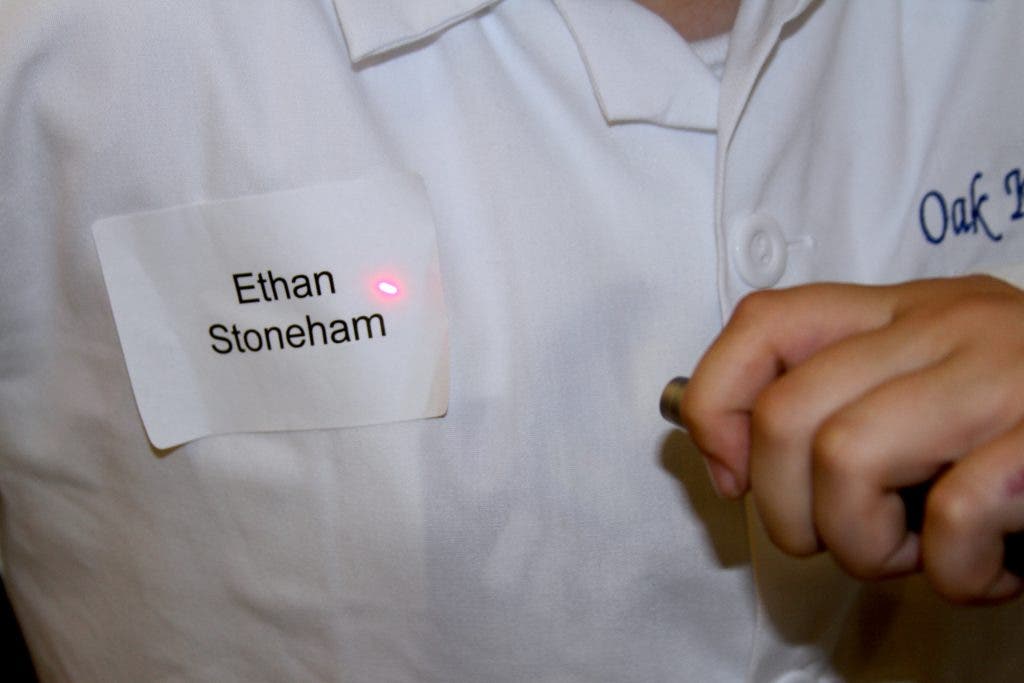
Ethan Stoneham, Bosch’s fifth-grade son, was very excited to show off his project on Thursday night, which he said had a lot of fun working on with his father. Ethan decided to do his experiment around a laser pointer.
“My problem is, what happens to the beam of a laser when it gets further from the source?” Ethan said. “My hypothesis was, the further from the laser you get, the wider and dimmer the beam would get.”
Ethan said, he and his father decided to use the street he lives on as their testing ground. They measured 546 yards of street, and started at the beginning. Using a poster board as a target, they moved away from the target in measured increments, to see how much of the board the laser’s beam filled at each increment.
“The package said the laser pointer had an 800-foot range, and my range was 546 yards, since that's how long my street is. But I don't think it should be used as a pointer at that distance. I think, as a laser pointer, the furthest you should be from your target is about 150 yards,” he said, and explained that as he moved more than 150 yards away from his target, he could barely see the beam any longer. And it shook all over the place.
Ethan’s sister, Kate, came up with a unique idea for her science fair project as well.
“I compared different species of wood to see how much weight they can hold until it breaks,” Kate said. “I just got the idea in my head.”
Bosch said, one of her favorite things about the fair is how collaborative the kids can get with each other, and how much of an interest they take in each others’ projects. She said if it were a competition, she didn’t think it would be that way.
“At the end of the night, when the kids get to walk around and see each others’ projects, it's just so interesting to see them get into these conversations,” she said. “They get quite detailed, telling each other about what their procedures were, how long the projects took them, and so forth. So, it’s a very fun environment.”
Eight-year-old Kate added, getting to look at other kids’ projects is one of her favorite parts of the night as well.
“I think it's cool how you get to look at other people's projects,” she said, describing how last year she had done a project around crystals. When she walked around at the end of the night, she came across another student who had done a different kind of project on crystals. She thoroughly enjoyed checking out her classmates' displays and comparing projects together with the other students.
Bosch said, some of the most popular projects in the room are always the food-based experiments.
“They have samples,” she said with a laugh.
Get more local news delivered straight to your inbox. Sign up for free Patch newsletters and alerts.