Community Corner
The Buzz About Bees and Wasps: Part II
Local beekeepers share their passion for this crucial species. This is the second part of two columns about wasps and bees.
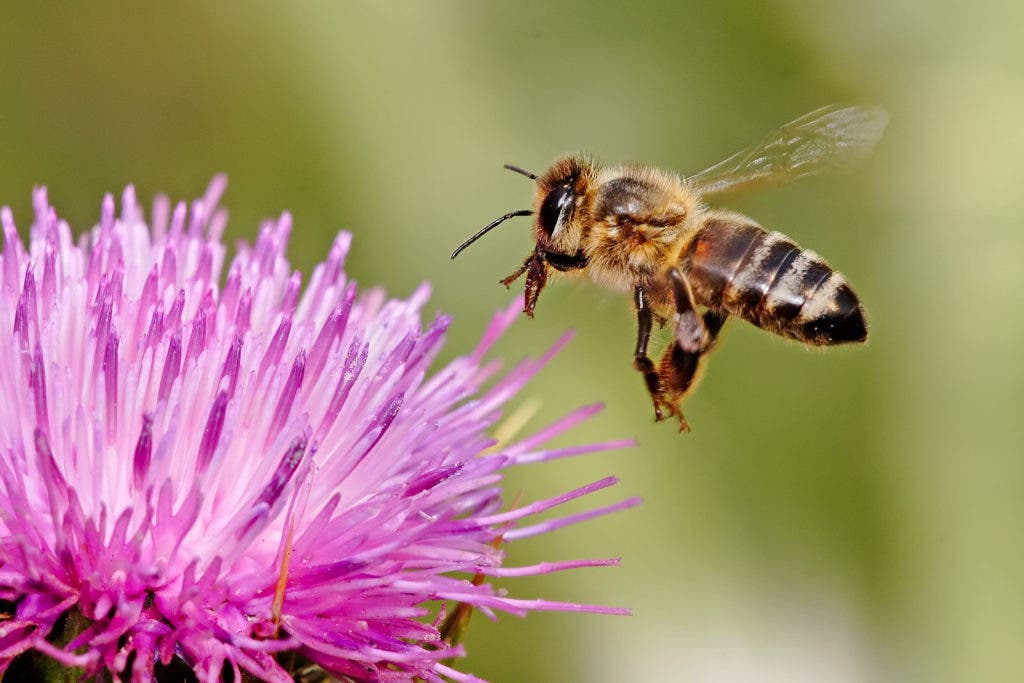
“If you see a bumble or honeybee on a flower, walk up close to the flower, stand still and watch,” says local beekeeper Randy Sue Collins, with an air of reverence. “Kids inherently know to do this,” she adds.
Unlike the , the honeybee blithely goes about her business – and her business is largely responsible for our food supply. About one mouthful in three of our diet is directly or indirectly due to honey bee pollination, according to the USDA.
California has over 1,500 native bee species, from the giant black Xylopopa (carpenter bee) to the tiny, ant-like Andrena; and each species is uniquely equipped to pollinate a given flower. Bay Area native bees consist mostly of the indispensible honey bee, the large and hairy bumble bee (reluctant to sting, despite its size), and the leaf-cutter, which nests in soft, rotted wood.
Find out what's happening in Mill Valleyfor free with the latest updates from Patch.
Most crops grown for their fruits, nuts, seeds and fiber require pollination by insects in order to produce and reproduce; and the main pollinators by far are bees. Honeybees in particular pollinate one third of all we eat – including the grass and clover that meat makers like cows eat.
“Our present day commercial agriculture system could not be what it is without bees,” says local beekeeper and Marin County Bee Census Survey administrator Bonnie Bollengier. They are also the only insects that provide a food (and a highly nutritious one at that) that we harvest and consume.
Find out what's happening in Mill Valleyfor free with the latest updates from Patch.
Local honey is particularly healthy, says Collins, a Marin native who raises bees. “It contains local pollens which can help us to build immunity to allergy symptoms.” Collins also sells beeswax candles, which she claims will clean the air of dust, molds and other pollutants.
For these abundant benefits we should be grateful, but the honeybees are in decline, and human interference seems to be the culprit. In 2010, Marin beekeepers reported a loss of 52 percent of their hives; a troubling increase from a 39 percent loss in 2009.
Bees are considered a sentinel species
A sentinel species means that they are an indicator of the health of our environment. Their decline points to, and will likely precipitate, broader ecosystem degradation. At the root of the problem is honey bee immune suppression (a threat also being recorded in other indicator species including frogs and bats). Bees are ailing and their decline, say experts, is ours.
Colony Collapse Disorder, a phenomenon in which worker bees abruptly disappear, may result from any number of threats including pesticide exposure, loss of foraging space and nesting sites, invasive mites that target hives and even from cell phone radiation (thought to interfere with bees’ navigation systems). According to the Pesticide Action Network, which advocates that hazardous pesticides be replaced with ecologically sound alternatives, bees are especially sensitive to a class of pesticides called Neonicotinoids – long-lasting, systemic toxins that move through soil and water and into a plant’s vascular system. Dozens of other pesticides have also been found in hives, compounding the problem.
We can protect honeybees by educating ourselves and tolerating them in our yards and communities.
Most importantly, urges Bollengier, do not intentionally harm bees by mistaking them for their problematic relative, the yellowjacket. “I have been stung by yellowjackets on several occasions when simply walking through my garden,” says Bollengier. “I have been stung by bees only when working inside a hive and making careless movements.”
Unlike yellow jackets, bees have a barbed stinger and can sting only once. “When they sting, they die,” says Bollengier. “Stinging is truly a kamikaze mission for them used as a last resort to protect their colony or themselves.”
“If you step on them or disrupt their flight pattern by waving your arms around and acting crazy, they will react,” says Bollengier. But honeybees are hardworking, vegetarian insects primarily concerned with foraging and collecting nectar and pollen.
Yellowjackets are wasps – not bees – and are identified by their telltale nipped-in waistline (as opposed to the bee’s round shape). They are omnivores, drawn to meat, sugar and other picnic food, as well as other insects. They will often sting when unprovoked, and due to the fact that they have a smooth stinger, they can sting repeatedly without harm to themselves. Yellowjackets have a role to play in the ecosystem, acknowledges Bollengier, however they can be a threat when living in close proximity to people. Learn more about yellow jackets and other wasps in .
If you see a swarm of bees, don’t panic.
“Swarming is naturally the way bees reproduce,” says Bollengier. “When the colony outgrows the space of its nesting cavity, half will leave with the old queen to find a new home (this is the swarm), and the other half will stay behind and rear a new queen. In Marin, swarms are usually seen April through June due to warmer weather and an abundance of pollen and nectar for food. During this time, they do not have a hive (and young and food stores) to protect, so they are usually docile in nature unless harassed or disturbed."
Do not touch or spray a swarm. Contact a local beekeeper immediately and they will gladly collect it, usually for free, and relocate the swarm so it can regenerate (if bees don’t find a home within a few days to a week, they will die out). Find beekeepers to collect a swarm through the Sonoma County Beekeeper’s Association or Marin Beekeepers. “Swarms are great way to start a hive,” adds Bollengier. “This is how I like to do it. This is how nature does it.”
If there is a hive in your yard …
“Lucky you!” says Collins. “Bees and people can co-exist quite easily.” Collins, whose Organic Beekeeping 101 website educates those who want to start their own hives, says that local beekeeping is one way to keep this crucial species healthy.
“Bees are very delicate,” says Collins. She is dismayed by the commercial practice of importing bees from thousands of miles away in order to pollinate local crops (for example, Australian bees are routinely brought in to pollinate almonds). Non-native bees can bring disease to local hives; and bees also suffer from the wear and tear of long-distance travel. “We stick [bees] on the back of a truck, bang them around and drive them 5,000 miles in a season and we wonder why we’re losing bees!”
If you are buying organic honey, asks Collins, where is it coming from? "If it's from Mexico [the bees] might be organic in the hive, but they fly out five miles to pesticide-sprayed flowers. So bees would need to be in the center of a five-mile organic field. No one has that.”
Rather than using chemicals to fight mites and other hive pests, beekeepers such as Collins allow some bees to die and the stronger to survive. “Contribute to the local survivor stock genetics,” she urges.
An increasing number of Marin-ites are keeping it local
More locals than ever are (intentionally) putting hives in their backyards. Whether they are making a living from their bees or just enjoying the buzz, they are doing a good turn. “Hives will lead to three times as many apples on your tree,” says Collins. “Share [the bees] with your neighbors – all of our plants will be pollinated.
Ross resident Kristine Kelley started her own hives after helping out a friend who had bees. “It’s good for the garden, good for the neighbors, good for the bees,” she says. “The honey is nice (she gets about 4 gallons in a season), but it’s not as important for me as playing a role in the environment.”
Kelley now has about 150,000 bees and says they are healthy. “They have lived through two winters. They are wonderful and fun to watch. My grandson always wants to see grandma’s bees.”
That’s a sweet experience worth handing down to the next generation.
Resources
Marin Beekeepers – swarm retrieval, monthly meetings, workshops and classes
Marin Bee Company – hive installation, adopt a hive, resources and information
Learn more about pesticides that contain neonicotinoids
Thank Nature – hive materials, beeswax products
Do you like bees? Tell us in the comments.