Schools
CUSD LCAP states that one of the major goals to improve student learning is to reduce class size.
Is the District meeting that goal? The answer is no.

School District Accountability and Transparency Under California’s New Local Control Funding Formula - CUSD LCAP Misrepresents Class Size Reductions.
Negotiated Class Sizes Since 2011
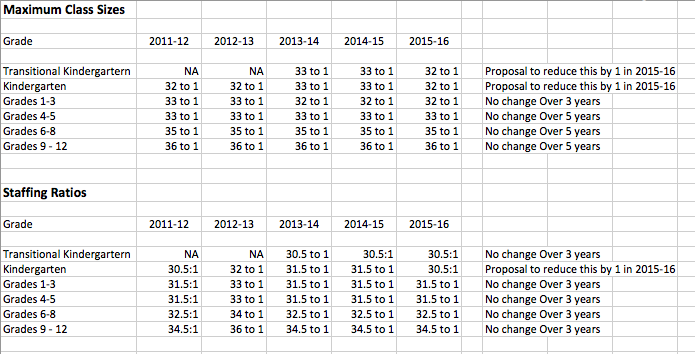
Sources Class Size:
Find out what's happening in Mission Viejofor free with the latest updates from Patch.
2011-12: http://www.cuea.org/information_v2/ContractToJun2013.pdf at page 19 and 20
2012-13: http://www.cuea.org/information_v2/ContractToJun2013.pdf at page 93
Of Note:
MOU dated 6/12/12 “Article 8.3 The Association proposes to increase class staffing ratios for regular classes by 1.5 students in grades K- 12 for the 2012-13 school year.”
Find out what's happening in Mission Viejofor free with the latest updates from Patch.
It should be noted that in 2012- 13 Average Teacher Compensation increased from $95,673 per year to $105,340 per year. That compensation increase was paid for with a class size increase of 1.5 students across all grades and 3 instructional furlough days. When the MOU expired class sizes went back to 2011-12 level seen above.
2013 -14: See letter from the Orange County Department of Education
2014 -15: See letter from the Orange County Department of Education
2015 -16: See letter from the Orange County Department of Education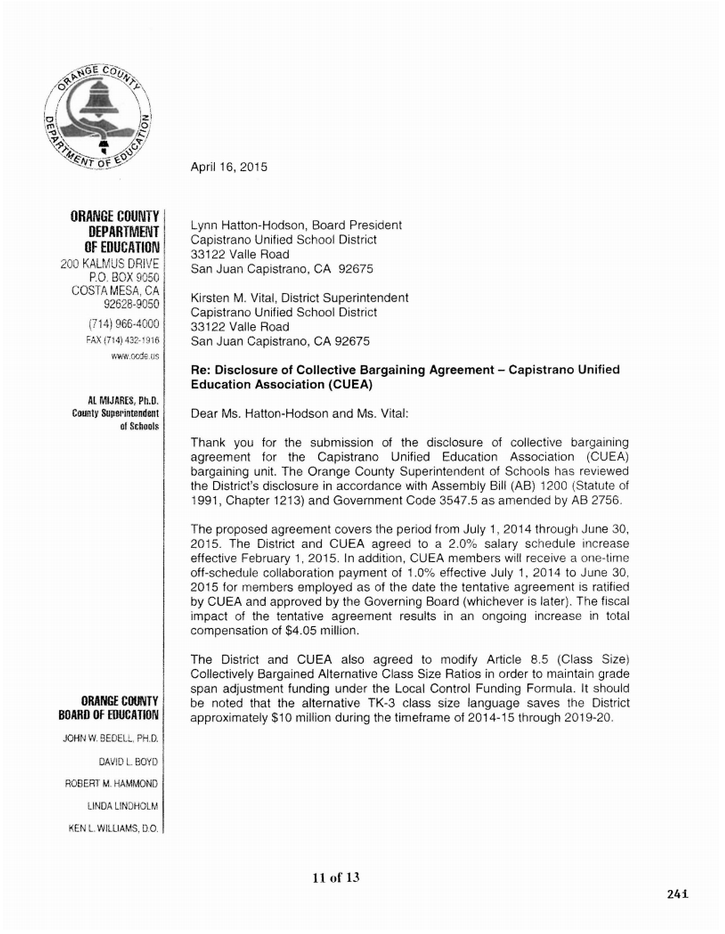
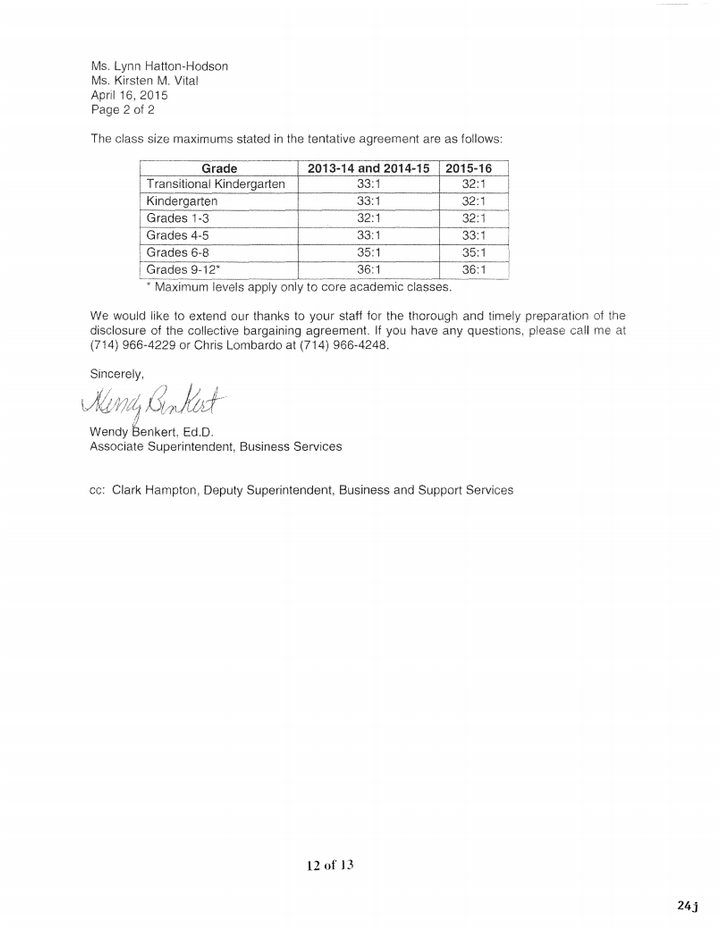
Class sizes were not reduced, but remained the same in 2013-14 and 2014-15. The District is proposing to reduce class sizes by 1 student in TK and K for 2015-16 but employment contracts have not been finalized for 2015-16 so that is still to be negotiated.
The Goal of Reducing Class Size Is Not Being Met.
LCFF Regarding Class Size Reduction:The State Recognizes the importance of smaller class sizes and is encouraging Districts to reduce class sizes in grades K - 3 to to 24:1 however the State gives Districts and it’s bargaining units the ability to negotiate what they want:
When may school districts use a collectively bargained alternative to an average K–3 class enrollment of not more than 24? (Posted 10-Mar-2014)
“A school district may use this option when the district has collectively bargained an alternative annual average K–3 class enrollment for each school site in contemplation of or subsequent to enactment of EC Section 42238.02. A school district can demonstrate that it agreed to an alternative in different ways. For example, the school district could enter into a new collective bargaining agreement, renegotiate an existing collective bargaining agreement, or mutually agree with its local union that an existing collective bargaining agreement contains an alternative annual average class enrollment for each school site. District legal counsel should be consulted as appropriate.”
Source: http://www.cde.ca.gov/fg/aa/lc/lcfffaq.asp#K3GSA
The State will financially penalize a district that exceed the following:
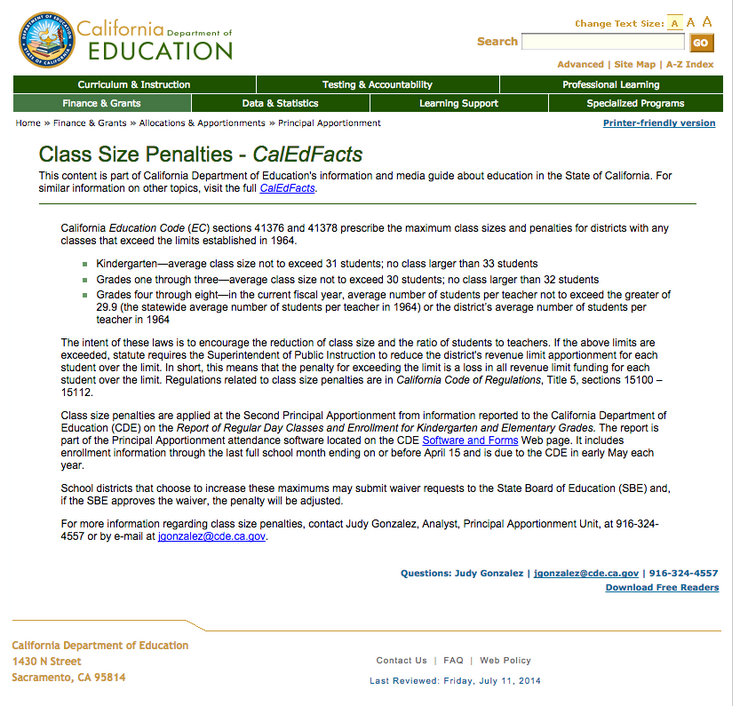
LCFF Accountability
As part of the LCFF, school districts, COEs, and charter schools are required to develop, adopt, and annually update a three-year Local Control and Accountability Plan (LCAP), beginning on July 1, 2014, using a template adopted by the California State Board of Education (SBE) on or before March 31, 2014. In addition, the SBE is required to adopt evaluation rubrics to assist LEAs and oversight entities in evaluating strengths, weaknesses, areas that require improvement, technical assistance needs, and where interventions are warranted on or before October 1, 2015. Subsequent revisions to the template or evaluation rubrics are required to be approved by the SBE by January 31 before the fiscal year in which the template or rubric would be used. The LCAP is required to identify goals and measure progress for student subgroups across multiple performance indicators. The budget provides $2 million to the Governor’s Office of Planning and Research to support the development of the LCAP template, regulations, and evaluation rubric.
Other LCFF accountability components include:
The SBE must adopt regulations that govern the expenditure of the supplemental and concentration grant funding. These regulations will require school districts, COEs, and charter schools “to increase and improve” services for targeted students and will provide authority for school districts to spend funds “school-wide” when significant populations of those students attend a school.
- LEAs must obtain parent and public input in developing, revising, and updating LCAPs.
- County superintendents must review school district LCAPs and ensure alignment of projected spending, services, and goals. Charter school LCAPs will be reviewed by the chartering authority. COEs are required to provide technical assistance when they disapprove an LCAP.
- The State Superintendent of Public Instruction must review LCAPs of COEs, as well as intervene if a school district or charter school fails to show improvement across multiple subgroups in three out of four consecutive years.
- The budget package provides $10 million to establish a new regional support network, called the California Collaborative for Educational Excellence, to advise and assist LEAs in achieving their LCAP goals.
- The budget package reduces subgroup size from 50 to 30 students and establishes foster youth as a new subgroup, with a subgroup size of 15, for purposes of Academic Performance Index accountability.
June 24, 2015 Board of Trustees Meeting Agenda Item #5 Discussion/Action (Page 35 Exhibit 5)
2015-16 Local Control and Accountability Plan Annual Up-date
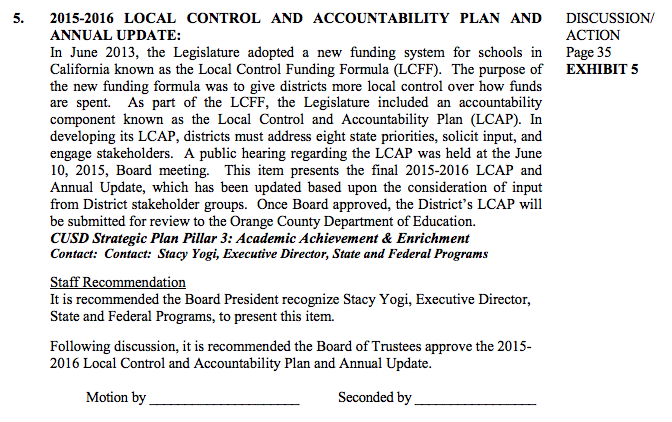
At Page 35: Local Control and Accountability Plan and Annual Update Template
“The Local Control and Accountability Plan (LCAP) and Annual Update Template shall be used to provide details regarding local educational agencies’ (LEAs) actions and expenditures to support pupil outcomes and overall performance pursuant to Education Code sections 52060, 52066, 47605, 47605.5, and 47606.5. The LCAP and Annual Update Template must be completed by all LEAs each year.”
At Page 36.2 Stakeholder Engagement - Misleading Information re: Community Engagement
The LCFF Law requires school Districts to show evidence of how they are engaging stakeholders in the development of the Districts LCAP. CUSD states over and over again that they have engaged in 76 meetings with Stakeholders regarding up-dates to the LCAP. This gives the impression that the Public has been given ample opportunity to have a voice in setting LCAP goals. However; in reality, the public has had little if any opportunity to understand the new law and participate in the LCAP. Most of the meetings that the district held were not open to the public. The meetings that were open to the public were meetings with Principals or the Superintendent where Trustees did not attend. For Public Disclosure purposes, a meeting must be with a majority of Trustees present to qualify. Meetings with Principals, District Staff and or the Superintendent do not qualify because these meetings do not provide the public to express itself before Trustees - the publics elected representative.
At page 36.3 District lists 76 meetings held to engage the public-
List of Stakeholder Input Meetings 2014-15 School Year:
- Site parent and staff meetings- 56 sites September-May
- Parent Advisory Council Meeting- September 22 and February 23
- Foster Parent Interviews- conducted individually January-March
- LCAP Parent Advisory Committee- January 29, March 10, and May 12
- ASB Executive Council Meeting {student forum-including unduplicated pupil
- representatives)- February 10
- Classified Staff Forum {Classified Local Bargaining Unit)- February 24
- Certificated Staff Forum {Certificated Local Bargaining Unit)- March 2
- Elementary Principals Meeting- March 3
- High School Principals Meeting- March 6
- Middle School Principals Meeting- March 9
- Capistrano Unified Council PTSA- March 9 and March 27 {Legis.)
- Teacher Advisory Council -March 9
- Special Education Community Advisory Committee {CAC)- March 17
- District English Learner Advisory Committee {DELAC)- March 31 and April 22
- Community Forum -April 28
The only meetings open to the General Public were-
Number 1:
Site parent and staff meetings September - May. This would be the Principal of an individual school site making a presentation to parents of that school site. A majority of Trustees would not be present at this type of meeting, and this would represent one opportunity for a parent of that particular school. So 56 school site meetings is really one opportunity per parent.
Number 2:
The Community Forum on April 28, 2015:
http://capousd.ca.schoolloop.com/file/1218998864154/8458275088731239781.pdf
“The forums are a part of the superintendent’s overall strategy to gather input from the various stakeholder groups in the Capistrano Unified School District.”
Community forums do not provide Trustees with an opportunity to gather in-put from stakeholders.
In reality, the only opportunity that Parents have had to express their opinion to a majority of Board members has been at a Board Meeting where their input is limited to a 3 minute comment to which Board members are not allowed to reply.
This article is to long for the Patch- it can be read in full at:http://disclosurecusd.blogspot.com/2015/06/school-district-accountability-and.html