

Get up to speed, read the and articles.
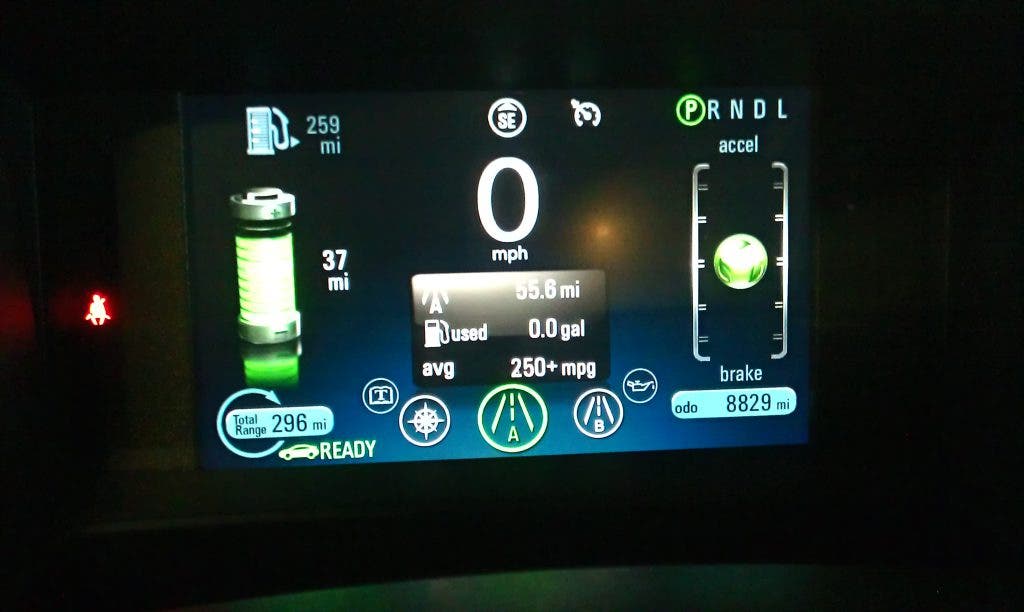
So I started the day with a fully charged battery. The display indicated that I had 39 miles of estimated range with that charge. So technically, I could make it to work and back, 28 miles, without recharging.
My commute one way is about 14 miles and when I got to work my estimated range was 37 miles. How is that? How can I drive 14 miles and only use of two miles of energy? Between the long descent I take from north Glendale to the 134 Freeway, the stop and go traffic on the streets and freeway I get to regenerate energy in all those situations! It's like an energy bank, I take some away and I put some back in.
Find out what's happening in Montrose-La Crescentafor free with the latest updates from Patch.
The regenerative process is similar to other hybrid and electric vehicles. When releasing the go pedal (not the gas, this is an EV first) the electric motor(s) in the car act like generators rather than motors. So energy is now flowing in the opposite direction, toward the battery not away. This energy, in a conventional vehicle, is usually lost as heat.
Because this is primarily an electric car, the entire ecosystem runs off of electricity. Think about it, in your car you have now how many systems run off of the turning of the engine? Power? A/C? Power Steering? Cooling?
Find out what's happening in Montrose-La Crescentafor free with the latest updates from Patch.
This car doesn't have any of that. All the on-board systems run off of electricity. GM had to make a few decisions on how to optimize power consumption. The radio is a special unit designed in conjunction with Bose to be very energy efficient. Also the power steering is completely electrical. Even the emergency/parking brake is electrically actuated. It sounds like a space ship whenever you engage it. Its really cool.
I mention all of this because as cars migrate to more efficient energy sources, like batteries etc more and more of the components will also become more efficient since their primary power source will be that big battery under the floor. All this is done to maximize your driving range and comfort.
Speaking of comfort, I wanted to briefly talk about the ride quality. I'm really impressed and this is coming from the guy in the sporty, stuck to the road, German car. The ride does get a little, what I like to call, boaty. You can feel the suspension working when going over bumps or into dips. It handles turns really well mostly because of the low center of gravity of the battery pack, with very little body roll. If GM ends up making a sport Cadillac luxury coupe from this drive train, the only thing that will make it better is grippy tires. But for the Volt, it works perfect. The car is so quiet, I purposely rolled down the windows in the parking structure at work just to hear what I couldn't hear, engine noise!
My goal for today was to not recharge at all. To see if I could run through a full day, including all my extra curriculars, without touching an outlet. It turns out my extra curriculars were sidetracked. So I didn't get to put in a few extra miles I had intended. But I was able to stuff my road bike into the rear with the seats down. Multi-Function, score!
Total for the day, 29 miles and I had about 15 miles estimated range left when I got home. And still zero gasoline consumed! (Starting to feel a little guilty about not feeling guilty...).
Tomorrow's treat: My wife is driving the Volt so she will be sharing her perspective in the Day 3 wrap-up.
References and Resources:
Chevrolet.com: Volt information from Chevrolet
GM-Volt.com: Volt and EV related blog
The Future is Electric: GM blog related to the Volt and EV in general
EV World: dedicated EV blog and resource