Crime & Safety
In the Wake of Japan, is the Crescenta Valley Ready?
"CERT" hosts a weekend forum on disaster preparedness.
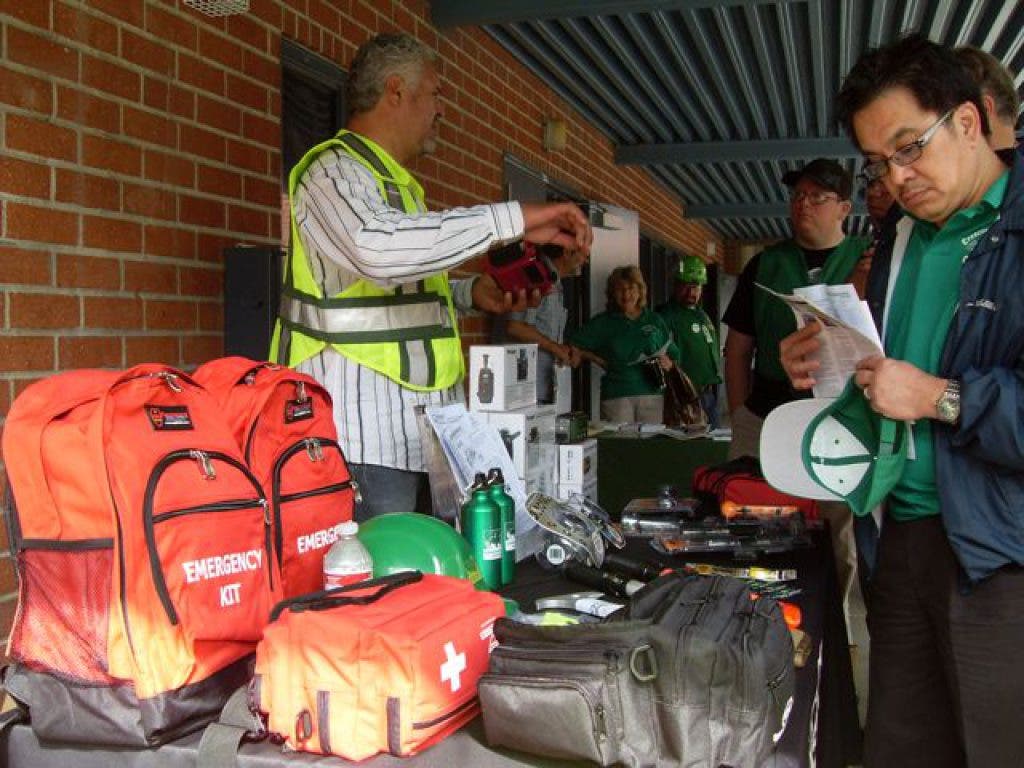


The Crescenta Valley squad held a community forum Saturday at in La Crescenta that presented the question, "in the wake of Japan, are we ready?"
Personnel from the Los Angeles County Sheriff's Department and CERT members spoke on disaster-related topics, and a geologist from the U.S. Geological Survey gave a presentation on the science of earthquakes.
CERT stands for Community Emergency Response Teams and consists of local volunteers who serve as the first line of defense in the event of an earthquake, flood, fire or other major threat to public safety. CERT teams have assembled all over Los Angeles County in recent years and work closely with police and fire departments.
Find out what's happening in Montrose-La Crescentafor free with the latest updates from Patch.
C.V. CERT Coordinator Paul Dutton identified Jet Propulsion Laboratory, and multifamily housing in Montrose as the most potentially dangerous spots in his team's coverage area. JPL and Leslie's pose a possible chemical threat, while the apartments and condos on and near Honolulu Avenue could host mass casualties in the event of a fire, flood or earthquake, he said.
"The definition of service is being prepared and helping your neighbors and helping your community," said Dutton. "CERT formulated so we could help ourselves as the early warning system for the Sheriff's Department."
Find out what's happening in Montrose-La Crescentafor free with the latest updates from Patch.
Geologist Erik Pounders from the USGS spoke on the differences between earthquakes in California and Japan.
Massive 9.0 earthquakes aren't possible in Southern California because Japanese faults run diagonally, shaking more of the earth's surface compared with local fault lines, he said. Tsunamis aren't likely here because unlike Japan, faults in Southern California are centered on land, not in the Pacific Ocean.
In addition to the mighty San Andreas, Pounders indicated the Sierra Madre Fault, which runs along the south side of the San Gabriel Mountains, and others such as the Newport-Inglewood and Puente Hills faults could also cause significant quakes.
The maximum magnitude for a Southern California temblor is between 7.9 and 8.2 on the Richter scale, however resulting damage depends primarily on the solidity of the ground in a particular location, said Pounders. A house built on bedrock, like the majority in the Crescenta Valley foothills of the San Gabriel Mountains, will experience less severe shaking than a structure built on soft rock or sediment such as the bulk of the L.A. Basin.
The San Andreas remains a key spot to watch "because all railroads and freeways cross [it]," said Pounders. "If we don't have things ready to go in advance, we're going to have to deal with not having things for a period of time."
Capt. David Silversparre, who heads the , pointed out the importance of emergency training for civilians and informed meeting attendees on local law enforcement's extensive disaster protocol.
"We need you to be our eyes and ears because in an emergency situation we may not hear about something," said Silversparre. "If you become a member of CERT you have access to a system to notify us."
Communication was a key point of discussion throughout the meeting.
Silversparre recommended residents get their phones and e-mail addresses hooked up to the Alert L.A. County and Nixle warning systems. "Nixle is like 4-1-1, Alert L.A. is like 9-1-1," he said.
"L.A. County is the disaster capital of the United States ... and does better than the rest of the country because we work together and have learned how to coordinate better than others," said Sgt. John Hargraves, a Sheriff's Department veteran of more than 30 years who has aided in disaster relief efforts for Hurricane Katrina, numerous fires throughout California and many other calamities including civil disturbances after Lakers championship victories.
Hargraves noted a lack of procedural synergy and communication as well as professional rivalry namely between fire and police departments that results in subpar emergency response and heightened confusion.
"Some people want to save face; some would rather save lives," he said.
West Coast public safety agencies take a more communal approach to disaster response compared with out-of-state colleagues, Hargraves said.
"Play well together and share your toys ... that's the crux of emergency response, pooling resources," said Hargraves, who characterized CERT as "the absolute first responder. [The Sheriff's Department has] to check more than 90 critical facilities before we can start responding to individual places. [CERT] is like a neighborhood watch for disasters."
The sergeant discussed the department's emergency response procedure, starting with notification options ranging from direct digital communications and the news media, to citizen-band radios and public address speakers mounted on patrol cars.
If authorities deem evacuation necessary, Hargraves said residents should leave immediately, though large animals such as horses should be evacuated before people. The county Department of Animal Control's Equine Response Team coordinates the evacuation of large and small animals if conditions demand it.
Hargraves also suggested these essential tools for a disaster kit: AM radio, flashlight, work gloves, heavy duty boots and clothes.
"People should participate in CERT because it gives a really good idea of how to respond to emergencies," said Robin Sauls, captain of C.V. CERT Team 8. "It increases your ability to think in an emergency and it often fulfills the need to serve."
Once a year, county CERT teams gather for an emergency response drill competition. The 2011 competition will take place in the fall. Visit the CERT site here.