Neighbor News
The Native American Powwow - behind the sounds, beneath the colors
Redbird's Children of Many Colors Powwow returns to Oxnard College June 2-4, and SCE co-sponsors the gathering for the second year

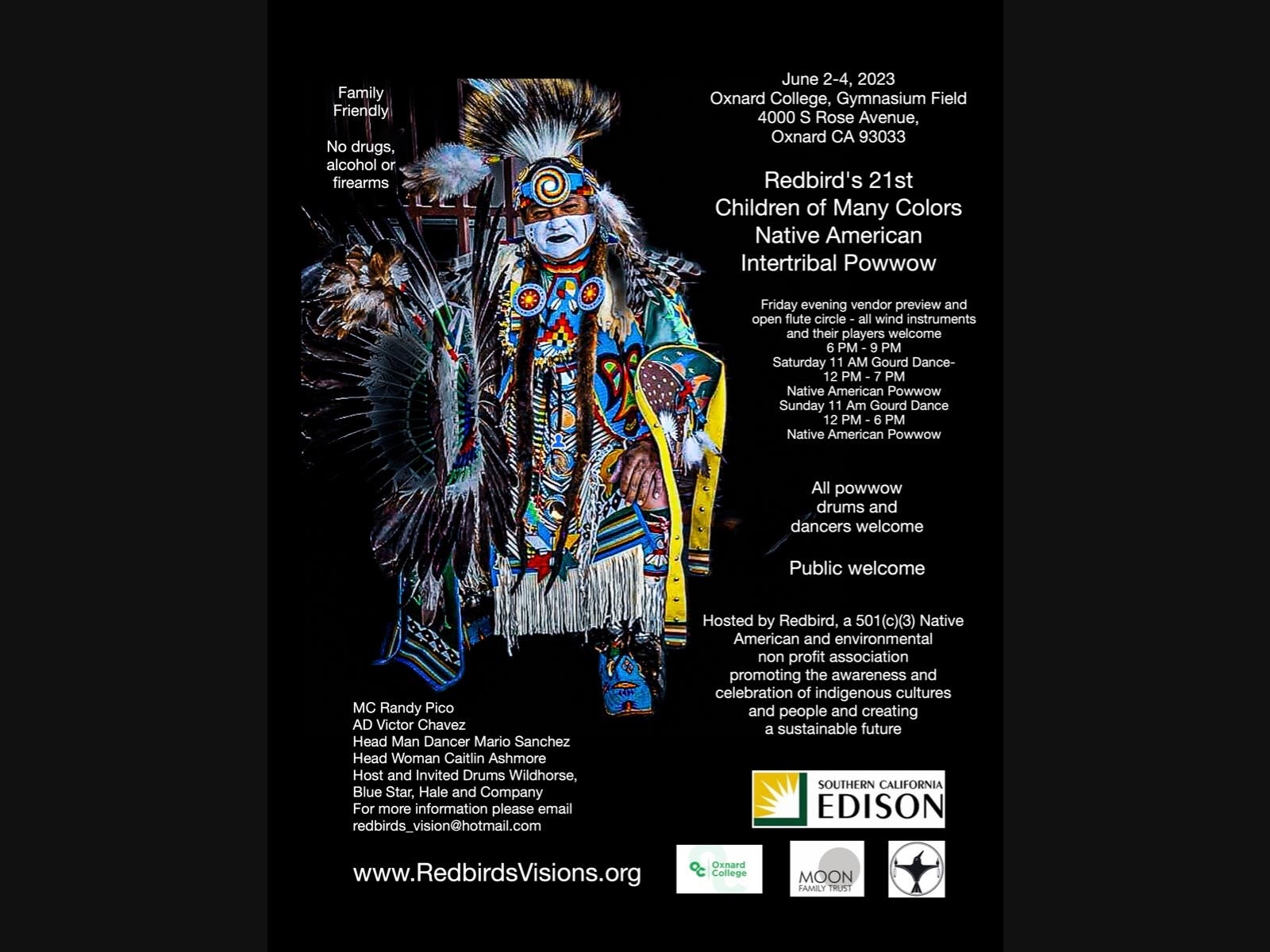
Thanks to the generous support of Southern California Edison, Oxnard College, the Moon Family Trust, the Barbara Barnard Smith Fund for World Musics and the tireless work of Redbird, the Children of Many Colors Native American Powwow will return to Oxnard College the first weekend in June.
On the surface, its an opportunity to experience Native American culture, shop with indigenous vendors and sink your teeth into an Indian taco. But the layers just beneath that experience run deep. What is a powwow, from an indigenous point of view?
Here are some descriptive words. A powwow is a cultural celebration. Today it encompasses indigenous people of the western hemisphere. It is a gathering that comes to us, here, in California, from native nations reaching from Canada to Texas and Oklahoma and all points in between. It is not a style of gathering which originated in California.
Find out what's happening in Moorparkfor free with the latest updates from Patch.
It is a celebration of culture, of continuity, of survival. It is a real-time, unscripted gathering that looks for all the world like entertainment from the viewpoint of a spectator. A spectacular show of dance, color, sound, movement. Yet for each dancer in the arena, it is a personal experience.
Powwow is also ceremony. Actually, a lot of ceremony. Powwows are unique in that they are steeped in traditions and ritual and story and history, and yet all of this takes place out in the open, in public. Pretty much everything has meaning and purpose. The dance regalia, its designs and colors, the dance steps, the songs, the way people conduct themselves, hand gestures or the lack of them, the empty chair at a drum...a thousand little pieces of ceremony woven into a fluid fabric by many nations. Because the ceremonies are not universal. Every nation has their own.
Find out what's happening in Moorparkfor free with the latest updates from Patch.
Powwow came to us during the Termination Act (1953-1968). This was a time when our government sought to end reservation life for native people by integrating them into big cities such as Los Angeles. You can learn more about that here:
https://library.law.howard.edu/civ.../indigenous/termination
The promise of a better life, jobs and independence prompted many native people to make a go at California. They left behind their land and their relatives, but they brought with them a wealth of songs, dances and skills. They brought along the wisdom of their ancestors; they brought along or made a new drum. Native people began to find each other, and they began having gatherings. In so doing, they gave us the rich legacy we know and embrace today, and they defied and defeated the real purpose of The Termination Act, which was to bring an end to tribal culture and identity. We have those native people to thank for our gatherings today. They did not assimilate. They carried their culture with them and gave it new life in the urban sprawl of southern California.
There is another element to powwow, interwoven in celebration and ceremony, equally evasive of written description. It is the spiritual element. The songs, the dances, the way of being, the current flowing through the ceremony as well as the laughter...it is a living, moving prayer. For many people, powwow is a spiritual gathering. Perhaps the only spiritual gathering they choose to be a part of. It circulates, entirely undetected, as indeed it had to for many years, subordinating to the colorful regalia, energetic dances and pounding songs. Why? Because indigenous people were only granted the right to exercise their own spiritual beliefs and ceremonies through the American Indian Religious Freedom Act of 1978.
That's not a typographical error. 1978.
Today, our powwows are a complex blend of indigenous cultures. Some people have been raised in their traditional ways. Others have been severed from their cultural connections, and powwows are a very important part of their connection and reconnection to their heritage. Others are just learning about their culture, or perhaps becoming ready to make a commitment to it; to dance, to sing, to learn the stories, the reasons, the life ways, the things that make us who we are and yet defy description. Still others have come upon their first powwow, and are in something close to a state of shock. Everything is new. And everything somehow touches them.
Laughter. Kindness. Beautiful smiles. Safe, happy children. Catching the spirit of a song. Acts of generosity. Stories shared. Honorings. Friendships that have spanned decades. Sneak up. Stories in their dances. Crow hops. The elders who have walked on. People standing for the traveling song. Cydnee's voice behind me. Knowing the people around me have my back. Scrambling to be dressed for the first gourd session. That moment when the dance becomes a prayer and the movement is effortless. Jorge's lead into a song. Thirty years of knowing Tso. These are my powwow memories. Surely you will have your own.
Redbird is a 501(c)(3) Native American and environmental non profit, and the host of the Children of Many Colors Powwow. You can learn more about our work at RedbirdsVisions.org