Community Corner
A North Bay ICU Nurse With Parkinson's Joins Grueling Offshore Race To Advance Research
A St. Helena ICU nurse joins offshore race as researchers track whether sailing can measurably affect Parkinson's symptoms.


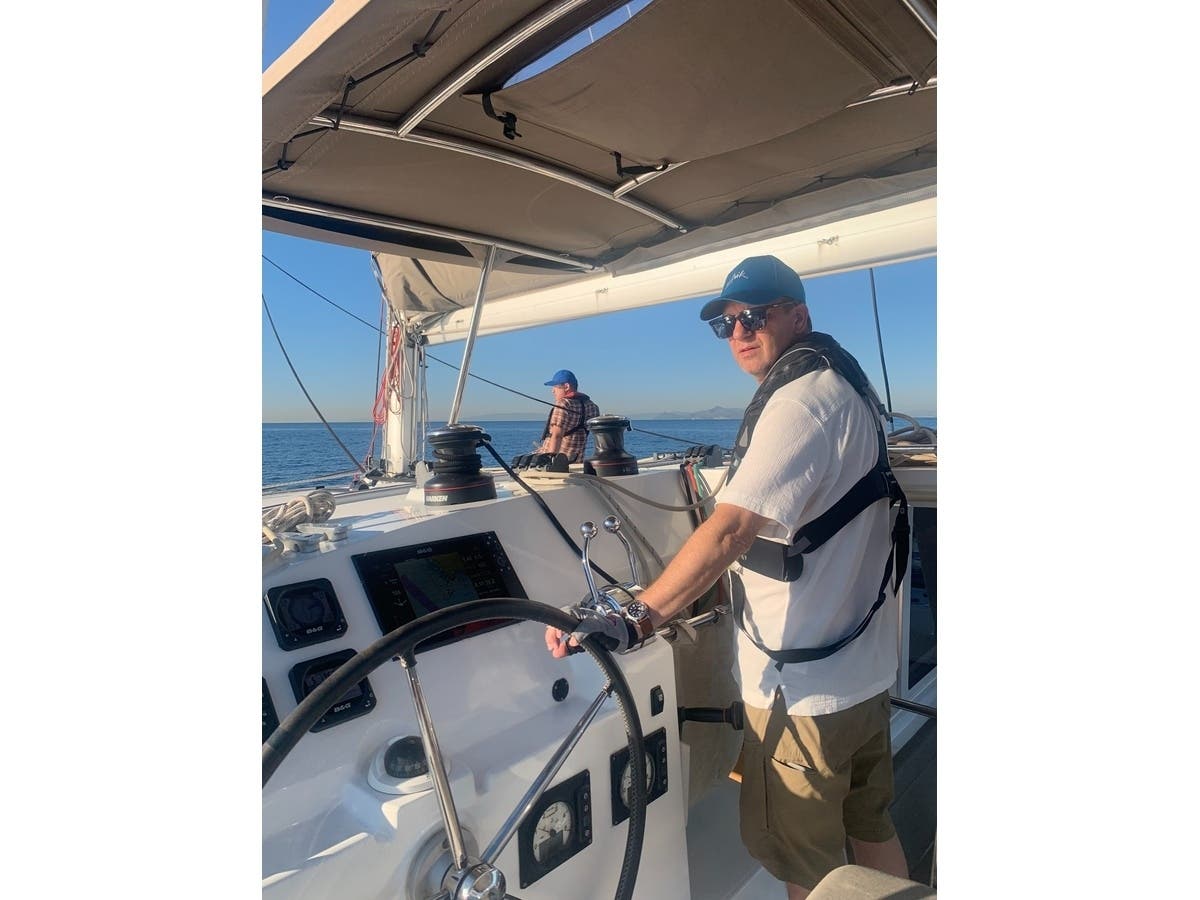
NAPA VALLEY, CA — Parkinson's often arrives as a narrowing — of movement, certainty, and the future people imagine for themselves. Darrel Wilken is pushing in the opposite direction.
The St. Helena resident, cardiac ICU nurse, Army veteran, and longtime San Francisco Bay sailor is leaving this week for Ireland, where he will join an offshore sailing race to France as part of a pioneering research effort examining whether sailing can produce measurable effects for people living with Parkinson's disease.
The voyage will also serve as a training run for the Ocean Globe Race, which sends competitors through some of the planet's most unforgiving oceans, aboard Neptune, a legendary 60-foot racing yacht that has evolved into something larger than a boat.
Find out what's happening in Napa Valleyfor free with the latest updates from Patch.
For researchers, Neptune is increasingly becoming a laboratory at sea, carrying sailors into conditions that test balance, cognition, endurance, sleep, and resilience while generating data that could help answer new questions about living with Parkinson's.
For the Parkinson's community, the vessel has become a symbol of possibility — proof that a diagnosis need not define the limits of a life.
Find out what's happening in Napa Valleyfor free with the latest updates from Patch.
The race will carry Wilken into unfamiliar seas, sleepless nights, rough weather, and uncertainty. But it is also carrying him toward something Parkinson's patients and researchers alike are seeking: knowledge.
Sailor, A Nurse And A Diagnosis
Wilken, 58, is a Santa Monica native and U.S. Army veteran who built a career as a cardiac ICU nurse.
Long before he discovered sailing, he dreamed of flight. He was fascinated by airplanes and gliders as a child. Then, at age 43, he took his first sailing lesson at Afterguard Sailing Academy in Oakland and found a new passion.
Although he had experienced symptoms for years, including a diminished sense of smell dating back to around 2010, Wilken did not receive a formal Parkinson's diagnosis until early 2025.
Wilken's introduction to the Parkinson's sailing community came through what he describes as a chance encounter that connected him to a growing international movement that began with one extraordinary voyage.
From Inspiration To Research
In 2024, French sailor Bertrand Delhom became the first person with Parkinson's disease to sailing around the world and to complete the 27,000-mile Ocean Globe Race.
Delhom was aboard Neptune, demonstrating that the disease did not have to define the limits of a person's life.
While Delhom proved that a sailor with Parkinson's could complete one of the world's toughest races, Wilken's mission aboard the vessel is different.
Instead of testing whether the feat is possible, he will help researchers collect objective evidence about what sailing does to the body and brain of someone living with Parkinson's.
Researchers affiliated with Sacramento State's Department of Kinesiology are building what organizers describe as a sailing-specific Parkinson's case study.
Parkinson’s disease is a brain disorder marked by tremors, slowed movement, stiffness, and difficulty with balance and coordination. Symptoms include depression and emotional stress. The condition typically worsens over time and with it the symptoms.
Wilken feels symptoms creeping in little by little— slightly more frequent tremors and cramps.
He has already undergone hours of baseline testing and will return for additional evaluations after completing the voyage.
Researchers will compare pre- and post-race measurements to determine whether extended offshore sailing produces measurable changes in balance, movement, cognition, fatigue, neurological function, and overall well-being.
"The goal is to get hard data, objective data before and after," Wilkin said. "Not just, 'I feel great, take my word for it.'"
The project reflects a broader movement within Parkinson's research that depends not only on scientists and physicians, but also on patients willing to participate in studies that push understanding of the disease forward.
As actor and Parkinson's advocate Michael J. Fox recently wrote in an op-ed, progress depends on "patients who roll up their sleeves and join clinical trials, scientists who turn dead-ends into detours, fundraisers who power research and advocates who help policymakers understand what's at stake."
Why Sailing?
Exercise is already recognized as one of the most powerful tools for living well with Parkinson's, but sailing remains largely unexplored by researchers.
The disease affects movement, balance, speech, sleep, mood, and cognition. Sailing demands many of those same systems: balance, coordination, sensory awareness, problem-solving, teamwork, adaptability, and endurance.
That overlap is what makes Wilkin's voyage intriguing to researchers. The question is not whether sailing can cure Parkinson's. It cannot.
The question is whether offshore sailing can help people function differently with the disease and whether those effects can be measured scientifically.
Wilken believes the ocean changes people physically and neurologically.
"Sailing is doing something to my brain, my equilibrium," he said. "It does affect me neurologically."
Researchers hope to determine exactly what those changes look like and whether they offer therapeutic value for people with Parkinson's.
Trial By Fire Off Ireland
Wilken will fly to Wicklow, Ireland, before joining Neptune and a largely unfamiliar crew for a passage that ends in Le Bono, France, where the vessel is based. The crew includes veteran offshore sailors, Raffray, and (by chance) two neurologists. “We’re covered," Wilken said.
The voyage represents a major leap beyond Wilken's previous sailing experience.
Most of his sailing has taken place on San Francisco Bay, widely regarded as one of the world's most challenging sailing venues. His offshore résumé, however, consists primarily of a two-week catamaran charter in Greece. But he reveled in the experience.
He admits he worries about motion sickness, fatigue, cold weather, disrupted sleep schedules, and how Parkinson's symptoms might respond to the stresses of offshore racing. "It's going to be a trial by fire," he said.
Still, he brings perspective shaped by experience. He once lived in Minnesota, where winter temperatures could plunge to 56 degrees below zero.
The offshore race will require rotating watches that often leave sailors working through exhaustion, cold, and rough weather. Yet Wilken remains confident.
"How can you feel any safer than with people who have sailed around the world?" he said.
Chasing Answers Across The Atlantic
Supporters will be able to track Wilkin's progress online as the race unfolds.
For Wilkin, however, the most important destination may not be the finish line. It may be the data waiting when he returns.
If the results reveal measurable benefits, Neptune may become more than a symbol of adventure or resilience. It may help chart a new course for understanding how people can live more fully with Parkinson's disease.
Observers will be able to track Wilken's path on share.garmin.com/Serenityfalcon.
Related:
A Sailor’s Global Race With Parkinson’s Inspires First Bay Area Regatta
Get more local news delivered straight to your inbox. Sign up for free Patch newsletters and alerts.