Neighbor News
Marin Ran a Close Election. On Monday, We Start Checking Its Work.
Public trust in elections does not come from officials telling us the count was right. It comes from officials showing us how they know.
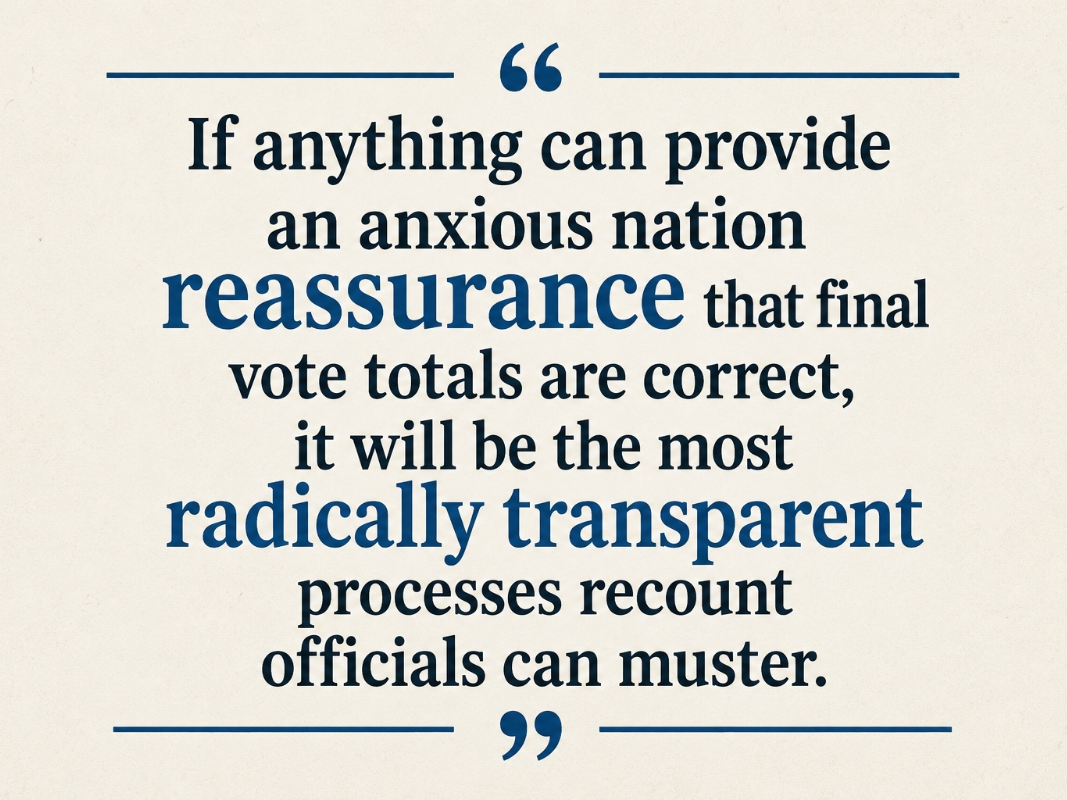
Public confidence in elections does not come from officials telling us the count was right. It comes from officials showing us how they know. California's election laws understand this. They are built around a simple principle: every sensitive step in handling a ballot, from the moment it leaves a voter's hand to the moment it is tallied, must be documented in a public record that any resident can inspect afterward. The count is only half of the job. The paper trail proving how the count was protected is the other half.
For Marin County's June 2, 2026 primary, that second half is missing pieces. Not because anyone has shown the results are wrong, but because the county has not yet produced the records that would let the public confirm they are right. That question is no longer academic. On Monday, July 13, at 9 a.m. in Suite 121 of the Civic Center, Marin begins a full manual recount of the County Supervisor District 5 race.
A recount is already happening
The Elections Department received a request to recount every ballot cast in the District 5 supervisor contest, and it will do so by hand. This is not a partial sample. By the county's own estimate, there are roughly 20,000 ballots to count, two counting boards will need about eleven days to finish, and the projected cost runs to $38,643.97, borne by the requester as a daily deposit under state law. The recount will be conducted publicly, as Elections Code Section 15629 requires, from 9 a.m. to 4 p.m. each day. Whatever one thinks of why it was requested, it is now the single most rigorous check available on this election, and it is open to public observation.
Find out what's happening in Novatofor free with the latest updates from Patch.
That makes the county's outstanding documentation gaps more urgent, not less. A recount tests whether the ballots were counted correctly. It does not, by itself, test whether every ballot was handled and safeguarded correctly on the way to being counted. For that, you need the chain-of-custody records. And those are exactly the records Marin has not fully produced.
Andy Podshadley has formally requested this hand recount, and under California law he has to pay for it himself: roughly $38,000 to hand count about 20,000 ballots, every dollar out of his own pocket. If you believe a 46-vote margin deserves a careful, public second look before anyone treats it as settled, chip in to help Andy cover the count.
Find out what's happening in Novatofor free with the latest updates from Patch.
Support the recount here: https://secure.anedot.com/andy2026/contribute
The audit no one can read
After every election that uses voting machines, the county must hand count a random sample of ballots and compare it against the machine totals. This is the most direct check we have on whether the equipment counted accurately. Marin conducted its tally on June 17 and certified the election on June 26. But state regulation, Title 2, Section 20315 of the California Code of Regulations, requires the county to publish a written report of that tally on its website, and to do so before certifying. The report must state which precincts and vote-by-mail batches were drawn, how they were selected, how many ballots were counted, how many members of the public observed, and whether any discrepancies were found and how they were resolved. As of this writing, I cannot find that report on the county's elections website. The county has posted its pre-tally notice and its final statement of votes. Neither is the Section 20315 report. The audit may well have matched perfectly. But an audit the public cannot read is not a public audit.
The wrong document for the wrong year
Marin operated thirteen ballot drop boxes for this election. State regulation, Section 20137, requires the county to maintain a written chain-of-custody procedure and to document every retrieval: two sworn retrievers, the box's unique number, arrival and departure times, tamper-seal inspections, and the ballot count in each sealed container. When I requested those procedures for the June 2026 primary, what the county produced was its procedures document from the November 2022 general election. It references twelve drop boxes and an Election Day of November 8, 2022. It is a well-written protocol. It is also the wrong document for the wrong election. Either Marin used an updated 2026 version it has not produced, or it never created one and is relying on a four-year-old file. The law requires the current version to be sent to the Secretary of State thirty days before this election. If it exists, it should be easy to hand over.
A procedure with strings attached
On the acknowledgement form counties file with the state, Marin checked "Yes," it would retrieve ballots before the close of polls on Election Day. That is expressly authorized under Elections Code Section 14422, and it makes operational sense for a county that funnels twenty vote centers and thirteen drop boxes into a single central count. But it is not a casual step. It triggers its own obligations: a public notice posted at least forty-eight hours in advance listing the dates, times, and places of retrieval, and a separate chain-of-custody procedure submitted to the state. I have not been able to locate that forty-eight-hour notice, and the retrieval forms that would show the process was followed have not been produced.
Missing records, not accusations
None of this is an accusation that ballots were mishandled or that the outcome is wrong. I want to be precise about that, because precision is what separates accountability from noise. What I am describing is an absence of records, three of them, each required by law, each the exact document a resident would need to independently verify that a close election was conducted cleanly. In a race decided by a wide margin, missing paperwork is a housekeeping problem. In a race this close, close enough to trigger a hand recount of 20,000 ballots, it is a legitimacy problem.
What the recount should include
Here is the opportunity. A manual recount is not only a re-tally of votes. Under state law it is a public proceeding in which the requester and observers may examine the conduct of the election, including the ballot containers, seals, and the records of how ballots were handled. As Marin counts, it should put the missing records on the table: the Section 20315 tally report, the correct 2026 drop box procedures, the early-retrieval notice, and every completed retrieval form with its seal numbers and tamper notations. These are public records. They should not require a fight to obtain, and residents should not have to file formal requests to see how their own election was run.
If those records are complete and consistent, the recount will vindicate the county twice over, on the count and on the custody, and put doubt to rest. That is the entire point of keeping them. If they are not, if the retrieval logs have gaps, if seals went unrecorded, if the chain of custody cannot be reconstructed for the ballots that decided this race, then the public will learn that in the open, which is exactly where it should happen.
Show the work
Marin can make this week a model of transparency instead of a source of suspicion. The recount is public. Observe it. Ask for the records. If the county ran a clean election, and I expect it did, the fastest way to prove it is to show the work, all of it, the count and the custody together. Transparency is not the enemy of a good result. It is how a good result earns the trust it deserves. Starting Monday, we get to watch that trust be earned, or not.
Marc Hunter Lewis
Trust Through Transparency
A note of respect
One last thing, and I mean it plainly. None of this is aimed at the people who run our elections. The staff of the Marin County Elections Department, the poll workers, the ballot retrievers, and the counting board members who will spend the next two weeks hand counting 20,000 ballots are doing demanding, exacting, often thankless work, most of it out of public view and none of it for the money. They show up early, they follow painstaking procedures, and they take an oath to do it faithfully. Asking hard questions about records and transparency is not a criticism of them. It is a show of respect for the seriousness of what they do. The whole point of a strong paper trail is to protect these workers as much as the public, so that when someone raises a doubt, the record answers it and their integrity is never left resting on anyone's word alone. I am grateful for their service, and I will be watching this recount the same way I would want my own work watched: closely, fairly, and with the assumption of good faith until the record shows otherwise.