Neighbor News
Novato's Ballot Drop Box Shortage Points to a Deeper Problem With Election Access
Novato had 1 drop box for ~39,000 voters in June 2026. The county met the statewide minimum but left its largest city severely underserved
Novato's Ballot Drop Box Shortage Points to a Deeper Problem With Election Access
One box for nearly 39,000 voters. Vote centers placed near industrial corridors. And a city watching transit-oriented development reshape its neighborhoods while its election infrastructure falls further behind.
For the June 2026 primary, Marin County deployed 18 official ballot drop boxes across its five supervisorial districts. On paper, that number clears the statutory floor set by California's Voter's Choice Act. But a closer look at how those boxes were distributed, and where vote centers were actually placed, raises serious questions about whether Novato residents received the same quality of election access as voters in the rest of the county.
Find out what's happening in Novatofor free with the latest updates from Patch.
One Box for Nearly 39,000 Voters
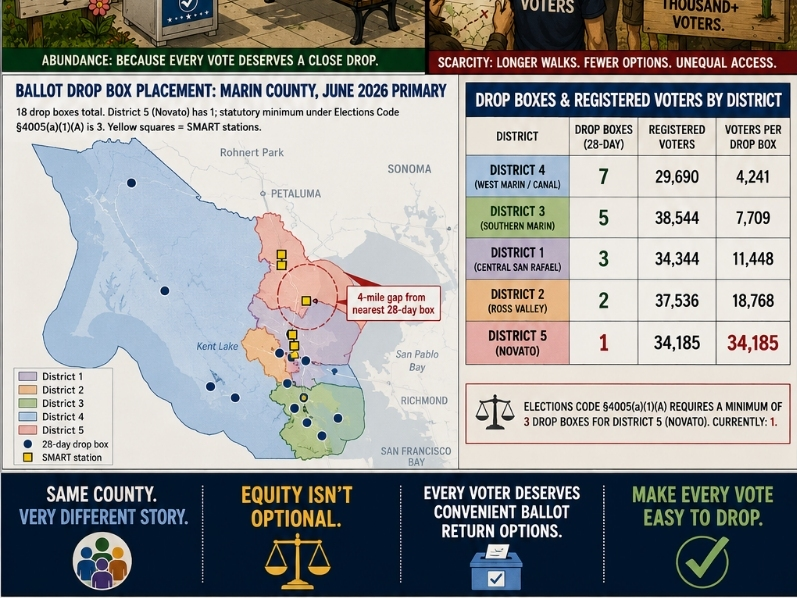
District 5, which covers the majority of Novato, had a single official drop box for 34,185 registered voters. The statutory minimum under Elections Code Section 4005 is three. That gap alone is significant. But the real number is larger.
Find out what's happening in Novatofor free with the latest updates from Patch.
Parts of Novato sit within District 4, specifically the Pleasant Valley and Vineyard neighborhoods. Pleasant Valley had approximately 3,511 registered voters across its precincts. Vineyard had 893 more. Those District 4 Novato residents had no drop box placed within their own neighborhoods. In practice, they were directed to the same single City Hall box as their District 5 neighbors.
That means one drop box at Novato City Hall served as the functional ballot return point for approximately 38,589 Novato-area voters across two supervisorial districts. The statutory minimum for that combined voter count would require at least five boxes. The county provided one.
Compare that to District 4 as a whole, which had seven boxes for 29,690 voters, a ratio of one box per 4,241 voters. A voter in West Marin had eight times better drop box access than a voter in Novato. The county-wide surplus does not cure that gap. It obscures it.
A Four-Mile Dead Zone
The map of drop box placement tells the story visually. The single District 5 box at City Hall sits in central Novato, and the nearest drop box in any direction is four miles away. The northern, eastern, and outlying residential areas of the city have no 24-hour, unstaffed ballot return option within any reasonable distance.
That four-mile gap is not a geographic inevitability. It is a placement decision. The county chose where to put its boxes, and it chose to leave the bulk of Novato without coverage.
Vote Centers Placed Away From Where People Live
The drop box shortage would be easier to accept if Novato's vote centers were positioned to fill the gap. They were not. Rather than being placed in or near single-family residential neighborhoods where most Novato voters actually live, vote centers were located adjacent to industrial corridors and high-density apartment complexes. For a voter in a quiet residential part of north or east Novato, neither the drop box nor the nearest vote center was particularly accessible.
This matters because the Voter's Choice Act's underlying premise is that the combination of drop boxes and vote centers should give every voter a realistic, convenient path to returning a ballot. When both resources are concentrated away from where voters live, the system fails on its own terms regardless of whether the raw numbers technically clear a statutory floor.
The SMART Station Missed Opportunity
Perhaps the most glaring omission is the absence of drop boxes near Novato's SMART train stations. The county placed no 24-hour drop box at or near a SMART station in District 5. That is a significant missed opportunity, and not only for logistical reasons.
Novato's SMART station areas are at the center of ongoing transit-oriented development, with new residential density being added specifically on the theory that residents in those corridors will rely on rail access and walkable infrastructure. The residents moving into those developments are precisely the voters who may lack personal vehicles, work non-traditional hours, and depend on the kind of 24/7 unstaffed access that a drop box provides.
The county is effectively encouraging denser, transit-dependent living in these corridors through land use policy while simultaneously failing to provide the election infrastructure that would make civic participation practical for the people living there. Those two positions are in direct tension.
The Vote Center Argument Does Not Hold
When confronted with Novato's single drop box, the standard response is that voters were not limited to drop boxes and could return their ballot at any vote center in the county during polling hours. That is technically accurate and practically inadequate.
The Voter's Choice Act created a separate drop box mandate for a reason. Unstaffed, 24-hour boxes serve a different population than staffed vote centers with limited hours. A Novato resident who works a full shift, relies on public transit, or has no one to watch their children cannot simply treat a vote center as a functional substitute. The Legislature understood this when it wrote geographic distribution requirements into Section 4005. The county's placement decisions do not reflect the same understanding.
If the vote center argument were sufficient, the county would not need to deploy multiple boxes in districts that also have full vote center coverage. But it did exactly that everywhere except Novato.
What the Law Requires and What the County Provided
Elections Code Section 4005 requires not just a county-wide headcount of drop boxes, but placement that accounts for geographic distribution and proximity to communities. That standard is not satisfied by concentrating resources in some districts while leaving the county's largest city with a single box serving two districts and a four-mile coverage gap.
The county met the minimum on paper. It did not meet the intent of the law.
What Needs to Happen
The Marin County Elections Division should publicly disclose the methodology it used to determine drop box and vote center placement for the 2026 cycle. A California Public Records Act request for that documentation has already been submitted. The response will provide the factual basis for evaluating whether the county's placement decisions were legally defensible under Section 4005 and, if not, what accountability measures follow.
Beyond disclosure, the Board of Supervisors and the Elections Division need to be put on formal notice before the next election that District 5 requires at minimum two additional permanent drop box installations, that the District 4 portions of Novato need dedicated coverage, and that SMART station locations should be prioritized for placement given the transit-oriented development reshaping those corridors. Vote centers must also be sited in and near the residential neighborhoods they are meant to serve, not in industrial areas and high-density apartment corridors that are disconnected from where most Novato voters live.
Novato voters showed up for the June 2026 primary. The question is whether their county showed up for them. One drop box for nearly 39,000 voters, placed away from transit hubs and residential neighborhoods, with a four-mile gap to the nearest neighboring box, suggests the answer is no.
Marc Hunter Lewis is a community policy advocate based in Novato