Neighbor News
Novato's School Tax Charges a Condo the Same as a Shopping Center
Novato's schools are running out of money. The tax meant to help hasn't changed, and it treats a small condo the same as Vintage Oaks
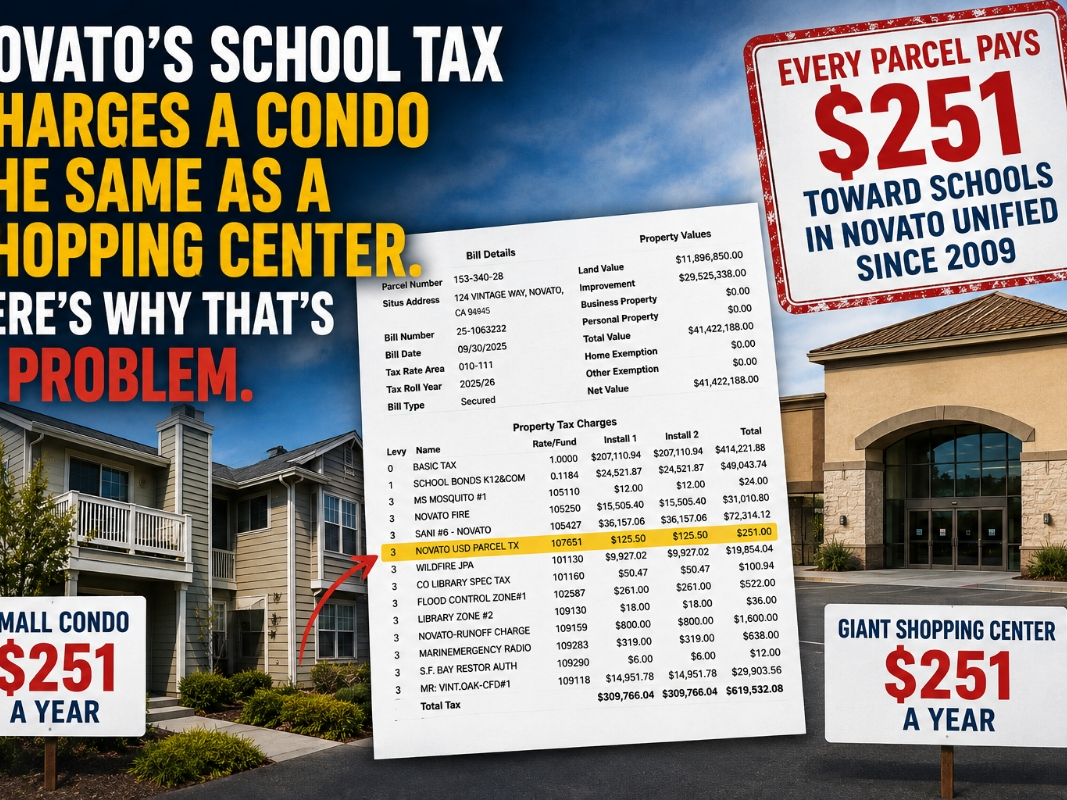
Novato's School Tax Charges a Condo the Same as a Shopping Center. Here's Why That's a Problem.
In short: Every property in Novato Unified School District pays a flat $251 a year toward schools, whether it's a condo or a shopping center. The district's finances are now under state watch, a tax increase (Measure G) barely failed in June, and the board has just postponed a second attempt from November to a March 2027 special election, aiming to bring back another flat, per-parcel tax rather than fix the underlying structure. This piece walks through why, what a fairer tax could look like, what happens if nothing changes, and the honest objections to fixing it.
The basics
Right now, every property owner in Novato Unified School District (NUSD) pays exactly $251 a year toward local schools. A small condo pays $251. A giant shopping center pays $251. That rate hasn't changed since 2009.
Here's what this piece covers, in order:
Find out what's happening in Novatofor free with the latest updates from Patch.
- Why the school district is in real financial trouble right now
- What happens if nothing changes
- Why a tax increase (Measure G) just failed by a hair, and what the district's options are now
- Why a wave of new Novato housing makes this more urgent, not less
- A fairer way to charge the tax, and what it would look like
- The honest objections to changing it, and why they don't hold up
1. The district's finances are in real trouble
In December 2025, the school district passed a $131.5 million budget. Along with it came a warning: the county downgraded the district's finances from "positive" to "qualified."
That sounds like paperwork. It isn't. It means county officials don't think the district can pay its bills over the next two years without changes.
Find out what's happening in Novatofor free with the latest updates from Patch.
Here's why. The district's savings cushion, its "reserve," is shrinking fast:
- This year: 4.6%
- Next year (projected): 3.2%
- The year after (projected): negative 0.3%
State law says schools this size need at least 3% in reserve at all times. A negative number means the district is on track to run out of money.
The board already knows this. They've approved $4.5 million in cuts, and promised $6.5 million more starting in 2027-28. The district's chief financial officer now says the true multi-year budget hole is $12 million. A frozen $251 tax is part of why they're in this spot.
2. What happens if nothing changes
This is not abstract. California has a real, well-documented process for what happens when a school district can't get its finances under control, and it has played out before in the Bay Area.
If a district's finances deteriorate far enough, it can be forced to take an emergency loan from the state. In exchange, state law requires the elected school board to hand over its powers to a state-appointed administrator. The board doesn't disappear, but it becomes advisory only. It can no longer make real decisions about the budget, staffing, or spending. A state administrator runs the district instead, until the loan is fully repaid.
This isn't a hypothetical. Oakland Unified School District went through exactly this after a 2003 financial collapse. It took a $100 million state loan, and the school board lost most of its power for years. Oakland only regained full local control in 2025, 22 years later.
Vallejo City Unified School District went through the same thing. It took a $60 million loan in 2004 after years of underestimating costs and overestimating enrollment. A state administrator ran the district, and the school board was reduced to an advisory role. Vallejo didn't get full control back until 2025, nearly 21 years later, after finally paying off the loan.
NUSD is not at that point yet. But a "qualified" budget certification and a reserve heading negative are the early warning signs the state watches for specifically because they can lead there. That's the real stake behind fixing the district's finances now, not later.
3. Measure G almost passed, and the district just postponed its next attempt
In June 2026, the district asked voters for a new $249 tax, stacked on top of the existing $251, for $500 total a year.
66.01% of voters said yes.
The measure needed 66.7% to pass. It failed by less than one percentage point.
That's almost two out of every three voters agreeing schools need more money, and it still failed. Why? Because it charged a tiny condo and a huge shopping center the exact same amount.
Here's where things stand as of this week. On July 29, the school board decided not to place a new measure on the November ballot after all. Instead, trustees voted to aim for a March 2, 2027 special election, with a filing deadline of December 4. Board members and the district's chief financial officer said they need the extra months to run town halls, a social media push, door-knocking, and a broader community campaign to actually hit the two-thirds threshold this time.
There's an important catch, though. The direction discussed at that meeting was not the reform this piece is describing. Trustee Abbey Picus said the new proposal needs to be a higher flat amount than $249 per parcel, and the district's CFO floated a flat $360 per parcel supplemental tax as one option. That is still a flat, per-parcel structure, the same design that just failed. It would raise the total flat rate even higher without fixing the underlying problem: a small condo and a shopping center would still pay the identical amount.
The stakes of getting this right in March are real. The CFO said the district can still avoid the worst of the $6.5 million in cuts and school-closure decisions if voters approve a measure in March that's big enough to close the district's $12 million multi-year deficit. If the vote count isn't finished by March 15, the state's deadline for layoff warning notices, the district may have to issue layoff notices anyway and rescind them later if the measure passes.
4. Why a wave of new Novato housing makes this more urgent, not less
Novato is not standing still. Under state law, the city must plan for 2,090 new housing units between 2023 and 2031, and a significant chunk of that is already approved or under construction, much of it multi-family.
The biggest single project is the former Fireman's Fund campus at 773-777 San Marin Drive. The Novato City Council approved a master plan in January 2024 allowing 1,000 to 1,300 new homes on the 65-acre site, mixing single-family houses with multi-family buildings up to five stories. Demolition of the old office campus began in September 2025. When built out, this one project alone could add more housing than the city's entire remaining RHNA obligation.
Other approved multi-family projects add up quickly. Landing Court Apartments, near Redwood Boulevard, is a five-story, 301-unit all-affordable building approved in October 2024. The Village at Novato, next to the Redwood Boulevard Trader Joe's, adds 178 units with ground-floor retail, approved the same January 2024 meeting as the Fireman's Fund plan. A downtown project at Grant Avenue and Third Street adds 56 apartments in a five-story building. Valley Oaks, on Redwood Boulevard, adds 126 units. Wood Hollow Residences adds dozens more. None of this counts the senior and supportive housing already built at Hamilton over the past two decades.
Here's why this matters for the tax fight described above. Every one of these buildings, once completed, becomes a single tax parcel or a small handful of parcels, just like Vintage Oaks. Under the current flat system, a 301-unit apartment building at Landing Court would pay the same $251 a year as a single detached house, or whatever higher flat number the board settles on for March. Under a square-footage system, a building of that size would generate revenue roughly in proportion to how much space, and how many students, it actually represents.
This cuts both ways, and it's worth being straight about that. New housing also means new students. Multi-family and affordable housing tends to bring more school-age children per building than the flat tax currently captures in revenue, which adds enrollment-driven costs at the same time the parcel tax formula caps what large buildings contribute. A flat fee was already mismatched to a mostly single-family city. It becomes more mismatched as the city's housing stock shifts toward larger, denser buildings.
One clarification worth making here: new construction already triggers a separate, one-time charge called a school facilities developer fee, currently capped by the state at $5.38 per square foot for residential and $0.87 per square foot for commercial development. NUSD collects this fee once, at the building permit stage, to help pay for the cost of new school facilities created by growth. That fee is a different tool for a different problem, one-time construction costs tied to new supply. It does not replace or substitute for the annual parcel tax that funds the district's ongoing operating budget, which is the tax this piece is about. Even a district collecting developer fees on every unit at the Fireman's Fund site would still be stuck with the same $251 flat annual rate on those same units once they're built and occupied.
What this could mean in real numbers. The most detailed count available so far comes from the project's March 2026 vesting tentative map, which describes 119 single-family lots, 84 townhome lots, and roughly 725 multi-family apartment units, built across three separate parcels. No official square footage total has been published yet, so the estimate below uses typical unit sizes from comparable Novato projects already cited in this piece (single-family homes around 2,700 square feet, townhomes around 1,950 square feet, apartments averaging around 950 square feet), and should be read as illustrative, not an official district or developer figure.
Under the current system, the 119 single-family homes and 84 townhomes would each sit on their own parcel and each pay $251 a year, for roughly $51,000 combined. But the 725 apartment units, because California typically assesses an apartment building as a handful of parcels rather than one parcel per unit, would likely generate only about $753 a year total across those three parcels, the same as three single-family homes, despite representing well over half the project's total building area and likely housing hundreds of school-age children. Total project revenue under the current flat structure: roughly $52,000 a year.
At the illustrative 11-cent-per-square-foot rate, the same project would generate roughly $129,000 a year, about two and a half times as much, because the tax would track the apartment buildings' actual footprint instead of collapsing hundreds of units into a handful of flat parcel payments. That gap only grows if the district ultimately proposes a higher flat rate like the $360 figure discussed at the July 29 meeting, since a higher flat number still does nothing to capture the apartment portion of a project like this.
The same math gets even more dramatic at two of the smaller, already-approved projects.
Landing Court Apartments, approved in October 2024, packs 301 units, mostly studios and one-bedrooms, onto a single 2-acre site with a single Assessor's Parcel Number (153-162-70). Because California treats an apartment building as one parcel unless it's legally subdivided into condominiums, this entire five-story, 301-unit building would owe exactly $251 a year under the current tax, the same as one house. Using a typical studio/one-bedroom size for this kind of dense, AB 2011 affordable housing (roughly 650 square feet, plus slightly larger manager units), the building's estimated square footage comes to around 196,000 square feet. At the illustrative 11-cent rate, that's roughly $21,600 a year, about 86 times more than the current flat tax collects from the same 301 households.
Village at Novato, approved the same month as the Fireman's Fund plan, spans two parcels (143-011-05 and 143-011-08) and will hold 178 residential units across three buildings, plus 14,000 square feet of ground-floor retail anchored by Trader Joe's. State environmental filings for the project give an exact figure for one of the three buildings: the 28-unit Building A totals 46,250 gross square feet, which after subtracting its retail and amenity space works out to roughly 980 square feet per residential unit. Applying that same per-unit average to the project's other two buildings (92 and 58 units, sizes not yet separately published) puts total residential space at roughly 174,000 square feet. Under the current system, the project's two parcels would owe $502 a year combined. At 11 cents a square foot, the residential portion alone would generate roughly $19,200 a year, without even counting the retail space, which would add more still if taxed under the same formula.
To be clear about what's solid and what's estimated here: the parcel counts, unit counts, and Building A's square footage at Village at Novato all come from the city's own project filings. The per-unit size assumptions used to fill in Landing Court's total and Village's Buildings B and C are this piece's own estimates, not official figures, and are flagged as such because no public filing yet breaks down square footage for every building in either project.
The upshot: whatever the board decides for March, it will apply to a city that looks different than it did in 2009, when the current rate was last set. More large buildings are coming whether or not the tax formula changes. The formula decides whether those buildings contribute to the district's ongoing budget in proportion to their size, or continue paying the same flat rate as a studio condo down the street.
5. A fairer way: charge by building size, not a flat fee
Instead of one flat fee, some California school districts charge by square footage. Bigger buildings pay more. Smaller ones pay less.
Nobody has officially proposed a rate for Novato yet. The number below (11 cents per square foot) is just used to show how it would work:
| Property | Size | Pays now | Would pay | Change |
|---|---|---|---|---|
| Small condo | 900 sq ft | $251 | $99 | −$152 |
| Starter home | 1,300 sq ft | $251 | $143 | −$108 |
| Typical Novato home | 2,280 sq ft | $251 | $251 | same |
| Larger house | 3,500 sq ft | $251 | $385 | +$134 |
| Small apartment building | 10,000 sq ft | $251 | $1,100 | +$849 |
| Shopping strip | 20,000 sq ft | $251 | $2,200 | +$1,949 |
| Large shopping center | 150,000 sq ft | $251 | $16,500 | +$16,249 |
Most Novato homes are around 2,280 square feet. Under this system, most homeowners would pay about the same or less. Big buildings would pay more.
A real example. Vintage Oaks, Novato's biggest shopping center (Costco, Target, and 50+ other stores), sits on many separate tax parcels. We pulled four actual 2025-26 county tax bills for parcels there. Combined, they're worth over $121 million. Combined, they pay $1,004 a year in school tax, the same rate as four small homes.
Using the fire district's tax on the same bills (which is already charged by square footage), we estimated these four parcels add up to roughly 597,000 square feet, close to the shopping center's known total size. This is our own estimate, calculated from public tax records, not an official district figure. At the illustrative 11-cent rate, those four parcels alone would owe about $65,700 a year, not $1,004.
Is this legal?
Yes. A 2023 court case (Traiman v. Alameda Unified School District) confirmed California school districts can charge by square footage, as long as everyone is charged using the same formula. The state Supreme Court let that ruling stand. There's no legal barrier here.
6. The honest objections, and why they don't kill the idea
"A flat tax is simpler." True. It's easier to explain and administer. But Measure G proved "simple" doesn't mean "passes." It already failed once.
"It takes more data to run." Also true. County records on building size aren't perfect, and people can dispute them. That's a real cost, but it's a one-time setup problem, not a permanent one.
"Big property owners will fight it." They probably will, since they'd pay more. That's a real political fight, not a flaw in the idea itself.
"Won't this look like a hidden tax hike?" This happened next door. Ross Valley switched to square footage in 2025 and got accused of a "sneaky" 67% tax increase. But Ross Valley started from a much higher base ($742–$1,282 a year) and jumped to 52 cents per square foot. Novato's starting point ($251) and the rate discussed here (11 cents, about a fifth of Ross Valley's) are nowhere near that scale. A better comparison is Sausalito Marin City School District, which switched to 15 cents per square foot in 2024 without backlash, because it was presented clearly from the start.
"Won't landlords just raise rent?" Look at the actual numbers. A 10-unit apartment building would see about $7 extra per unit, per month. A 150-unit complex would see about $9 per unit, per month. California law already limits rent increases to about 5–10% a year regardless of this tax, and that cap already allows roughly $150/month of increase on a typical $2,500 rent. A few extra dollars from this tax barely registers against that.
What this doesn't fix, and why it still matters
To be clear: changing this tax formula alone will not solve the district's whole budget problem. NUSD still faces a $12 million multi-year shortfall even with cuts already made.
But Measure G's near-miss shows something important: the way a tax is structured can be the difference between passing and failing. Raising the flat amount to $360 per parcel, as discussed at the July 29 board meeting, does not fix that problem. It just makes the same unfair formula bigger. A small condo would still pay the same as a shopping center, just a higher shared number. The district now has until December 4 to decide what actually goes in front of voters in March, which means there's still time for a different structure to be considered, if residents ask for it.
What you can do
- Look up your own home's square footage and see where you'd land under a square-footage system like the one shown here
- NUSD board meetings are open to the public, and public comment matters right now, while the March ballot proposal is still being shaped. The board's next update is scheduled for August 11
- If you think a per-square-foot structure is worth considering instead of a bigger flat fee, that's the kind of feedback board members have said they want to hear before December
- NUSD's budget reports are public documents, don't just take this article's word for it