Neighbor News
When a Race Is Decided by 46 Votes, Who Checks the Count?
D5 supervisor race certified by 46 votes, but 1 in 7 ballots read blank. Only a hand recount can tell if machines missed real votes.
When a Race Is Decided by 46 Votes, Who Checks the Count?
By Marc Hunter Lewis
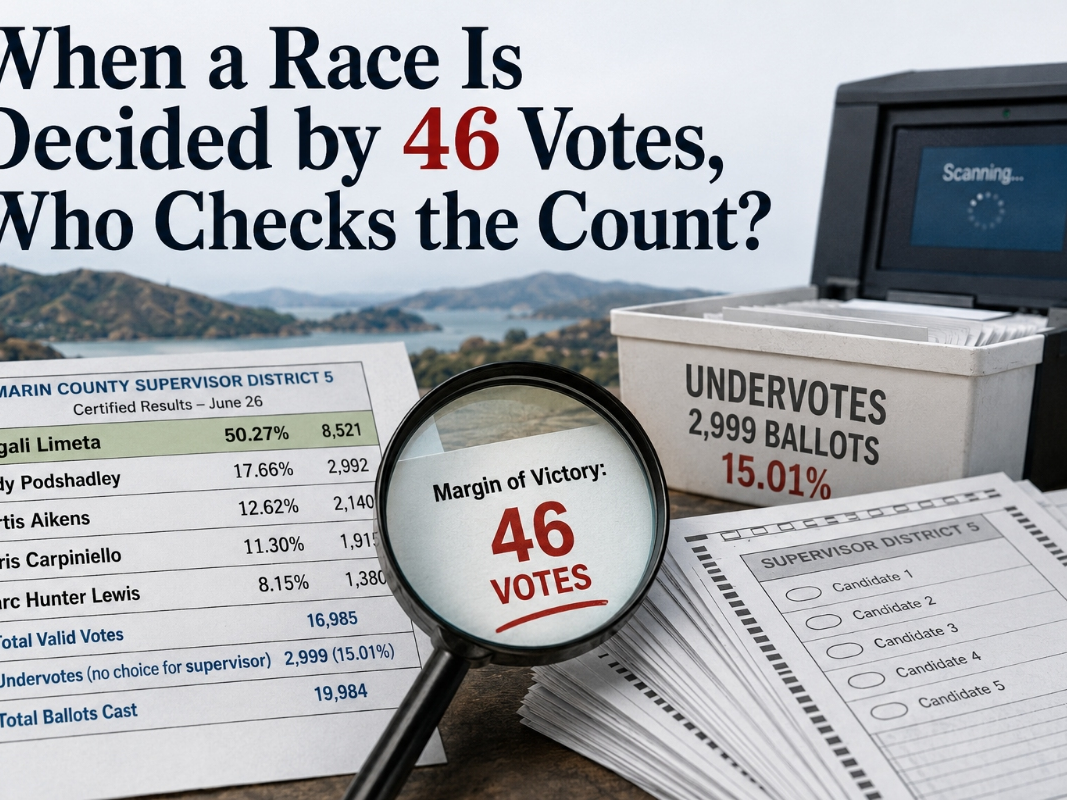
A result decided by 46 votes
On June 2, voters in Marin County Supervisor District 5 cast nearly twenty thousand ballots. When the Registrar certified the results on June 26, one candidate, Magali Limeta, had finished at 50.27 percent of the valid vote, clearing the majority threshold that avoids a November runoff by 46 votes. The other four candidates split the remainder: Andy Podshadley at 17.66 percent, Curtis Aikens at 12.62 percent, Chris Carpiniello at 11.30 percent, and me, at 8.15 percent. I ran in this race and finished fifth, so let me be clear at the outset that I have no path to the seat and no personal stake in who holds it. I am writing because of something in the numbers that should concern every voter in the district, regardless of who they backed.
Find out what's happening in Novatofor free with the latest updates from Patch.
One in seven ballots came back blank
Here it is. Of the 19,984 ballots cast in the supervisor race, only 16,985 recorded a vote for supervisor. The rest, roughly one in seven, or 15.01 percent, came back as undervotes: ballots the tabulation equipment read as containing no choice for the office. On its own, an undervote rate is not alarming. Voters skip races all the time. What is hard to explain is the comparison to the other contests printed on the very same ballots.
The identical voters who supposedly skipped the supervisor race 15.01 percent of the time left the State Assembly race blank only 9.32 percent of the time, the State Senate race 8.09 percent, and Measure G, the school district measure, just 3.91 percent. So the marquee local office, the seat that controls land use, budgets, and public safety for roughly a quarter of Marin, was left blank at nearly four times the rate of a school funding measure on the same sheet of paper. That is not how voters behave. People do not diligently mark a school tax, two legislative races, and a rail measure and then, in large numbers, silently pass on the biggest local contest.
Find out what's happening in Novatofor free with the latest updates from Patch.
The anomaly deepens by voting method
The pattern gets stranger when you break the undervotes out by how people voted. In-person Vote Center ballots came back blank for supervisor 18.87 percent of the time. Mailed ballots did so 14.71 percent of the time. That is a four-point gap between two groups of voters marking the identical ballot for the identical office, and the in-person rate ran higher in seven of the district's eight precincts. Voter intent does not change based on which scanner ultimately reads the paper. When the electorate's behavior holds steady but the recorded results diverge along the line that separates one tabulation path from another, a careful examiner looks at the equipment, not the electorate.
The concept that makes undervotes decisive: denominator shaving
To see why those set-aside ballots matter so much, it helps to name a concept that statisticians and election analysts use: denominator shaving, sometimes called the denominator effect. Any percentage is a numerator divided by a denominator, and if you remove items from the denominator without touching the numerator, the percentage rises even though nothing real has changed (Rakesh Mittal, on the denominator effect). It is a well-documented way statistics mislead. India's election authority produced record-looking turnout figures in 2026 largely because a roll purge shrank the denominator rather than because more people voted (analysis of the SIR turnout effect). In a recent Voting Rights Act case, the Justice Department was accused of inflating a turnout comparison by choosing a denominator that included ineligible people (The Guardian).
Now apply that to a majority-decides race. A candidate wins outright by clearing 50 percent, but 50 percent of what? Only the valid votes, the ballots that recorded a choice. Blank ballots, the undervotes, are excluded from that denominator by rule; the same principle governs parliamentary majorities, where blanks and abstentions do not count toward the base (Wikipedia: Majority). This creates a structural vulnerability. A frontrunner's share can be pushed across 50 percent two ways: by gaining votes, which is hard, or by shrinking the pool of valid votes, which happens automatically every time an opponent's ballot is recorded as blank. Each ballot reclassified from a vote into an undervote leaves the frontrunner's raw total untouched while shrinking the denominator beneath them, nudging their percentage up.
I am not alleging anyone did this deliberately in District 5, and the public data cannot show intent. But the mechanism is real, and it is exactly why the undervotes are not a side issue in a majority race decided by 46 votes. Every one of those roughly three thousand blank ballots is a unit of the denominator. If some fraction of them are misread votes rather than true abstentions, the denominator was effectively shaved, whether by machine error or anything else, and the 50.27 percent majority is an artifact of that shaving rather than a true reflection of the vote.
Why this is the case that must be checked
None of this proves that anything went wrong, and I am not claiming it does. There are innocent explanations. Late-arriving mail ballots often skew toward voters who skip down-ballot races. Ballot design and contest placement affect how often a race gets missed. A high undervote rate is a red flag, not a verdict, and the public totals alone cannot tell an ordinary drop-off apart from votes that were cast but read as blank.
But sit with what that admission actually means. We have a result where the margin of victory is 46 votes, and we have nearly three thousand ballots the machines set aside as blank in that same race, a stack roughly sixty-five times the size of the margin. If even a small fraction of those blanks contain a real mark the scanner missed, the outcome changes and the district goes to a November runoff. The certified totals cannot tell us whether that happened. The only instrument that can is a human being looking at the actual ballots. When the potential error dwarfs the margin by that much, verifying is not paranoia. It is the minimum diligence any serious person would apply before calling a contest final.
That is what makes this race different from the ordinary close call. It is not merely close. It is close and carries an unexplained anomaly that points, however tentatively, at the very ballots that could move it. You do not need to believe the machines failed to believe those ballots should be looked at. You only need to believe that a 46-vote decision resting on a 15 percent blank rate deserves more certainty than a first-pass machine count can provide. A recount is how that certainty is obtained. There is no substitute for it, and there is no honest argument for preferring doubt to proof when the proof is one hand count away.
Why the burden falls on voters
Here is what most people do not realize. California has no automatic recount for a close local contest like this one. The automatic, state-funded recount that exists in law is reserved for statewide races decided within the lesser of 1,000 votes or 0.015 percent, a threshold with nothing to do with a county supervisor election. For everything below that, verifying a razor-thin result falls to a voter-requested recount. And the law requires the person who requests it to pay: the county calculates the cost based on staff time and materials and bills the requester directly, under Elections Code section 15624. In plain terms, the county will not re-examine even a 46-vote majority on its own dime. Someone has to open their wallet first.
The county followed the law. The law is the problem
The county did not do anything improper. It followed the law. After the election it ran the mandatory 1 percent manual tally that every California county performs, certified the result, and moved on. But the law it followed sets a floor, and in a race decided by 46 votes out of nearly 17,000, with an undervote rate that quadruples a same-ballot measure and swings by voting method, the floor is plainly not enough. California law actually gives county officials the discretionary authority to order a recount on their own when a result carries an anomaly they cannot adequately explain, and it lets a board of supervisors, grand jury, or district attorney seek a court-ordered recount on evidence of tabulation error. Those tools exist for exactly this situation. They were not used.
A two-tier system of verification
So we are left with a strange arrangement. A public election, tabulated by public equipment, certified by public officials, can be independently verified only if a private citizen agrees to finance the government's work, and only gets that money back if the recount changes the outcome. A well-funded campaign can afford to test a suspicious count. An ordinary voter, or an underfunded candidate, cannot. That is a two-tier system of election verification, and it should trouble anyone across the political spectrum. Confidence in elections does not come from telling people to trust the result. It comes from making the result easy to check.
A recount in this race has now been requested and will be conducted by hand, which is exactly the right response to a result like this. Understand what that recount is and is not. It is not a partisan maneuver, not an accusation of fraud, and not an attempt to overturn the will of the voters. It is the opposite: it is the effort to find out what the will of the voters actually was, by looking at the ballots they cast rather than trusting a scanner's first read. A hand recount asks one plain question of each set-aside ballot, does this contain a mark a machine missed, and it either confirms the count or corrects it. Both outcomes serve the public. A confirmed result earns real confidence instead of assumed confidence. A corrected result restores an election to the outcome voters actually chose. There is no version of this in which looking is the wrong call.
What should trouble people is not that a recount is happening. It is how nearly it did not, and how much had to fall into place for it to occur at all. Verification should not depend on whether a candidate or a citizen happens to be willing and able to pay for it. In this instance the check will be made. In the next close race, with no one able to foot the bill, it will not be, and a result just as questionable will simply stand.
Marin can fix this itself
Marin can fix this without waiting for Sacramento. The county, or the cities within it, can adopt a local ordinance or a Registrar policy that sets automatic, publicly funded hand-verification triggers for close local races, a defined margin below which the county checks a sample of undervoted ballots as a matter of routine, in public, before certification. Several jurisdictions around the country already run risk-limiting audits that do something similar. The mechanism is not exotic. What is missing is the will to treat verification as a normal cost of running an election rather than a favor extended to whoever can pay.
The lesson is bigger than one race
The District 5 result may well stand, and if a full hand review confirms it, that confirmation will be worth having. Most recounts do confirm the original count, and I am not predicting otherwise. But that is an argument for the recount, not against it. Certainty is the point. When 46 votes separate a decided election from a November runoff, and when nearly three thousand ballots sit unexamined in the very race that hangs on them, the responsible course is not to assume the machines got it right. It is to look, and to be able to tell the public, with proof rather than faith, exactly what the voters chose.
The lesson of this race is not about any one candidate. It is that when an outcome is this close and this strange, verifying it is not a courtesy or a favor. It is the whole job. The public should not have to buy the right to be sure its election was counted correctly, and no one should have to wonder, in a contest decided by 46 votes, what those three thousand set-aside ballots would have said if someone had simply looked.
Marc Hunter Lewis is a Novato-based policy advocate with a background in economics, political science, and law. He was a candidate for Marin County Supervisor District 5 in the June 2026 primary. Vote figures are drawn from the Marin County final Statement of Vote, certified June 26, 2026.