Crime & Safety
OCFA Partners with Coto Equestrian Preserve to Help Horses
OCFA Firefighters worked in Partnership w Coto Equestrian Preserve late January to Give Firefighters New Training to Help Horses



(Coto de Caza, Ca) – They were gentle, calm, compassionate – yet assertive.
And the 1,000-lb, buckskin colored American Quarter Horse named “Spirit” – who was well-muscled and powerful, instinctually knew he was safe, secure and in very good hands.
They --- OCFA firefighters, were participating in a drill Monday January 28th at the pristine Coto Equestrian Preserve in Coto de Caza aimed at introducing firefighters to basic horse behavior in a relaxed, informative and non-emergency situation. They arrived promptly on bright red engines with shiny silver and white detailing and matched perfectly in pressed navy blue uniforms – one sleeve donning an American Flag patch and the other an Orange County Fire Authority patch. Each wore the distinguished and time honored firefighter badge above their heart.
Find out what's happening in Orange Countyfor free with the latest updates from Patch.
Over the last two weeks in January, OCFA firefighters from South County stations participated in a battalion-wide drill in partnership with the Coto Equestrian Preserve in order for firefighters stationed in these equestrian rich communities to be well-versed in equine behavior – such as proper approach, haltering, securing and guiding a horse to safety in an emergency such as a wildfire evacuation or unexpected rescue.
“The men and women of the OCFA constantly train and educate themselves in a variety of businesses, tradecrafts, and activities to prepare for any emergency situation,” said OCFA Captain PIO Larry Kurtz. “Working with horses is no different.”
Find out what's happening in Orange Countyfor free with the latest updates from Patch.
“Although equestrian emergencies are a low frequency event, there is great value in working with the equestrian community to help us gain insight and knowledge in dealing with these and other forms of livestock,” Kurtz said. “We care about the safety and well-being of all Orange County residents… not just the ones with two legs.”
PRACTICE MAKES PERFECT
Longtime Coto Equestrian Preserve operators, Robin Borders and Ozzy Gonzalez of Cinnabar Equestrian Operations, led the equine trainings and emphasized the notion that when it comes to horses -- it’s all about the approach. They worked in tandem with the professional, respectful and attentive group of OCFA firefighters who watched as Gonzalez and Borders covered several aspects of “Horsemanship 101” from a large arena on the property called the “covered bullpen.”
“The main thing we learned was how to approach a horse from the proper side (their left) and how to approach them with confidence – to not let them see any fear we may have,” said seasoned and highly experienced OCFA Captain Thom Rivas. Rivas played a key and invested role in the collaborative planning of these specialized equine trainings for fellow OCFA firefighters alongside community partner Coto Equestrian Preserve. “Horses are domesticated, yet they can be unpredictable -- so OCFA firefighters responding to a call should be prepared for their power and size.”
Rivas added that another key and highly practical aspect of the training was that OCFA firefighters learned how to quickly and efficiently make a functioning equine lead-line out of their “firefighter webbing,” also called nylon webbing. These make-shift bridle’s would allow the firefighters to see how they can gain control, secure a horse and lead it to safety with webbing alone. Firefighter webbing is a key part of their “firefighter toolkit” that’s kept with each firefighter’s turnout gear back on the engine or truck.
‘WE ARE PROBLEM SOLVERS. FIREFIGHTERS HAVE A PLAN FOR EVERYTHING’
Experienced career firefighters will be the first to tell you that extensive training and drills are a critical component to the job – and ultimately what helps them help all of us and our animals (small, medium, large and horse-sized). They save the tiniest of newborn kittens stuck in sealed engine compartments, to bunnies in cages, to dogs stranded on hillsides or horses stuck in a raven or trash dumpster.
“The more training we have, the more our common sense and decision making sharpens on a call,” said OCFA Firefighter Paramedic Paul Robertson, who has 28-years experience as a firefighter. “We are problem solvers. Firefighters have a plan for everything.”
Robertson knows a lot about horses from working with and being around them all of his life. He said the equine trainings were very beneficial because not all of the firefighters had actively been around horses – no different than the general public.
He affirmed that the equine trainings in Coto de Caza will surely aid OCFA crews when responding to future incidents involving horses.
“The key to overriding fears is to be educated on a subject,” Robertson said. “Firefighters don’t get to choose the calls they answer. We are going to solve the problem regardless of any fears we might have: whether it’s a large animal rescue or dealing with a fire. Training helps bridge the gap between fears and knowledge.”
“The more we train ourselves in all the different scenarios we may face, the more prepared we will be when answering the call for help,” Robertson said.
HORSES READ ENERGY AND NON-VERBAL COMMUNICATION: AURA, AURA, AURA
Borders and Gonzalez explained what a critical service it provides Orange County’s equestrian population to have first responders’ trained in general equine behavior.
“If you were to go into their stall in an emergency to help us try to unload the almost 200 horses here into trailers -- that sure would be helpful to us,” said Borders. She told the group on January 28th that it was of immeasurable service to the Coto Equestrian Preserve staff to have these firefighters trained and ready to partner with them in an emergency.
“The number one thing you want to do is have confidence when you approach them,” Borders said.
HAVE CONFIDENCE IN YOUR APPROACH
Mother nature heightened a horse’s senses based on their status as prey animals. They have the largest eyes of any land mammal, a strong sense of smell and must be aware of their surroundings at all times – therefore, they have a strong fight-or-flight response, experts say.
“Horses are pretty sensitive to people’s feelings,” Borders told the group. “If you go into a horse’s stall afraid and you are afraid -- they will sense that. When you handle a horse you want to act like you are the boss, you are in charge.”
They can run up to 40 miles per hour and bolting if startled is not uncommon.
Borders acknowledged that while all of the horses at Coto Equestrian Preserve are domesticated and tame because they are handled daily, they can get riled up in an emergency situation like a fire.
HORSEMANSHIP 101: KEY CONCEPTS COVERED BY COTO EQUESTRIAN PRESERVE’S HORSE WHISPERER, OZZY GONZALEZ
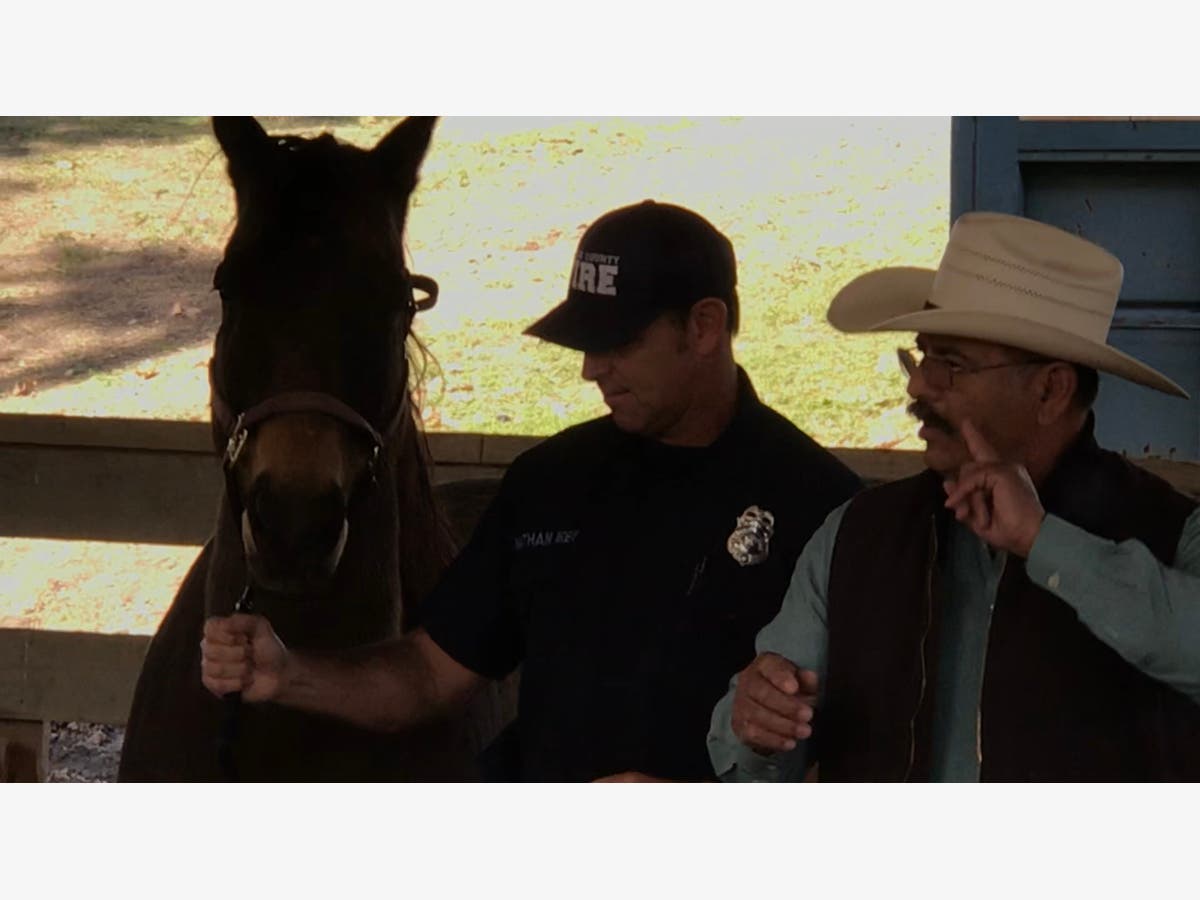
The bright early morning sunlight shone through the heavy wooded-beams of Coto Equestrian Preserve’s covered bullpen Monday. The group of OCFA firefighters entered the bullpen and watched as Coto Equestrian’s own “Horse Whisperer” -- Ozzy Gonzalez, stood center stage with Spirit.
Gonzalez is a longtime South County native and has been with Coto Equestrian since 2005 alongside Borders. He has worked on ranches his entire life. He knows the area. He know the people. He knows the horses.
But more than that: these precious large animals know, respect him – and trust him.
Gonzalez wore a light colored cowboy hat with a dark brown trim, a long-sleeved mint green oxford style shirt and blue boot-cut denim jeans styled with a silver buckled western themed belt. His chestnut colored cowboy boots were worn, yet sturdy. He had sunglasses on and was identifiable with his trademark mustache.
As he held the brown leather halter with attached rope, he – along with Borders, began to share the secretes of handling a horse with the highly skilled OCFA firefighters he had as his audience.
Key concepts included: always approaching a horse from the left (and never, ever from behind); roping the horse first around its neck before securing it with a halter and never acting afraid of the horse.
Gonzalez emphasized to the firefighters to have their mind set and, “…the horse will follow your lead.”
After he gave his presentation and demonstration, Gonzalez turned to the group and asked:
“Who wants to try?”
As birds chirped in the background, the first brave volunteer stepped forward.
LART (LARGE ANIMAL RESPONSE TEAM), CITY OF SAN JUAN CAPISTRANO
Borders also talked about the critical role played by the San Juan Capistrano Large Animal Response Team (LART) during emergencies. Volunteers are a necessary and vital part to LART’s success.
According to http://sanjuancapistrano.org/Departments/Emergency-Preparedness/LART::
During an emergency or disaster, taking care of large animals requires advance planning and skills on how to handle and move animals to safety. Animal owners are responsible for the basic care and sheltering of their pets and animals during a major disaster or emergency. When warned of an upcoming emergency or pending evacuation, it is assumed that owners of pets, service animals and livestock will take precautions to protect and care for their animals. Be prepared when emergencies arise with the proper supplies, veterinary information, animal identification and an evacuation plan that has been practiced. Make sure animals are familiar with being loaded onto a trailer and prearrange an evacuation site for animals outside the immediate area.
San Juan Capistrano Large Animal Response Team (LART) provides training to safety evacuate large animals during emergency situations. The program offers training in safe and humane animal handling, trailer loading and transportation, assisting in emergency animal shelters, and fire behavior and safety.
For more information on Coto Equestrian Preserve (http://cotoequestrianpreserve.com/), please contact Cinnabar Equestrian Operations principals Robin Borders or Ozzy Gonzalez at (949) 635-6958. Coto Equestrian Preserve was used for modern equestrian pentathlon events during the 1984 Olympics in Los Angeles where the United States won Silver and Bronze Olympic medals.
###